
新辅助化疗治疗的乳腺癌患者中不同残留病灶模式对长期肿瘤学结局的影响
The Impact of Different Patterns of Residual Disease on Long-Term Oncological Outcomes in Breast Cancer Patients Treated with Neo-Adjuvant Chemotherapy.
作者信息
Tinterri Corrado, Fernandes Bethania, Zambelli Alberto, Sagona Andrea, Barbieri Erika, Di Maria Grimaldi Simone, Darwish Shadya Sara, Jacobs Flavia, De Carlo Camilla, Iuzzolino Martina, Gentile Damiano
机构信息
Breast Unit, IRCCS Humanitas Research Hospital, Via Manzoni 56, 20089 Rozzano, Milan, Italy.
Department of Biomedical Sciences, Humanitas University, Via Rita Levi Montalcini 4, 20090 Pieve Emanuele, Milan, Italy.
出版信息
Cancers (Basel). 2024 Jan 16;16(2):376. doi: 10.3390/cancers16020376.
BACKGROUNDS
The majority of breast cancer (BC) patients treated with neo-adjuvant chemotherapy (NAC) achieves a pathologic partial response with different patterns of residual disease. No clear correlation between these patterns and oncological results was described. Our aims were to define the predictive factors for different patterns of residual disease and compare the outcomes between the scattered versus the circumscribed pattern.
METHODS
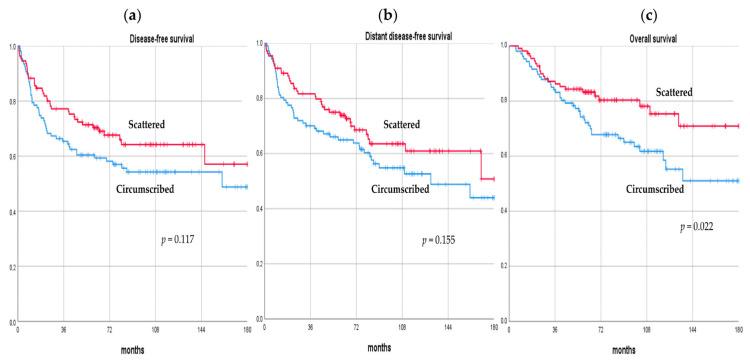
We reviewed 219 postoperative surgical specimens. Patients were divided into two groups: scattered versus circumscribed. Disease-free survival (DFS), distant DFS (DDFS), and overall survival (OS) were analyzed.
RESULTS
The scattered and circumscribed patterns were assessed in 111 (50.7%) and 108 (49.3%) patients. Two independent predictive factors for the circumscribed pattern were identified: discontinuation of NAC cycles ( = 0.011), and tumor size post-NAC >18 mm ( = 0.022). No difference was observed in terms of DFS and DDFS. Patients with the scattered pattern exhibited a statistically significant better OS. Discontinuation of NAC cycles, tumor size >18 mm, triple-negative BC, and ypN+ were associated with increased recurrence and poorer survival.
CONCLUSIONS
Discontinuation of NAC cycles and tumor size are independent factors associated with patterns of residual disease. The scattered pattern presents better survival. Understanding the relationship between NAC, the residual pattern, and differences in survival outcomes offers the potential to optimize the therapeutic approaches.
背景
大多数接受新辅助化疗(NAC)的乳腺癌(BC)患者实现了病理部分缓解,伴有不同模式的残留病灶。这些模式与肿瘤学结果之间尚无明确关联。我们的目的是确定不同残留病灶模式的预测因素,并比较散在型与局限型模式之间的预后。
方法
我们回顾了219份术后手术标本。患者分为两组:散在型与局限型。分析无病生存期(DFS)、远处无病生存期(DDFS)和总生存期(OS)。
结果
111例(50.7%)患者为散在型模式,108例(49.3%)患者为局限型模式。确定了局限型模式的两个独立预测因素:NAC周期中断(P = 0.011),以及NAC后肿瘤大小>18 mm(P = 0.022)。在DFS和DDFS方面未观察到差异。散在型模式的患者OS在统计学上显著更好。NAC周期中断、肿瘤大小>18 mm、三阴性乳腺癌和ypN+与复发增加和生存期较差相关。
结论
NAC周期中断和肿瘤大小是与残留病灶模式相关的独立因素。散在型模式的生存期更好。了解NAC、残留模式和生存结果差异之间的关系为优化治疗方法提供了可能。

 Zotero 插件