
联合分析 TyG 指数、SII 指数和 SIRI 指数:与 NAFLD 患者的 CHD 风险和冠状动脉粥样硬化严重程度呈正相关。
A combined analysis of TyG index, SII index, and SIRI index: positive association with CHD risk and coronary atherosclerosis severity in patients with NAFLD.
机构信息
Vasculocardiology Department, The Third People's Hospital of Datong, Datong, Shanxi, China.
Key Laboratory of Cardiovascular Diseases, Second Hospital of Shanxi Medical University, Taiyuan, Shanxi, China.
出版信息
Front Endocrinol (Lausanne). 2024 Jan 8;14:1281839. doi: 10.3389/fendo.2023.1281839. eCollection 2023.
BACKGROUND
Insulin resistance(IR) and inflammation have been regarded as common potential mechanisms in coronary heart disease (CHD) and non-alcoholic fatty liver disease (NAFLD). Triglyceride-glucose (TyG) index is a novel biomarker of insulin resistance, System immune-inflammation index(SII) and Systemic inflammation response index(SIRI) are novel biomarkers of inflammation, these biomarkers have not been studied in CHD with NAFLD patients. This study investigated the correlation between the TyG index, SII index, and SIRI index and CHD risk among NAFLD patients.
METHODS
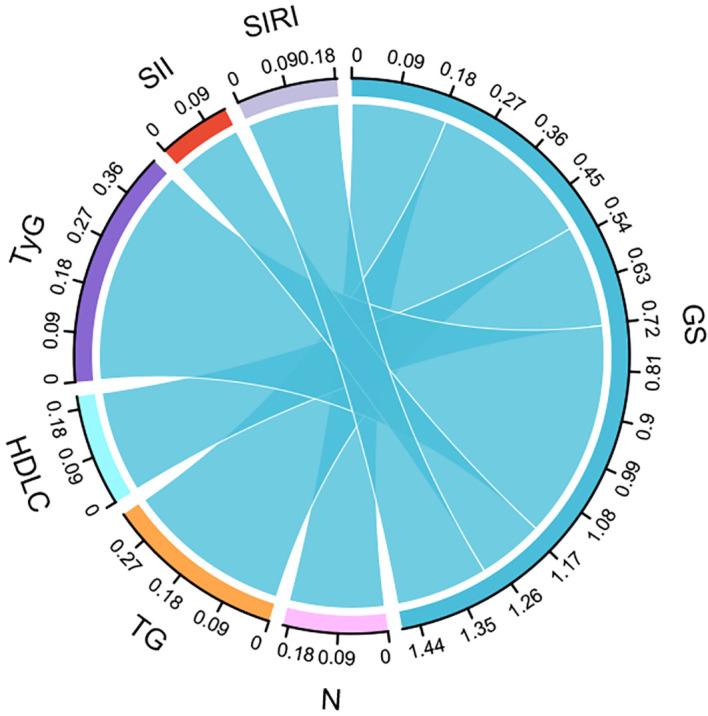
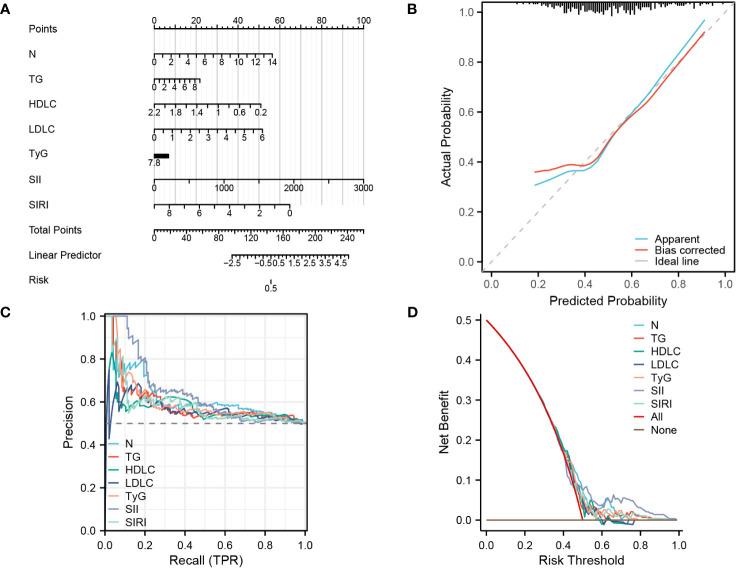
This cross-sectional study included 407 patients with NAFLD in the Department of Cardiology, The Second Hospital of Shanxi Medical University. Of these, 250 patients with CHD were enrolled in the NAFLD+CHD group and 157 patients without CHD were enrolled as NAFLD control. To balance covariates between groups, 144 patients were selected from each group in a 1:1 ratio based on propensity score matching (PSM). Potential influences were screened using Lasso regression analysis. Univariate and multivariate logistic regression analyses and the Least Absolute Shrinkage and Selection Operator (LASSO) regression were used to assess independent risk and protective factors for CHD. Construction of nomogram using independent risk factors screened by machine learning. The receiver operating characteristic(ROC) curve was used to assess the ability of these independent risk factors to predict coronary heart disease. The relationship between the Gensini score and independent risk factors was reflected using the Sankey diagram.
RESULTS
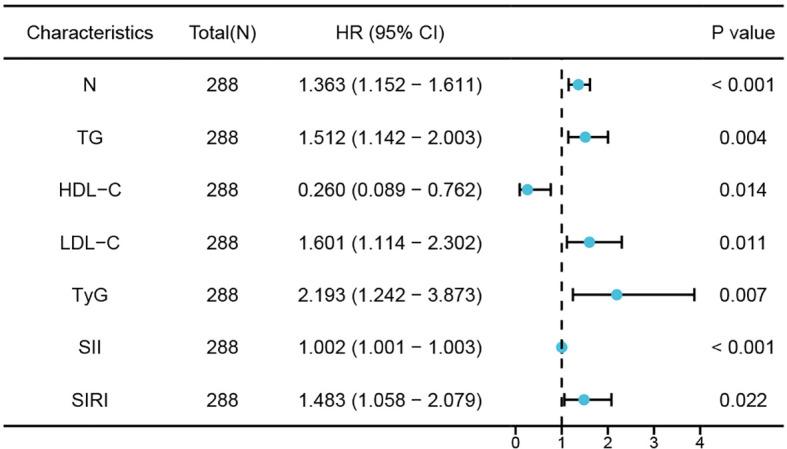
The LASSO logistic regression analysis and Logistic regression analyses suggest that TyG index (OR, 2.193; 95% CI, 1.242-3.873; = 0.007), SII index (OR, 1.002; 95% CI, 1.001-29 1.003; 0.001), and SIRI index (OR,1.483;95%CI,1.058-2.079,=0.022) are independent risk factors for CHD. At the same time, Neutrophils, TG, and LDL-C were also found to be independent risk factors in patients, HDL-C was a protective factor for CHD in patients with NAFLD. Further analysis using three machine learning algorithms found these independent risk factors to have good predictive value for disease diagnosis, SII index shows the highest predictive value. ROC curve analysis demonstrated that combining the SII index, SIRI index, and TyG index can improve the diagnostic ability of non-alcoholic liver cirrhosis patients with CHD.ROC curve analysis showed that the combined analysis of these independent risk factors improved the predictive value of CHD(AUC: 0.751; 95% CI: 0.704-0.798; 0.001).
CONCLUSION
TyG index, SII index, and SIRI index are all independent risk factors for CHD in patients with NAFLD and are strongly associated with prediction and the severity of CHD.
背景
胰岛素抵抗(IR)和炎症被认为是冠心病(CHD)和非酒精性脂肪肝(NAFLD)的共同潜在机制。甘油三酯-葡萄糖(TyG)指数是胰岛素抵抗的新型生物标志物,系统性免疫炎症指数(SII)和系统性炎症反应指数(SIRI)是炎症的新型生物标志物,这些生物标志物在 CHD 伴 NAFLD 患者中尚未得到研究。本研究探讨了 TyG 指数、SII 指数和 SIRI 指数与 NAFLD 患者 CHD 风险之间的相关性。
方法
本横断面研究纳入了山西医科大学第二医院心内科 407 例 NAFLD 患者。其中,250 例 CHD 患者纳入 NAFLD+CHD 组,157 例无 CHD 患者纳入 NAFLD 对照组。为了平衡组间混杂因素,采用倾向评分匹配(PSM)方法,按 1:1 比例从每组中各选择 144 例患者。采用 Lasso 回归分析筛选潜在影响因素。采用单因素和多因素 logistic 回归分析以及最小绝对收缩和选择算子(LASSO)回归分析评估 CHD 的独立风险和保护因素。使用机器学习筛选的独立风险因素构建列线图。采用受试者工作特征(ROC)曲线评估这些独立风险因素预测 CHD 的能力。采用 Sankey 图反映 Gensini 评分与独立风险因素的关系。
结果
LASSO logistic 回归分析和 logistic 回归分析表明,TyG 指数(OR,2.193;95%CI,1.242-3.873;P=0.007)、SII 指数(OR,1.002;95%CI,1.001-291.003;P=0.001)和 SIRI 指数(OR,1.483;95%CI,1.058-2.079;P=0.022)是 CHD 的独立危险因素。同时,中性粒细胞、TG 和 LDL-C 也是患者的独立危险因素,HDL-C 是 NAFLD 患者 CHD 的保护因素。进一步使用三种机器学习算法进行分析发现,这些独立风险因素对疾病诊断具有良好的预测价值,SII 指数具有最高的预测价值。ROC 曲线分析表明,联合 SII 指数、SIRI 指数和 TyG 指数可提高 CHD 非酒精性肝硬化患者的诊断能力。ROC 曲线分析显示,联合这些独立风险因素可提高 CHD 的预测价值(AUC:0.751;95%CI:0.704-0.798;P=0.001)。
结论
TyG 指数、SII 指数和 SIRI 指数均是非酒精性脂肪肝患者 CHD 的独立危险因素,与 CHD 的预测和严重程度密切相关。




 Zotero 插件