
髋部疼痛患者中与疼痛相关的心理困扰患病率很高:心理困扰及表型特征分析
Pain-Associated Psychological Distress Is of High Prevalence in Patients With Hip Pain: Characterizing Psychological Distress and Phenotypes.
作者信息
Cabell Grant H, Kwon Nicholas F, Sutton Kent F, Lentz Trevor A, Lewis Brian D, Olson Steven, Mather Richard C
机构信息
Department of Orthopaedic Surgery, Duke University Medical Center, Durham, North Carolina, U.S.A.
Department of Orthopaedic Surgery, Stanford Medicine, Redwood City, California, U.S.A.
出版信息
Arthrosc Sports Med Rehabil. 2023 Dec 30;6(1):100846. doi: 10.1016/j.asmr.2023.100846. eCollection 2024 Feb.
PURPOSE
To identify common pain-related psychological factors among patients seeking care for athletic hip pain, as well as characterize psychological distress phenotypes and compare hip-specific quality-of-life measures across those phenotypes.
METHODS
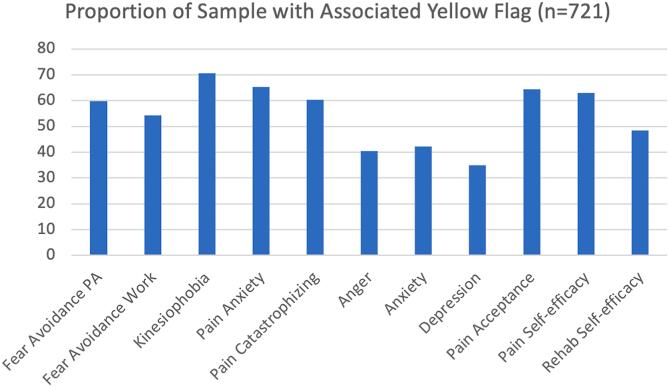
A total of 721 patients were recruited from hip preservation clinics. The Optimal Screening for Prediction of Referral and Outcome-Yellow Flag Assessment Tool (OSPRO-YF) was used to identify the presence or absence of 11 different pain-associated psychological distress characteristics (yellow flags), while the International Hip Outcome Tool-12 (iHOT-12) was used to assess hip-related quality of life. Latent class analysis identified patient subgroups (phenotypes) based on naturally occurring combinations of distress characteristics. An analysis of variance was used to compare demographics, number of yellow flags, and iHOT-12 scores across phenotypes.
RESULTS
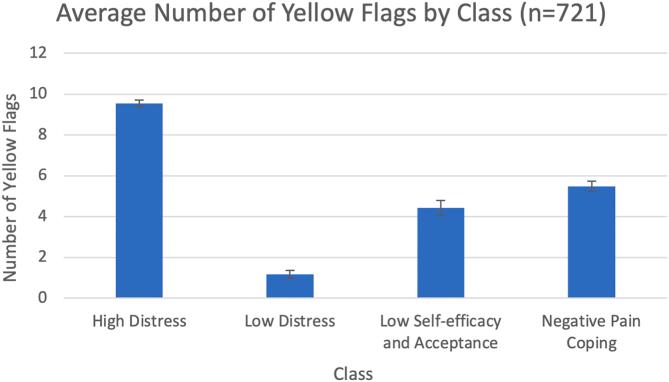
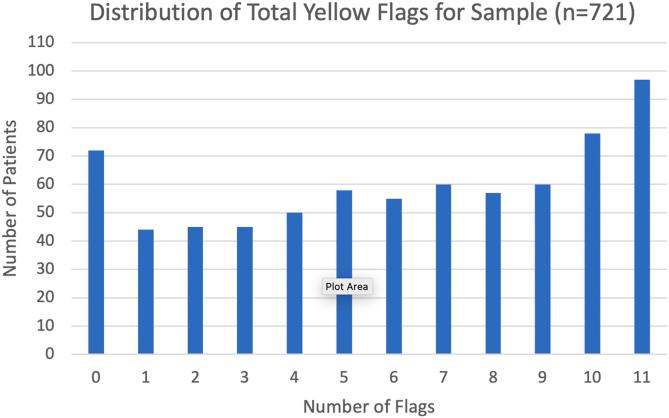
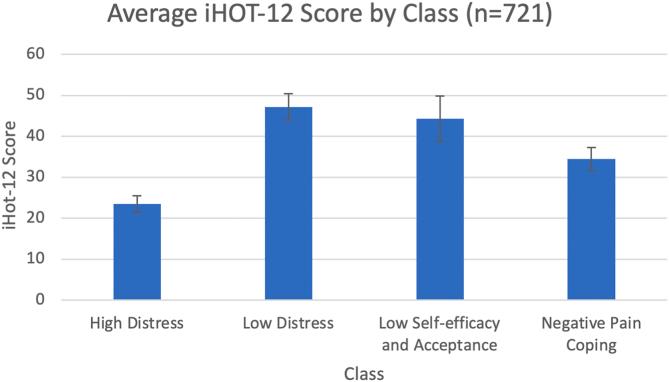
The median (interquartile range) number of yellow flags was 6 (3-9), with 13.5% of the sample reporting 11 yellow flags. Latent class analysis (L = 543.3, classification errors = 0.082) resulted in 4 phenotypes: high distress (n = 299, 41.5%), low distress (n = 172, 23.9%), low self-efficacy and acceptance (n = 74, 10.3%), and negative pain coping (n = 276, 24.4%). Significant differences in mean yellow flags existed between all phenotypes except low self-efficacy and negative pain coping. There were no differences in demographics between phenotypes. The high distress class had the lowest mean iHOT-12 score (mean [SD], 23.5 [17.6]), with significant differences found between each phenotypic class.
CONCLUSIONS
There was a high prevalence of pain-associated psychological distress in patients presenting to tertiary hip arthroscopy clinics with hip pain. Furthermore, hip quality-of-life outcome scores were uniformly lower in patients with higher levels of psychological distress.
LEVEL OF EVIDENCE
Level III, retrospective cohort study.
目的
确定因运动性髋关节疼痛而寻求治疗的患者中常见的与疼痛相关的心理因素,对心理困扰表型进行特征描述,并比较这些表型之间髋关节特异性生活质量指标。
方法
从髋关节保留诊所招募了721名患者。使用转诊和结果预测的最佳筛查——黄旗评估工具(OSPRO-YF)来确定11种不同的与疼痛相关的心理困扰特征(黄旗)的存在与否,同时使用国际髋关节结果工具-12(iHOT-12)来评估与髋关节相关的生活质量。潜在类别分析根据困扰特征的自然组合确定患者亚组(表型)。使用方差分析比较各表型之间的人口统计学特征、黄旗数量和iHOT-12评分。
结果
黄旗数量的中位数(四分位间距)为6(3-9),13.5%的样本报告有11个黄旗。潜在类别分析(L = 543.3,分类错误 = 0.082)产生了4种表型:高度困扰(n = 299,41.5%)、低度困扰(n = 172,23.9%)、低自我效能感和接受度(n = 74,10.3%)以及消极疼痛应对(n = 276,24.4%)。除低自我效能感和消极疼痛应对外,所有表型之间的平均黄旗数量存在显著差异。各表型之间的人口统计学特征无差异。高度困扰组的平均iHOT-12评分最低(平均值[标准差],23.5[17.6]),各表型组之间存在显著差异。
结论
在因髋关节疼痛就诊于三级髋关节镜诊所的患者中,与疼痛相关的心理困扰患病率较高。此外,心理困扰程度较高的患者髋关节生活质量结果评分普遍较低。
证据水平
III级,回顾性队列研究。


 Zotero 插件