
来自[具体来源未提及]的双COX-2/5-LOX抑制剂通过交叉介导甲状腺、雌激素和催产素信号通路来抑制胃癌细胞。
Dual COX-2/5-LOX inhibitors from inhibit gastric cancer cells by cross-mediating thyroid, estrogen, and oxytocin signaling pathways.
作者信息
Tian Yong-Qiang, Liu Jing, Cheng Peng, Zou Jian, Xu Hui-Fang, Shi Xin-Hua, Zhang Yi-Sheng, Mei Ling
机构信息
Department of Pharmacy, Wuhan Hospital of Traditional Chinese Medicine, Third Clinical Medical College of Hubei University of Chinese Medicine, Wuhan, Hubei, China.
Department of Acupuncture, Wuhan Hospital of Traditional Chinese Medicine, Third Clinical Medical College of Hubei University of Chinese Medicine, Wuhan, Hubei, China.
出版信息
Front Chem. 2024 Jan 10;11:1287570. doi: 10.3389/fchem.2023.1287570. eCollection 2023.
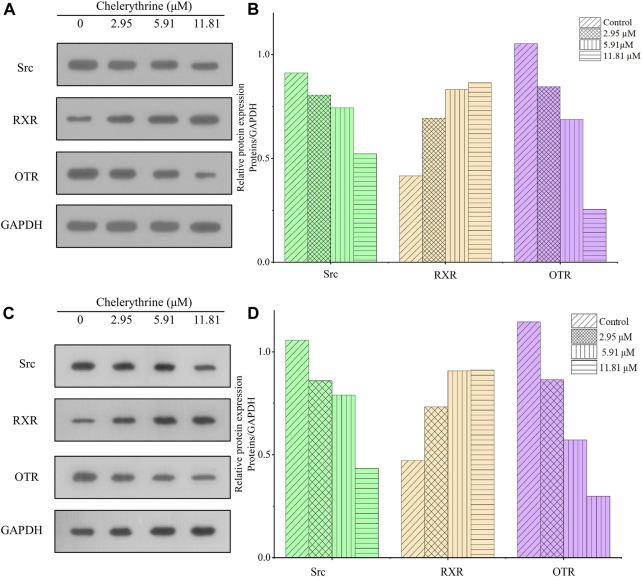
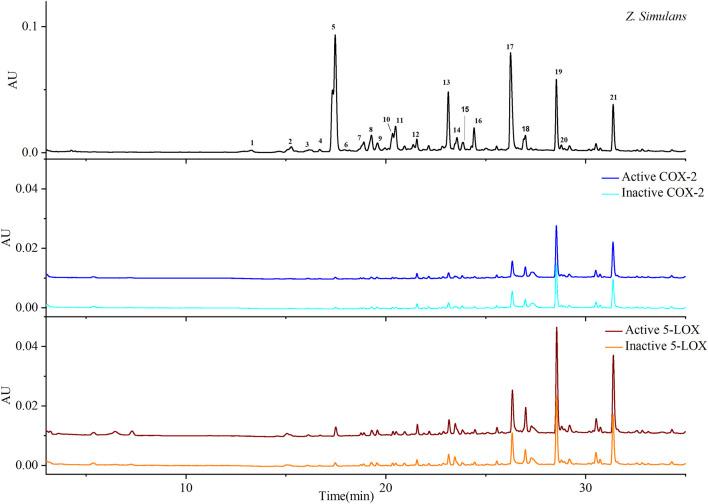
Cyclooxygenase 2 (COX-2) and 5-lipoxygenase (5-LOX) are overexpressed in gastric cancer cells, the dual inhibitors of which exhibit potential against metastasis and invasion with fewer side effects. To discover inhibitors targeting COX-2 and 5-LOX, we conducted ultrafiltration and enrichment calculation to screen candidates in quaternary alkaloids (QAs) from through LC and LC-Q-TOF. For intensive peaks, peaks 19 (berberine) and 21 (chelerythrine) were observed as the most potent dual candidates and showed selective affinity to 5-LOX over COX-2. Peak 19 showed an enrichment at 4.36 for COX-2 and 22.81 for 5-LOX, while peak 21 showed an enrichment at 7.81 for COX-2 and 24.49 for 5-LOX. Molecular docking results revealed chelerythrine as a better dual inhibitor, showing time- and dose-dependent anti-proliferation against AGS cells. Bio-informatics strategies, such as Gene Expression Omnibus (GEO), Gene Ontology (GO), and Kyoto Encyclopedia of Genes and Genomes (KEGG), suggested that hormone pathways in gastric cancer cells might be mediated by chelerythrine. Further reviews and summaries helped outline the mechanisms by which COX-2/5-LOX inhibitors might promote apoptosis in gastric cancer cells via estrogen, thyroid, and oxytocin signaling pathways. Chelerythrine was also added to gastric cancer cells to verify the regulation of these three signaling pathways. As a result, significant calling back of thyroid-stimulating hormone receptor (TSHR), thyroid hormone α3 (TRα3), and thyroid hormone receptor β1 (TRβ1) and suppressing estrogen receptor α36 (ER-α36)-Src could benefit the anti-proliferation of chelerythrine. However, it was disappointing that regulation of estrogen receptor α66 (ER-α66), estrogen receptor β (ER-β), and oxytocin receptor (OTR) contributed inversely negative effects on anti-gastric cancer cells. At present, the integrative study not only revealed chelerythrine as the most potent dual COX-2/5-LOX inhibitor from QAs but also generally highlighted that comprehensive regulation of the estrogen, thyroid, and oxytocin pathway should be noted once gastric cancer cells were treated with inflammatory inhibitors.
环氧化酶2(COX-2)和5-脂氧合酶(5-LOX)在胃癌细胞中过表达,其双重抑制剂对转移和侵袭具有潜在作用且副作用较少。为了发现靶向COX-2和5-LOX的抑制剂,我们通过液相色谱(LC)和液相色谱-四极杆飞行时间质谱(LC-Q-TOF)进行超滤和富集计算,以筛选季铵生物碱(QAs)中的候选物。对于密集峰,观察到峰19(小檗碱)和峰21(白屈菜红碱)是最有效的双重候选物,并且对5-LOX的选择性亲和力高于COX-2。峰19对COX-2的富集倍数为4.36,对5-LOX的富集倍数为22.81,而峰21对COX-2的富集倍数为7.81,对5-LOX的富集倍数为24.49。分子对接结果显示白屈菜红碱是一种更好的双重抑制剂,对AGS细胞表现出时间和剂量依赖性的抗增殖作用。生物信息学策略,如基因表达综合数据库(GEO)、基因本体论(GO)和京都基因与基因组百科全书(KEGG),表明胃癌细胞中的激素途径可能由白屈菜红碱介导。进一步的综述和总结有助于概述COX-2/5-LOX抑制剂可能通过雌激素、甲状腺和催产素信号通路促进胃癌细胞凋亡的机制。还将白屈菜红碱添加到胃癌细胞中以验证这三种信号通路的调节作用。结果,甲状腺刺激激素受体(TSHR)、甲状腺激素α3(TRα3)和甲状腺激素受体β1(TRβ1)的显著回调以及雌激素受体α36(ER-α36)-Src的抑制有利于白屈菜红碱的抗增殖作用。然而,令人失望的是,雌激素受体α66(ER-α66)、雌激素受体β(ER-β)和催产素受体(OTR)的调节对抗胃癌细胞产生了相反的负面影响。目前,综合研究不仅揭示了白屈菜红碱是QAs中最有效的双重COX-2/5-LOX抑制剂,还普遍强调,用炎症抑制剂治疗胃癌细胞时,应注意对雌激素、甲状腺和催产素途径的全面调节。


 Zotero 插件