
KIRNK 细胞在单倍体造血干细胞移植后持续存在可预防人类巨细胞病毒感染/再激活。
Persistence of KIR NK cells after haploidentical hematopoietic stem cell transplantation protects from human cytomegalovirus infection/reactivation.
机构信息
Unit of Clinical and Experimental Immunology, IRCCS Humanitas Research Hospital, Rozzano, Milan, Italy.
Department of Medical Biotechnologies and Translational Medicine (BioMeTra), University of Milan, Milan, Italy.
出版信息
Front Immunol. 2024 Jan 10;14:1266051. doi: 10.3389/fimmu.2023.1266051. eCollection 2023.
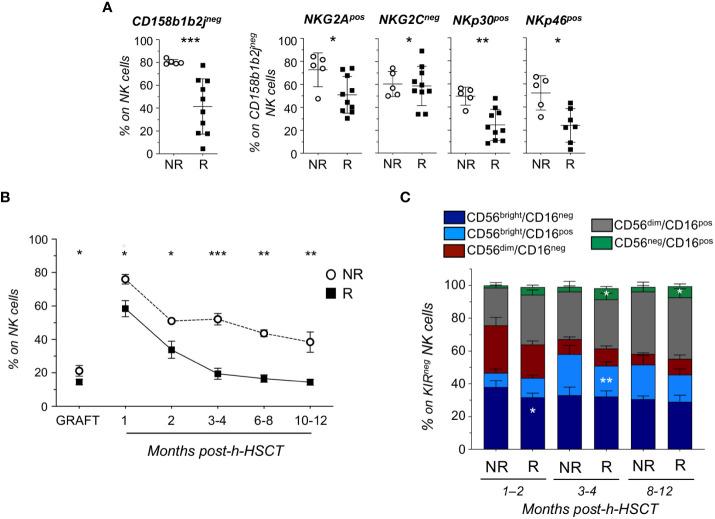
Haploidentical hematopoietic stem cell transplantation (h-HSCT) is a therapeutic option to cure patients affected by hematologic malignancies. The kinetics and the quality of immune-reconstitution (IR) impact the clinical outcome of h-HSCT and limit the onset of life-threatening Human Cytomegalovirus (HCMV) infection/reactivation. Natural Killer (NK) cells are the first lymphocytes that recover after h-HSCT and they can provide rapid innate immune responses against opportunistic pathogens. By performing a longitudinal single-cell analysis of multiparametric flow-cytometry data, we show here that the persistence at high frequencies of CD158b1b2j/NKG2A/NKG2C/NKp30/NKp46 (KIR) NK cells is associated with HCMV infection/reactivation control. These KIR NK cells are "unlicensed", and are not terminal-differentiated lymphocytes appearing early during IR and mainly belonging to CD56/CD16 and CD56/CD16 subsets. KIR NK cells are enriched in oxidative and glucose metabolism pathways, produce interferon-γ, and are endowed with potent antiviral activity against HCMV . Decreased frequencies of KIR NK cells early during IR are associated with clinically relevant HCMV replication. Taken together, our findings indicate that the prolonged persistence of KIR NK cells after h-HSCT could serve as a biomarker to better predict HCMV infection/reactivation. This phenomenon also paves the way to optimize anti-viral immune responses by enriching post-transplant donor lymphocyte infusions with KIR NK cells.
单倍体造血干细胞移植(haploidentical HSCT)是治疗血液系统恶性肿瘤患者的一种治疗选择。免疫重建(IR)的动力学和质量会影响 haploidentical HSCT 的临床结果,并限制危及生命的人巨细胞病毒(HCMV)感染/再激活的发生。自然杀伤(NK)细胞是 haploidentical HSCT 后最早恢复的淋巴细胞,能够对机会性病原体提供快速的先天免疫反应。通过对多参数流式细胞术数据进行纵向单细胞分析,我们在这里表明,高频率的 CD158b1b2j/NKG2A/NKG2C/NKp30/NKp46(KIR)NK 细胞的持续存在与 HCMV 感染/再激活控制有关。这些 KIR NK 细胞是“未许可的”,不是终末分化的淋巴细胞,在 IR 早期出现,主要属于 CD56/CD16 和 CD56/CD16 亚群。KIR NK 细胞富集于氧化和葡萄糖代谢途径,产生干扰素-γ,并具有针对 HCMV 的强大抗病毒活性。IR 早期 KIR NK 细胞的频率降低与临床相关的 HCMV 复制有关。总之,我们的研究结果表明,haploidentical HSCT 后 KIR NK 细胞的持续存在可作为更好地预测 HCMV 感染/再激活的生物标志物。这一现象也为通过富含 KIR NK 细胞的供体淋巴细胞输注来优化抗病毒免疫反应铺平了道路。



 Zotero 插件