
叉头转录因子Foxj1控制脊椎动物嗅觉纤毛的生物发生和感觉神经元分化。
The forkhead transcription factor Foxj1 controls vertebrate olfactory cilia biogenesis and sensory neuron differentiation.
作者信息
Rayamajhi Dheeraj, Ege Mert, Ukhanov Kirill, Ringers Christa, Zhang Yiliu, Jung Inyoung, D'Gama Percival P, Li Summer Shijia, Cosacak Mehmet Ilyas, Kizil Caghan, Park Hae-Chul, Yaksi Emre, Martens Jeffrey R, Brody Steven L, Jurisch-Yaksi Nathalie, Roy Sudipto
机构信息
Institute of Molecular and Cell Biology, Agency for Science, Technology and Research, Singapore.
Department of Clinical and Molecular Medicine, Norwegian University of Science and Technology, Trondheim, Norway.
出版信息
PLoS Biol. 2024 Jan 25;22(1):e3002468. doi: 10.1371/journal.pbio.3002468. eCollection 2024 Jan.
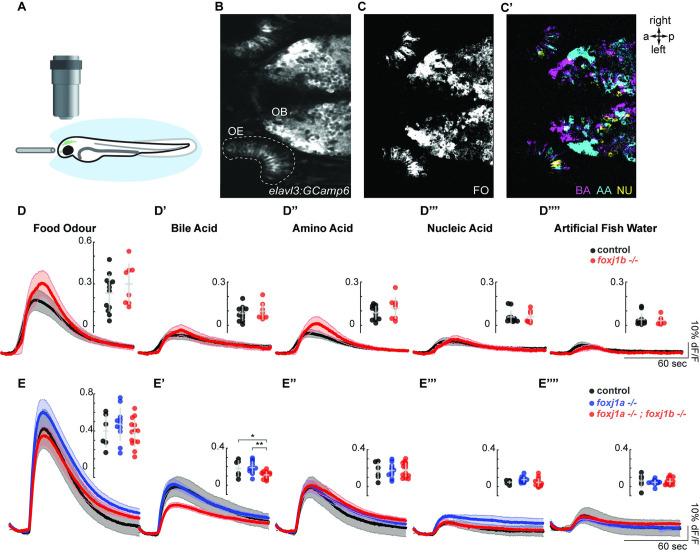
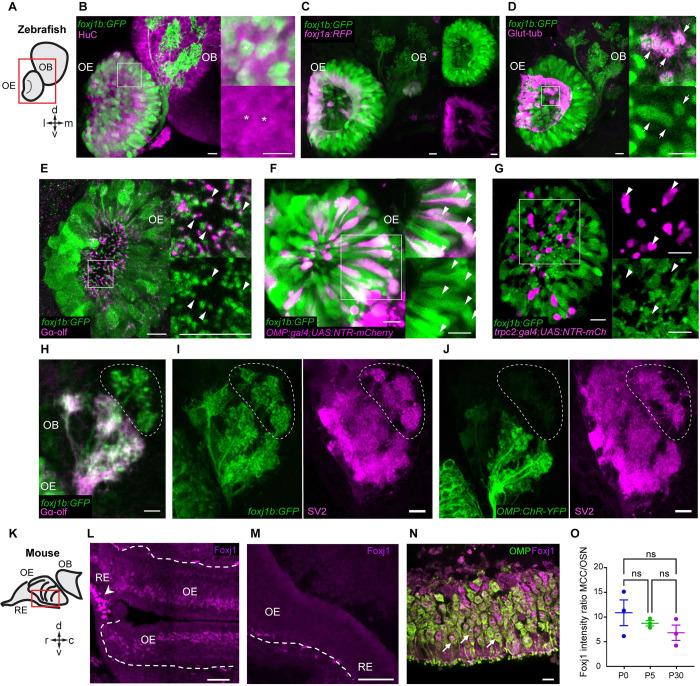
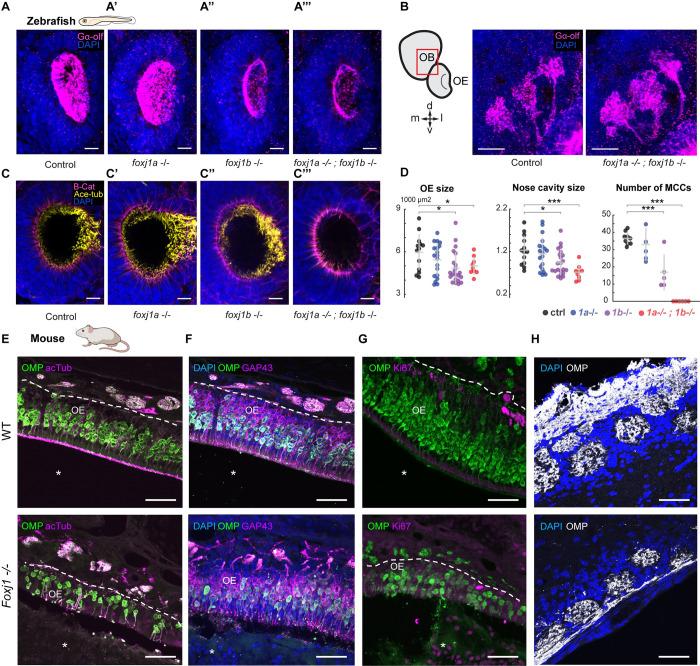
In vertebrates, olfactory receptors localize on multiple cilia elaborated on dendritic knobs of olfactory sensory neurons (OSNs). Although olfactory cilia dysfunction can cause anosmia, how their differentiation is programmed at the transcriptional level has remained largely unexplored. We discovered in zebrafish and mice that Foxj1, a forkhead domain-containing transcription factor traditionally linked with motile cilia biogenesis, is expressed in OSNs and required for olfactory epithelium (OE) formation. In keeping with the immotile nature of olfactory cilia, we observed that ciliary motility genes are repressed in zebrafish, mouse, and human OSNs. Strikingly, we also found that besides ciliogenesis, Foxj1 controls the differentiation of the OSNs themselves by regulating their cell type-specific gene expression, such as that of olfactory marker protein (omp) involved in odor-evoked signal transduction. In line with this, response to bile acids, odors detected by OMP-positive OSNs, was significantly diminished in foxj1 mutant zebrafish. Taken together, our findings establish how the canonical Foxj1-mediated motile ciliogenic transcriptional program has been repurposed for the biogenesis of immotile olfactory cilia, as well as for the development of the OSNs.
在脊椎动物中,嗅觉受体定位于嗅觉感觉神经元(OSNs)树突状小体上的多个纤毛上。尽管嗅觉纤毛功能障碍可导致嗅觉丧失,但在转录水平上其分化是如何被编程的,在很大程度上仍未得到探索。我们在斑马鱼和小鼠中发现,Foxj1是一种传统上与运动性纤毛生物发生相关的含叉头结构域的转录因子,在OSNs中表达,并且是嗅觉上皮(OE)形成所必需的。与嗅觉纤毛的非运动性本质一致,我们观察到在斑马鱼、小鼠和人类的OSNs中,纤毛运动基因受到抑制。令人惊讶的是,我们还发现,除了纤毛发生外,Foxj1还通过调节OSNs自身的细胞类型特异性基因表达来控制其分化,例如参与气味诱发信号转导的嗅觉标记蛋白(omp)的表达。与此一致的是,在foxj1突变斑马鱼中,对胆汁酸(由OMP阳性OSNs检测到的气味)的反应显著减弱。综上所述,我们的研究结果揭示了经典的Foxj1介导的运动性纤毛生成转录程序是如何被重新用于非运动性嗅觉纤毛的生物发生以及OSNs的发育的。

 Zotero 插件