
嵌合胚胎移植后的健康活产:自我纠正还是植入前基因检测筛查(PGT-A)高估?
Healthy Live Births after the Transfer of Mosaic Embryos: Self-Correction or PGT-A Overestimation?
作者信息
Campos Gerard, Sciorio Romualdo, Fleming Steven
机构信息
Geisinger Medical Center, Women's Health Fertility Clinic, Danville, PA 17821, USA.
GIREXX Fertility Clinics, C. de Cartagena, 258, 08025 Girona, Spain.
出版信息
Genes (Basel). 2023 Dec 21;15(1):18. doi: 10.3390/genes15010018.
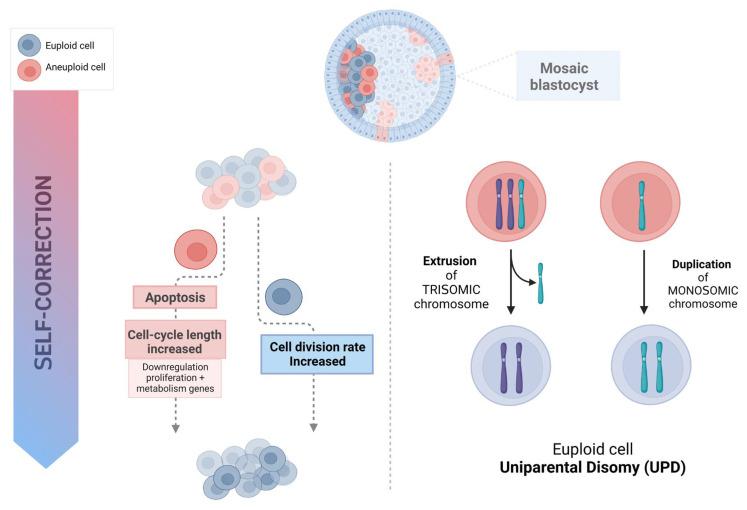
The implementation of next generation sequencing (NGS) in preimplantation genetic testing for aneuploidy (PGT-A) has led to a higher prevalence of mosaic diagnosis within the trophectoderm (TE) sample. Regardless, mosaicism could potentially increase the rate of live-born children with chromosomic syndromes, though available data from the transfer of embryos with putative PGT-A mosaicism are scarce but reassuring. Even with lower implantation and higher miscarriage rates, mosaic embryos can develop into healthy live births. Therefore, this urges an explanation for the disappearance of aneuploid cells throughout development, to provide guidance in the management of mosaicism in clinical practice. Technical overestimation of mosaicism, together with some sort of "self-correction" mechanisms during the early post-implantation stages, emerged as potential explanations. Unlike the animal model, in which the elimination of genetically abnormal cells from the future fetal lineage has been demonstrated, in human embryos this capability remains unverified even though the germ layer displays an aneuploidy-induced cell death lineage preference with higher rates of apoptosis in the inner cell mass (ICM) than in the TE cells. Moreover, the reported differential dynamics of cell proliferation and apoptosis between euploid, mosaic, and aneuploid embryos, together with pro-apoptosis gene products (cfDNA and mRNA) and extracellular vesicles identified in the blastocoel fluid, may support the hypothesis of apoptosis as a mechanism to purge the preimplantation embryo of aneuploid cells. Alternative hypotheses, like correction of aneuploidy by extrusion of a trisomy chromosome or by monosomic chromosome duplication, are even, though they represent an extremely rare phenomenon. On the other hand, the technical limitations of PGT-A analysis may lead to inaccuracy in embryo diagnoses, identifying as "mosaic" those embryos that are uniformly euploid or aneuploid. NGS assumption of "intermediate copy number profiles" as evidence of a mixture of euploid and aneuploid cells in a single biopsy has been reported to be poorly predictive in cases of mosaicism diagnosis. Additionally, the concordance found between the TE and the ICM in cases of TE biopsies displaying mosaicism is lower than expected, and it correlates differently depending on the type (whole chromosome versus segmental) and the level of mosaicism reported. Thus, in cases of low-/medium-level mosaicism (<50%), aneuploid cells would rarely involve the ICM and other regions. However, in high-level mosaics (≥50%), abnormal cells in the ICM should display higher prevalence, revealing more uniform aneuploidy in most embryos, representing a technical variation in the uniform aneuploidy range, and therefore might impair the live birth rate.
在植入前非整倍体基因检测(PGT-A)中实施下一代测序(NGS)已导致滋养外胚层(TE)样本中嵌合体诊断的发生率更高。尽管如此,嵌合体可能会增加患有染色体综合征的活产儿比例,不过关于假定为PGT-A嵌合体的胚胎移植的现有数据很少,但令人安心。即使着床率较低且流产率较高,嵌合胚胎仍可发育为健康的活产儿。因此,这就迫切需要解释非整倍体细胞在整个发育过程中的消失情况,以便为临床实践中嵌合体的管理提供指导。技术上对嵌合体的高估,以及植入后早期阶段的某种“自我纠正”机制,成为了可能的解释。与动物模型不同,在动物模型中已证明可从未来的胎儿谱系中清除基因异常细胞,而在人类胚胎中,尽管胚层显示出非整倍体诱导的细胞死亡谱系偏好,即内细胞团(ICM)中的凋亡率高于TE细胞,但这种能力仍未得到证实。此外,报道的整倍体、嵌合体和非整倍体胚胎之间细胞增殖和凋亡的差异动态,以及在囊胚腔液中鉴定出的促凋亡基因产物(cfDNA和mRNA)和细胞外囊泡,可能支持凋亡作为清除植入前胚胎中非整倍体细胞的一种机制的假设。其他假设,如通过三体染色体的挤出或单体染色体的复制来纠正非整倍体,即使它们代表一种极其罕见的现象。另一方面,PGT-A分析的技术局限性可能导致胚胎诊断不准确,将那些均匀整倍体或非整倍体的胚胎鉴定为“嵌合体”。据报道,在嵌合体诊断的情况下,NGS将“中间拷贝数谱”假定为单个活检中整倍体和非整倍体细胞混合物的证据,其预测性很差。此外,在显示嵌合体的TE活检病例中,TE和ICM之间的一致性低于预期,并且根据报道的类型(整条染色体与节段性)和嵌合体水平的不同而有不同的相关性。因此,在低/中等水平嵌合体(<50%)的情况下,非整倍体细胞很少会涉及ICM和其他区域。然而,在高水平嵌合体(≥50%)中,ICM中的异常细胞应该具有更高的发生率,在大多数胚胎中显示出更均匀的非整倍体,这代表了均匀非整倍体范围内的技术差异,因此可能会损害活产率。
 Zotero 插件