
粒子线性能量传递和注量对DNA簇状损伤的复杂性和频率的影响
The Effects of Particle LET and Fluence on the Complexity and Frequency of Clustered DNA Damage.
作者信息
Rezaee Mohammad, Adhikary Amitava
机构信息
Department of Radiation Oncology and Molecular Radiation Sciences, School of Medicine, Johns Hopkins University, 1550 Orleans St., Baltimore, MD 21231, USA.
Department of Chemistry, Oakland University, 146 Library Drive, Rochester, MI 48309, USA.
出版信息
DNA (Basel). 2024 Mar;4(1):34-51. doi: 10.3390/dna4010002. Epub 2024 Jan 5.
MOTIVATION
Clustered DNA-lesions are predominantly induced by ionizing radiation, particularly by high-LET particles, and considered as lethal damage. Quantification of this specific type of damage as a function of radiation parameters such as LET, dose rate, dose, and particle type can be informative for the prediction of biological outcome in radiobiological studies. This study investigated the induction and complexity of clustered DNA damage for three different types of particles at an LET range of 0.5-250 keV/μm.
METHODS
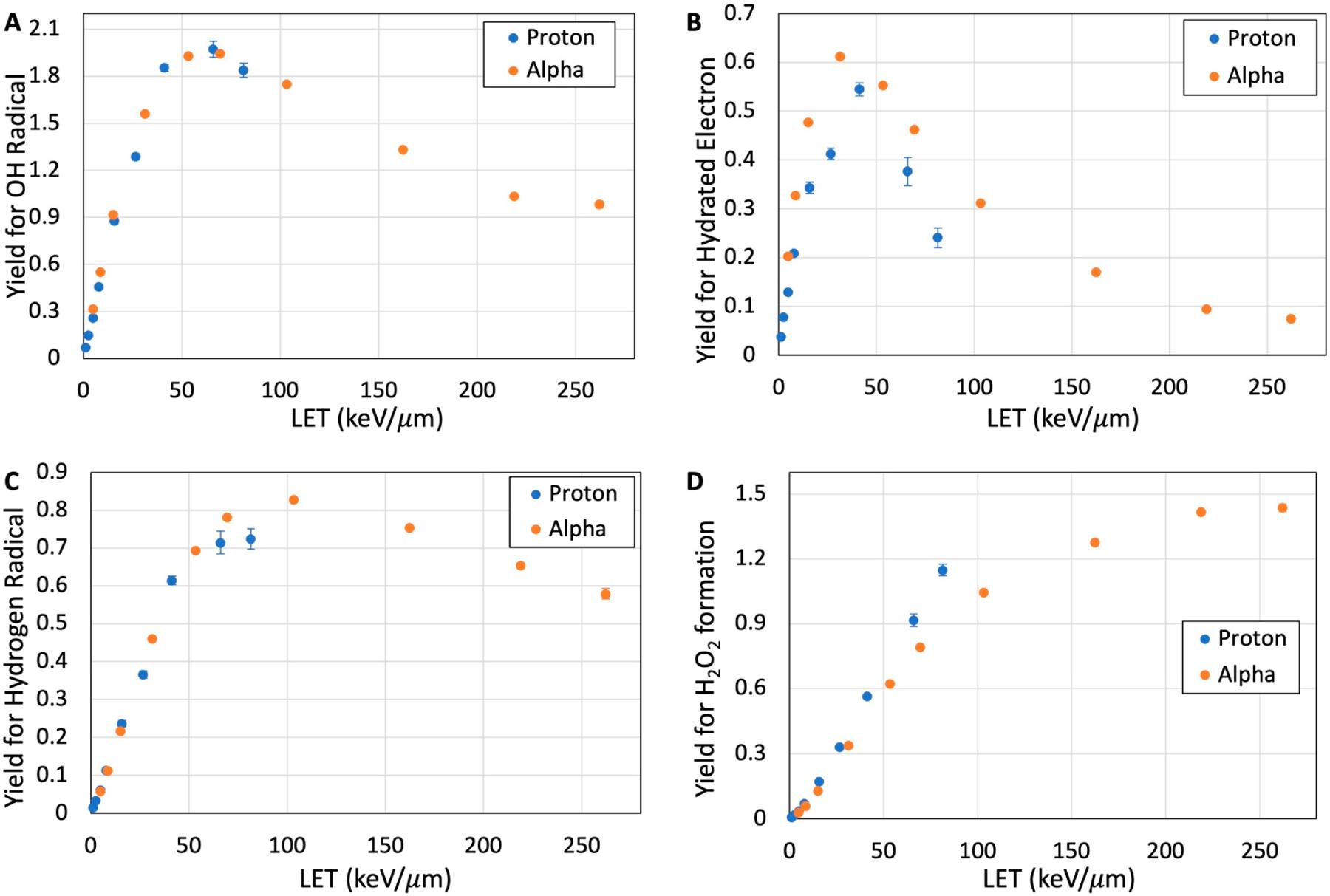
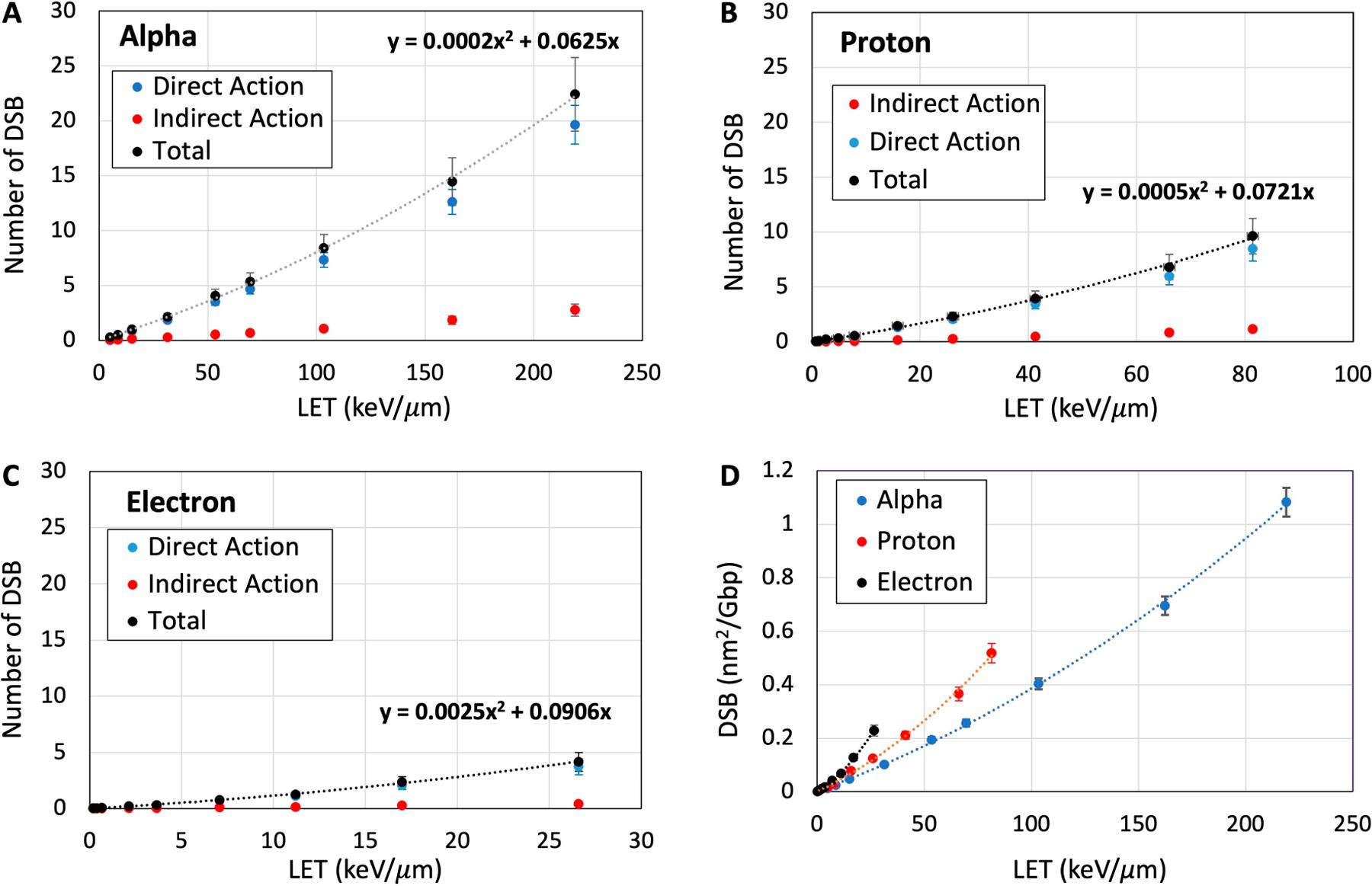
Nanometric volumes (36.0 nm) of 15 base-pair DNA with its hydration shell was modeled. Electron, proton, and alpha particles at various energies were simulated to irradiate the nanometric volumes. The number of ionization events, low-energy electron spectra, and chemical yields for the formation of °OH, H°, , and HO were calculated for each particle as a function of LET. Single- and double-strand breaks (SSB and DSB), base release, and clustered DNA-lesions were computed from the Monte-Carlo based quantification of the reactive species and measured yields of the species responsible for the DNA lesion formation.
RESULTS
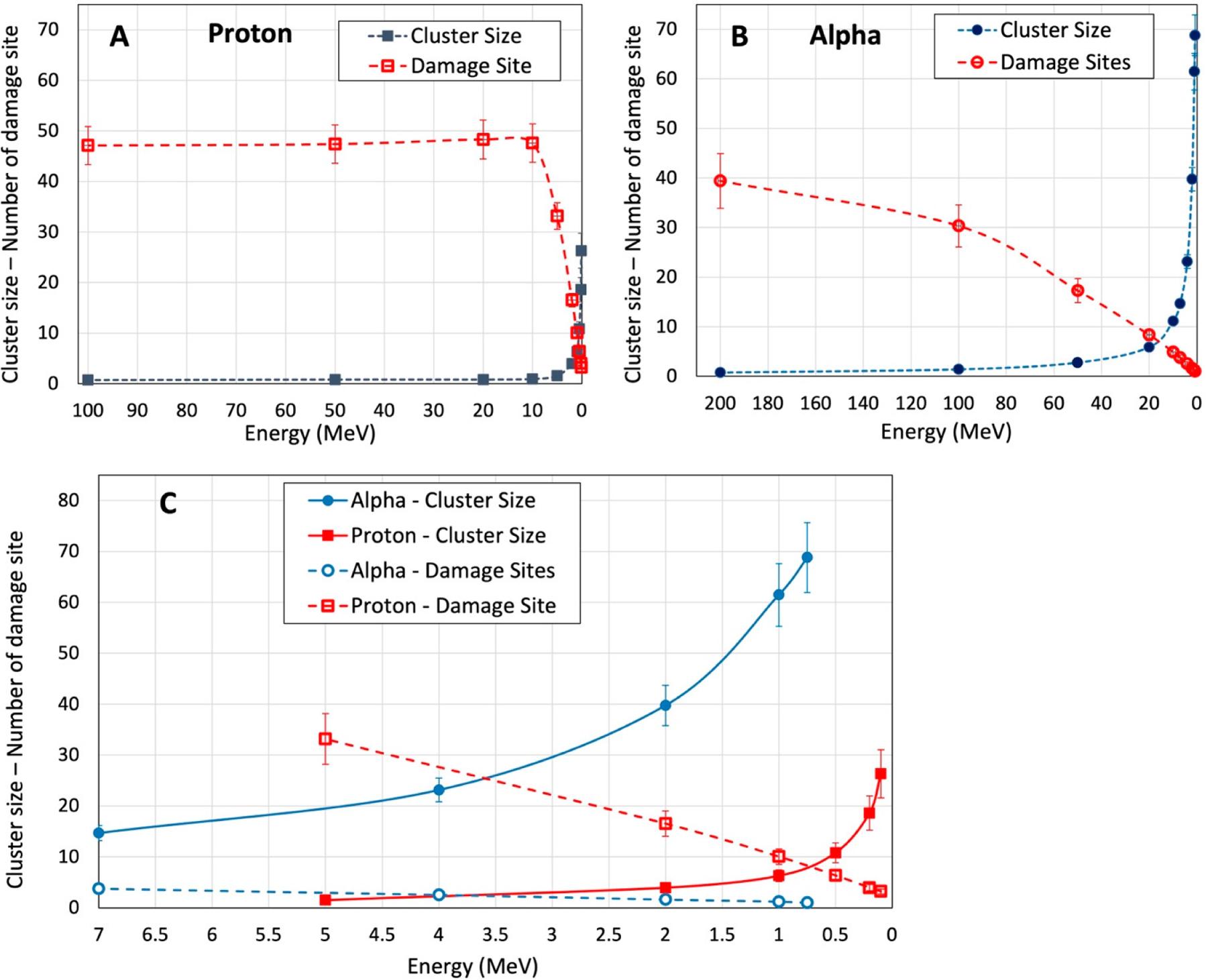
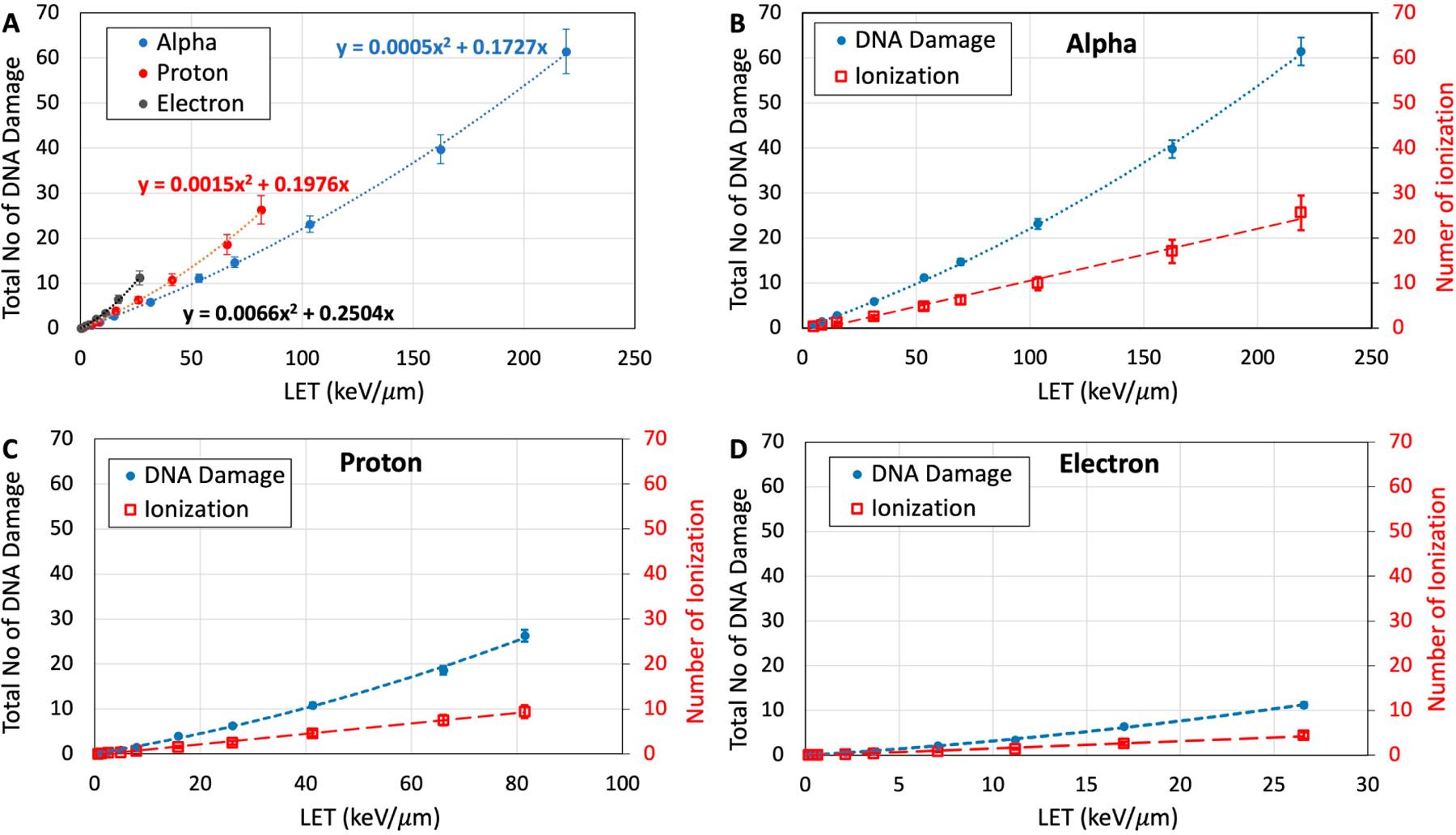
The total amount of DNA damage depends on particle type and LET. The number of ionization events underestimates the quantity of DNA damage at LETs higher than 10 keV/μm. Minimum LETs of 9.4 and 11.5 keV/μm are required to induce clustered damage by a single track of proton and alpha particles, respectively. For a given radiation dose, an increase in LET reduces the number of particle tracks, leading to more complex clustered DNA damage, but a smaller number of separated clustered damage sites.
CONCLUSIONS
The dependency of the number and the complexity of clustered DNA damage on LET and fluence suggests that the quantification of this damage can be a useful method for the estimation of the biological effectiveness of radiation. These results also suggest that medium-LET particles are more appropriate for the treatment of bulk targets, whereas high-LET particles can be more effective for small targets.
动机
簇状DNA损伤主要由电离辐射诱导产生,尤其是高传能线密度(LET)粒子,并被视为致死性损伤。将这种特定类型的损伤作为LET、剂量率、剂量和粒子类型等辐射参数的函数进行量化,对于放射生物学研究中生物效应的预测具有重要意义。本研究在0.5 - 250 keV/μm的LET范围内,研究了三种不同类型粒子诱导的簇状DNA损伤及其复杂性。
方法
对包含其水合壳的15个碱基对DNA的纳米级体积(36.0 nm)进行建模。模拟不同能量的电子、质子和α粒子辐照该纳米级体积。计算每个粒子作为LET函数的电离事件数、低能电子能谱以及°OH、H°、 和HO形成的化学产率。通过基于蒙特卡罗方法对反应物种的量化以及对负责DNA损伤形成的物种的测量产率,计算单链和双链断裂(SSB和DSB)、碱基释放和簇状DNA损伤。
结果
DNA损伤的总量取决于粒子类型和LET。在LET高于10 keV/μm时,电离事件数低估了DNA损伤的量。质子和α粒子单轨迹诱导簇状损伤分别需要的最低LET为9.4 keV/μm和11.5 keV/μm。对于给定的辐射剂量,LET的增加会减少粒子轨迹的数量,导致更复杂的簇状DNA损伤,但分离的簇状损伤位点数量减少。
结论
簇状DNA损伤的数量和复杂性对LET和注量的依赖性表明,对这种损伤的量化可能是估计辐射生物有效性的一种有用方法。这些结果还表明,中等LET粒子更适合治疗大块靶标,而高LET粒子对小靶标可能更有效。


 Zotero 插件