
健康老年人 24 小时时间利用组成、灰质体积与认知功能的横断面关联。
Cross-sectional associations between 24-hour time-use composition, grey matter volume and cognitive function in healthy older adults.
机构信息
Alliance for Research in Exercise, Nutrition and Activity, Allied Health and Human Performance, University of South Australia, Adelaide, Australia.
Behaviour-Brain-Body Research Centre, Justice and Society, University of South Australia, Adelaide, Australia.
出版信息
Int J Behav Nutr Phys Act. 2024 Jan 30;21(1):11. doi: 10.1186/s12966-023-01557-4.
BACKGROUND
Increasing physical activity (PA) is an effective strategy to slow reductions in cortical volume and maintain cognitive function in older adulthood. However, PA does not exist in isolation, but coexists with sleep and sedentary behaviour to make up the 24-hour day. We investigated how the balance of all three behaviours (24-hour time-use composition) is associated with grey matter volume in healthy older adults, and whether grey matter volume influences the relationship between 24-hour time-use composition and cognitive function.
METHODS
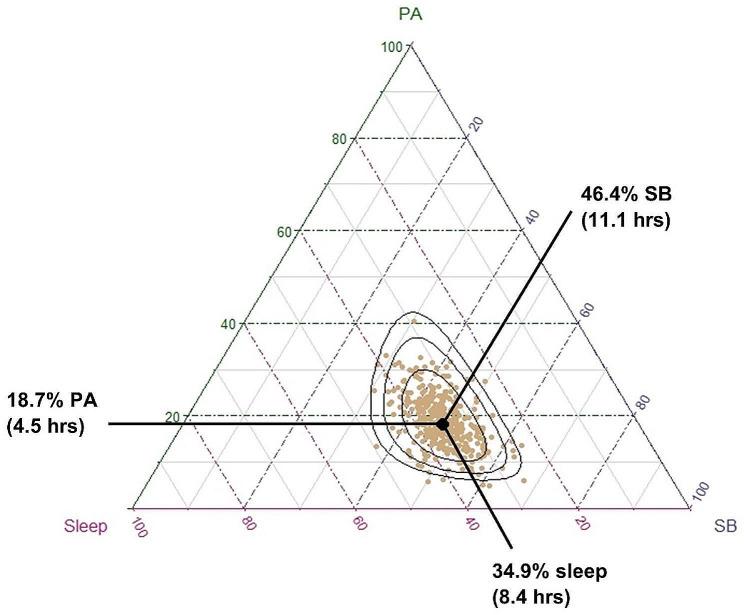
This cross-sectional study included 378 older adults (65.6 ± 3.0 years old, 123 male) from the ACTIVate study across two Australian sites (Adelaide and Newcastle). Time-use composition was captured using 7-day accelerometry, and T1-weighted magnetic resonance imaging was used to measure grey matter volume both globally and across regions of interest (ROI: frontal lobe, temporal lobe, hippocampi, and lateral ventricles). Pairwise correlations were used to explore univariate associations between time-use variables, grey matter volumes and cognitive outcomes. Compositional data analysis linear regression models were used to quantify associations between ROI volumes and time-use composition, and explore potential associations between the interaction between ROI volumes and time-use composition with cognitive outcomes.
RESULTS
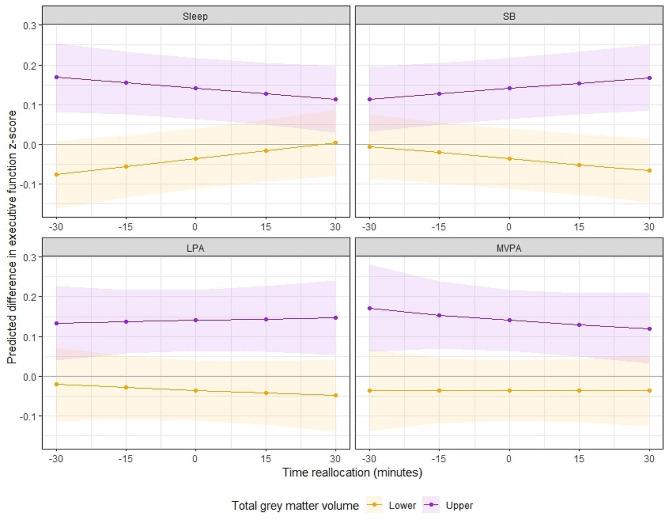
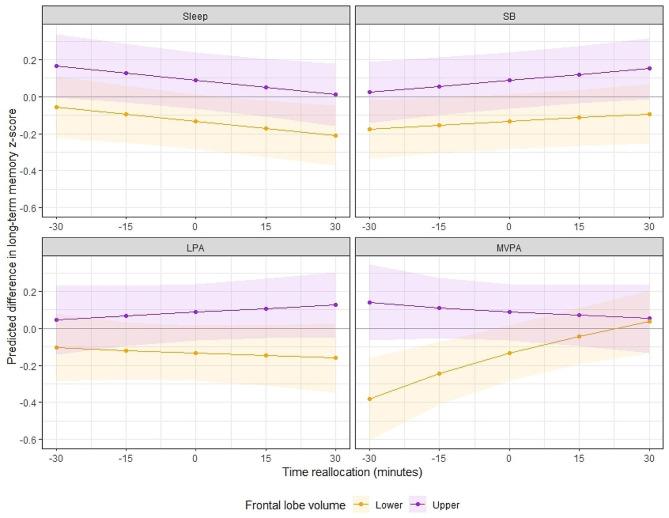
After adjusting for covariates (age, sex, education), there were no significant associations between time-use composition and any volumetric outcomes. There were significant interactions between time-use composition and frontal lobe volume for long-term memory (p = 0.018) and executive function (p = 0.018), and between time-use composition and total grey matter volume for executive function (p = 0.028). Spending more time in moderate-vigorous PA was associated with better long-term memory scores, but only for those with smaller frontal lobe volume (below the sample mean). Conversely, spending more time in sleep and less time in sedentary behaviour was associated with better executive function in those with smaller total grey matter volume.
CONCLUSIONS
Although 24-hour time use was not associated with total or regional grey matter independently, total grey matter and frontal lobe grey matter volume moderated the relationship between time-use composition and several cognitive outcomes. Future studies should investigate these relationships longitudinally to assess whether changes in time-use composition correspond to changes in grey matter volume and cognition.
背景
增加身体活动(PA)是减缓皮质体积减少和维持老年认知功能的有效策略。然而,PA 并非孤立存在,而是与睡眠和久坐行为共存,构成 24 小时。我们研究了三种行为(24 小时时间利用组成)的平衡如何与健康老年人的灰质体积相关,以及灰质体积是否影响 24 小时时间利用组成与认知功能之间的关系。
方法
这项横断面研究包括来自澳大利亚两个地点(阿德莱德和纽卡斯尔)的 ACTIVate 研究中的 378 名老年人(65.6±3.0 岁,123 名男性)。使用 7 天加速度计来记录时间利用组成,使用 T1 加权磁共振成像来测量全脑和感兴趣区域(ROI:额叶、颞叶、海马体和侧脑室)的灰质体积。使用成对相关来探索时间利用变量、灰质体积和认知结果之间的单变量关联。使用组成数据分析线性回归模型来量化 ROI 体积与时间利用组成之间的关联,并探索 ROI 体积与时间利用组成之间的相互作用与认知结果之间的潜在关联。
结果
在校正协变量(年龄、性别、教育)后,时间利用组成与任何体积结果之间没有显著关联。时间利用组成与额叶体积之间存在显著的交互作用,用于长期记忆(p=0.018)和执行功能(p=0.018),以及时间利用组成与总灰质体积之间存在显著的交互作用,用于执行功能(p=0.028)。花更多的时间进行中高强度体力活动与更好的长期记忆分数相关,但仅与额叶体积较小的人相关(低于样本平均值)。相反,在总灰质体积较小的情况下,花更多的时间睡眠和更少的时间久坐与更好的执行功能相关。
结论
尽管 24 小时时间利用与总灰质体积或区域灰质体积独立无关,但总灰质体积和额叶灰质体积调节了时间利用组成与几个认知结果之间的关系。未来的研究应该进行纵向研究,以评估时间利用组成的变化是否与灰质体积和认知的变化相对应。
 Zotero 插件