
新冠疫情与全球人乳头瘤病毒疫苗接种的公平性:世界卫生组织-联合国儿童基金会疫苗接种覆盖率估计值的描述性研究
Covid-19 pandemic and equity of global human papillomavirus vaccination: descriptive study of World Health Organization-Unicef vaccination coverage estimates.
作者信息
Casey Rebecca Mary, Akaba Hiroki, Hyde Terri B, Bloem Paul
机构信息
Centers for Disease Control and Prevention, Atlanta, Georgia, USA.
Immunization, Vaccines and Biologicals Department, World Health Organization, Geneva, Switzerland.
出版信息
BMJ Med. 2024 Jan 29;3(1):e000726. doi: 10.1136/bmjmed-2023-000726. eCollection 2024.
OBJECTIVE
To analyse progress in global vaccination against human papillomavirus (HPV) during the covid-19 pandemic, with a particular focus on equity.
DESIGN
Descriptive study of World Health Organization-Unicef vaccination coverage estimates.
SETTING
WHO-Unicef estimates of global, regional, and national HPV vaccination coverage, before (2010-19) and during (2020-21) the covid-19 pandemic.
PARTICIPANTS
Girls aged 9-14 years who received a HPV vaccine globally before (12.3 million in 2019) and during (2020-21) the covid-19 pandemic (10.6 million in 2021).
MAIN OUTCOME MEASURES
Mean programme and population adjusted coverage for first dose HPV vaccine (HPV1) by country, country income (World Bank income categories), sex, and WHO region, before (2010-19) and during (2020-21) the covid-19 pandemic, based on WHO-Unicef estimates of HPV vaccination coverage. Annual number of national HPV vaccine programme introduced since the first HPV vaccine licence was granted in 2006, based on data reported to WHO-Unicef. Number of girls vaccinated before (2019) versus during (2020-21) the covid-19 pandemic period.
RESULTS
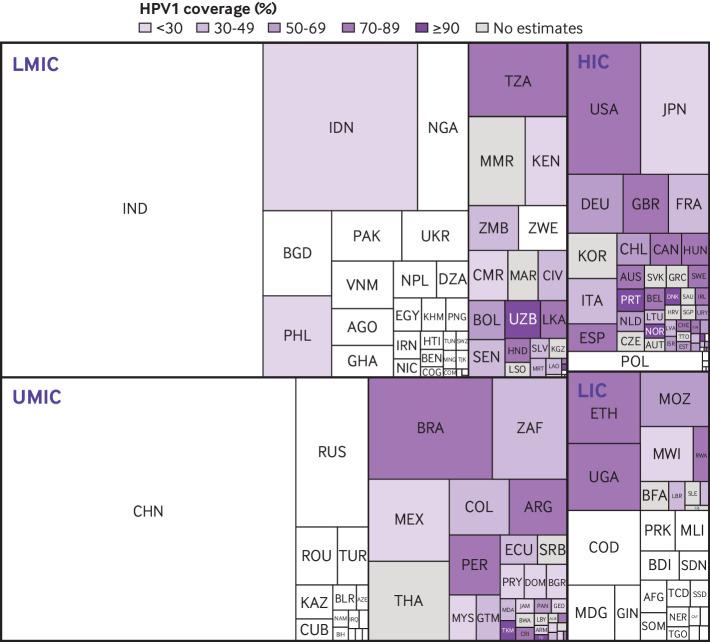
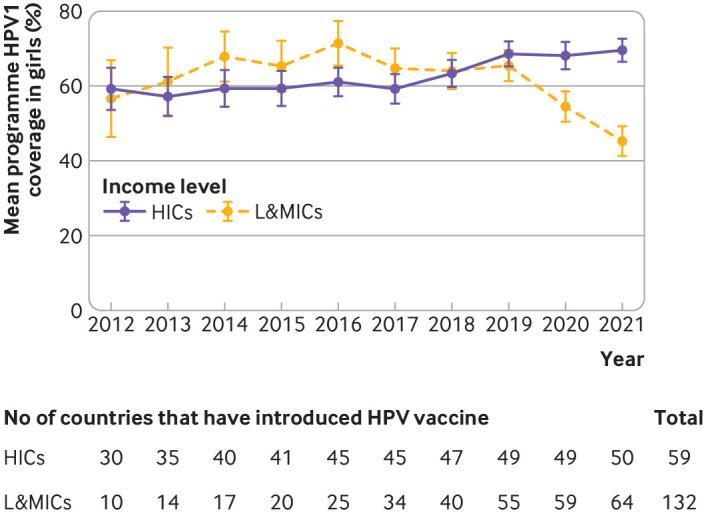
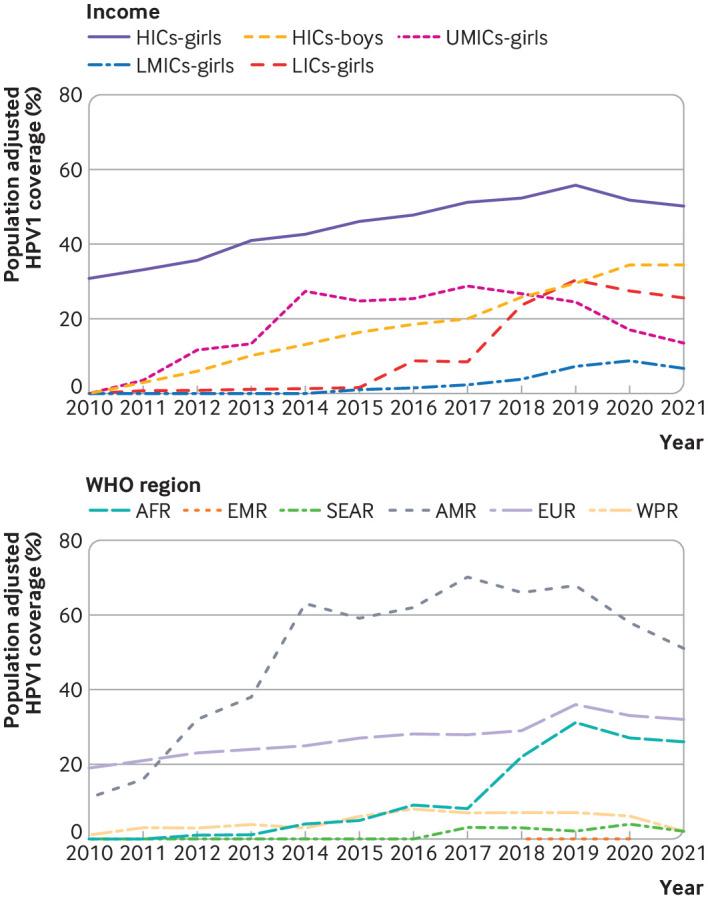
Mean coverage of HPV vaccination programmes among girls decreased from 65% in 2010-19 to 50% in 2020-21 in low and middle income countries compared with an increase in high income countries from 61% to 69% for the same periods. Population adjusted HPV1 coverage was higher among girls in high income countries before and during the covid-19 pandemic than in girls in low and middle income countries. During the covid-19 pandemic, population adjusted HPV1 coverage among boys in high income countries was higher and remained higher than coverage among girls in low and middle income countries. Globally, 23 countries recorded a severe reduction in their HPV programme (≥50% reduction in coverage), and another 3.8 million girls globally did not receive a HPV vaccine in countries with existing HPV vaccination programmes in 2020-21 compared with 2019. A reduction was seen in the annual rate of new introductions of national HPV vaccine programmes during 2020-21, affecting countries in all income categories, followed by an increase in introductions during 2022. During the second half of 2023, several low and middle income countries with large birth cohorts and a high relative burden of cervical cancer have yet to introduce HPV vaccination.
CONCLUSIONS
Although HPV vaccines have been available for more than 15 years, global HPV vaccination coverage is low. During the covid-19 pandemic period (2020-21 globally), worsening coverage, delayed introductions of national vaccine programmes, and an increase in missed girls globally (ie, girls who did not receive a HPV vaccine compared with the previous year in countries with an existing HPV vaccination programme) that disproportionately affected girls in low and middle income countries were found. Urgent and innovative recovery efforts are needed to accelerate national introduction of HPV vaccination programmes and achieve high coverage of HPV vaccination worldwide.
目的
分析2019冠状病毒病大流行期间全球人乳头瘤病毒(HPV)疫苗接种进展,特别关注公平性。
设计
对世界卫生组织-联合国儿童基金会疫苗接种覆盖率估计值进行描述性研究。
背景
世界卫生组织-联合国儿童基金会对2019冠状病毒病大流行之前(2010 - 2019年)和期间(2020 - 2021年)全球、区域和国家HPV疫苗接种覆盖率的估计。
参与者
在2019冠状病毒病大流行之前(2019年为1230万)和期间(2020 - 2021年,2021年为1060万)全球范围内接种HPV疫苗的9至14岁女孩。
主要观察指标
根据世界卫生组织-联合国儿童基金会对HPV疫苗接种覆盖率的估计,按国家、国家收入(世界银行收入类别)、性别和世界卫生组织区域划分,2019冠状病毒病大流行之前(2010 - 2019年)和期间(2020 - 2021年)首剂HPV疫苗(HPV1)的平均项目覆盖率和人群校正覆盖率。自2006年首个HPV疫苗获得许可以来每年新启动国家HPV疫苗计划的数量,基于向世界卫生组织-联合国儿童基金会报告的数据。2019年之前与2020 - 2021年2019冠状病毒病大流行期间接种疫苗的女孩数量。
结果
在低收入和中等收入国家,HPV疫苗接种计划在女孩中的平均覆盖率从2010 - 2019年的65%降至2020 - 2021年的50%,而高收入国家同期从61%增至69%。在2019冠状病毒病大流行之前和期间,高收入国家女孩的人群校正HPV1覆盖率高于低收入和中等收入国家女孩。在2019冠状病毒病大流行期间,高收入国家男孩的人群校正HPV1覆盖率高于低收入和中等收入国家女孩,且一直保持较高水平。全球有23个国家的HPV计划大幅缩减(覆盖率降低≥50%),2020 - 2021年与2019年相比,在已有HPV疫苗接种计划的国家中,全球另有380万女孩未接种HPV疫苗。2020 - 2021年国家HPV疫苗计划的年度新增率有所下降,所有收入类别的国家均受影响,随后在2022年新增率有所上升。在2023年下半年,几个拥有大量出生队列且宫颈癌相对负担较高的低收入和中等收入国家尚未引入HPV疫苗接种。
结论
尽管HPV疫苗已问世超过15年,但全球HPV疫苗接种覆盖率较低。在2019冠状病毒病大流行期间(2020 - 2021年全球范围),发现覆盖率恶化、国家疫苗计划引入延迟,以及全球未接种疫苗女孩数量增加(即在已有HPV疫苗接种计划的国家中,与上一年相比未接种HPV疫苗的女孩),低收入和中等收入国家女孩受影响尤为严重。需要采取紧急且创新的恢复措施,以加速各国引入HPV疫苗接种计划,并在全球实现HPV疫苗的高覆盖率。


 Zotero 插件