
他汀类药物强化治疗 2 型糖尿病合并轻度高胆固醇血症人群的适宜性:一项随机临床试验。
Appropriateness of Intensive Statin Treatment in People with Type Two Diabetes and Mild Hypercholesterolemia: A Randomized Clinical Trial.
机构信息
Endocrine Research Center, Institute of Endocrinology and Metabolism, Iran University of Medical Sciences (IUMS), Tehran, Iran.
Research Center for Prevention of Cardiovascular Disease, Institute of Endocrinology and Metabolism, Iran University of Medical Sciences (IUMS), Tehran, Iran.
出版信息
Arch Iran Med. 2023 Jun 1;26(6):290-299. doi: 10.34172/aim.2023.45.
BACKGROUND
The aim of this study was to compare moderate- versus high-intensity statin therapy in patients with type 2 diabetes and low-density lipoprotein (LDL) cholesterol less than 130 mg/dL.
METHODS
This was a randomized, open-label, parallel design trial comprised of 79 patients randomly allocated into two groups receiving high-intensity [atorvastatin 40 mg (A40) or rosuvastatin 20 mg (R20) daily] or moderate-intensity [atorvastatin 20 mg (A20) or rosuvastatin 10 (R10) mg daily] statins for eight weeks. The variables investigated were lipid profile, high sensitivity C-reactive protein (hs-CRP), and interleukin-6 (IL-6).
RESULTS
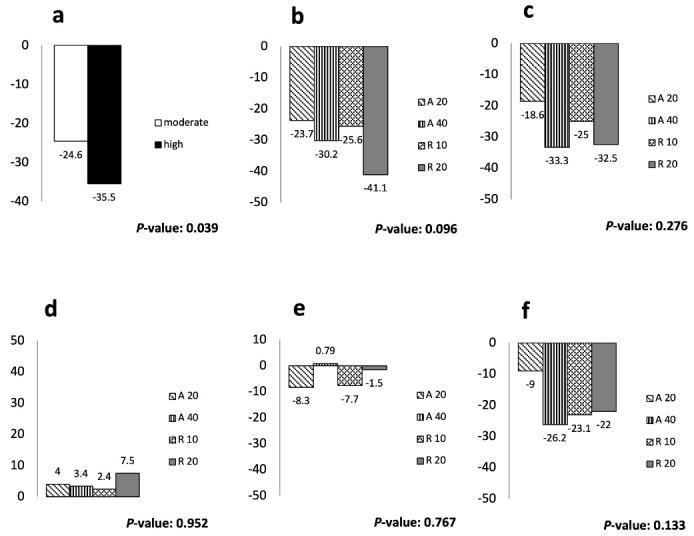
The percentage of decrease in LDL levels (±SD) for the high-intensity group (-35.5±25.5) was significantly greater than the moderate-intensity group (-24.6±23.5) (=0.04). While 38.1% (n:8) of patients receiving A20 and 55% (n:11) of those being on R10 achieved the targets of≥30% reduction in the LDL level, these figures were 63.2% (n=12) and 73.8% (n=14) for A40 and R20 subgroups, respectively. Subsequently, the likelihood of achieving LDL reduction≥30%, was significantly greater with high-intensity statin therapy (OR: 3.1, 95% CI: 1.09, 8.90, =0.03). Logistic regression analysis also showed that for every 1 mg/ dL increase in the baseline LDL level, the odds of achieving the LDL reduction≥30% increased by 1.04 times [95% CI: (1.01, 1.07), =0.003].
CONCLUSION
Despite the general conception, moderate-intensity statins are not adequate for the majority of patients with T2DM and mild hyperlipidemia and greater numbers of patients could reach the LDL cholesterol target with high-intensity statin therapy.
背景
本研究旨在比较 2 型糖尿病患者中 LDL 胆固醇<130mg/dL 时中强度与高强度他汀类药物治疗。
方法
这是一项随机、开放标签、平行设计的试验,共纳入 79 例患者,随机分为两组,分别接受高强度阿托伐他汀 40mg(A40)或瑞舒伐他汀 20mg(R20)每日治疗或中强度阿托伐他汀 20mg(A20)或瑞舒伐他汀 10mg(R10)每日治疗,疗程 8 周。研究变量包括血脂谱、高敏 C 反应蛋白(hs-CRP)和白细胞介素 6(IL-6)。
结果
高强度组 LDL 水平降低率(±SD)为-35.5±25.5%,明显大于中强度组-24.6±23.5%(=0.04)。A20 组有 38.1%(n:8)患者和 R10 组有 55%(n:11)患者达到 LDL 水平降低≥30%的目标,而 A40 组和 R20 组分别为 63.2%(n:12)和 73.8%(n:14)。因此,高强度他汀类药物治疗 LDL 降低≥30%的可能性显著增加(OR:3.1,95%CI:1.09,8.90,=0.03)。Logistic 回归分析还表明,基线 LDL 水平每增加 1mg/dL,达到 LDL 降低≥30%的几率增加 1.04 倍[95%CI:(1.01,1.07),=0.003]。
结论
尽管一般认为,中强度他汀类药物不能满足大多数 2 型糖尿病和轻度血脂异常患者的需要,更多患者可以通过高强度他汀类药物治疗达到 LDL 胆固醇目标。

 Zotero 插件