
抗 CD38 单克隆抗体可损害多发性骨髓瘤患者 CD34+细胞的动员,并影响其集落形成能力。
Anti-CD38 monoclonal antibody impairs CD34+ mobilization and affects clonogenic potential in multiple myeloma patients.
机构信息
Department of Medicine and Surgery, Milano-Bicocca University, Monza, Italy.
Hematology Division, Fondazione IRCCS San Gerardo dei Tintori Hospital, Monza, Italy.
出版信息
Blood Transfus. 2024 Jul;22(4):328-337. doi: 10.2450/BloodTransfus.667.
BACKGROUND
Induction with daratumumab-based regimens followed by autologous stem cell transplantation is the current standard for newly diagnosed multiple myeloma (NDMM) patients eligible for intensive chemotherapy. However, concerns emerged regarding potential negative effects following daratumumab-based treatment on CD34+ mobilization. We here compared CD34+ mobilization and clonogenic potential between daratumumab and non-daratumumab based therapy without upfront plerixafor administration among patients affected by NDMM.
MATERIALS AND METHODS
Clinical, mobilization and clonogenic data from 41 consecutively enrolled NDMM patients were analyzed. Patients underwent collection of autologous CD34+ by apheresis at the ASST Grande Ospedale Metropolitano Niguarda, Milan, Italy, from January 2021 to March 2023. Clonogenicity analysis was performed on BFU-E and CFU-GM.
RESULTS
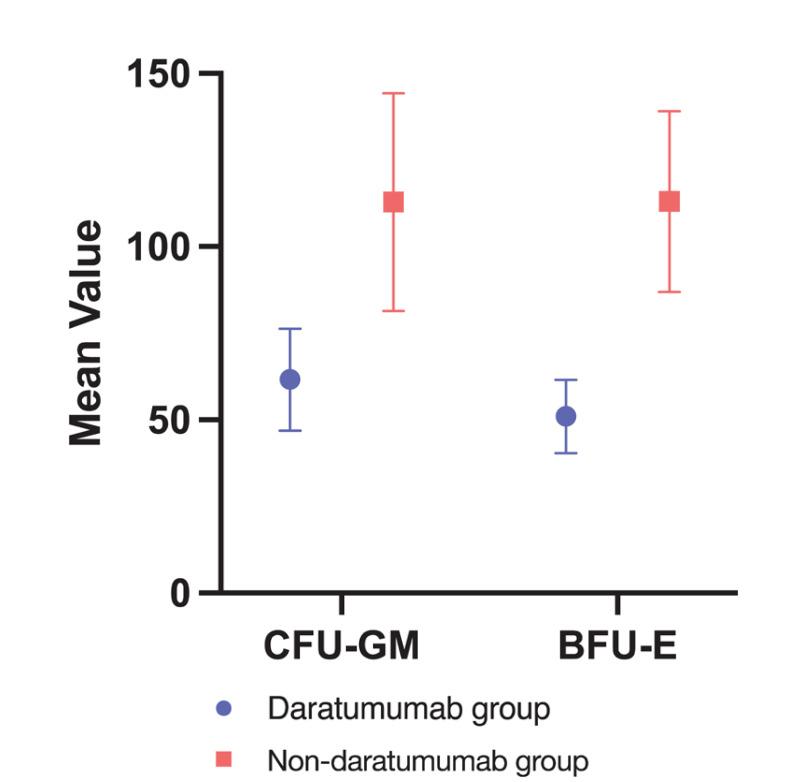
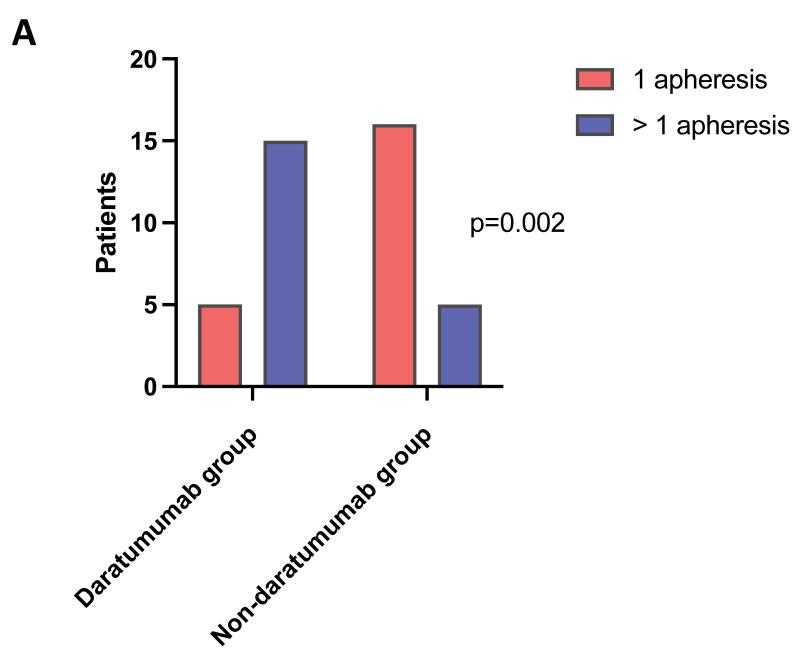
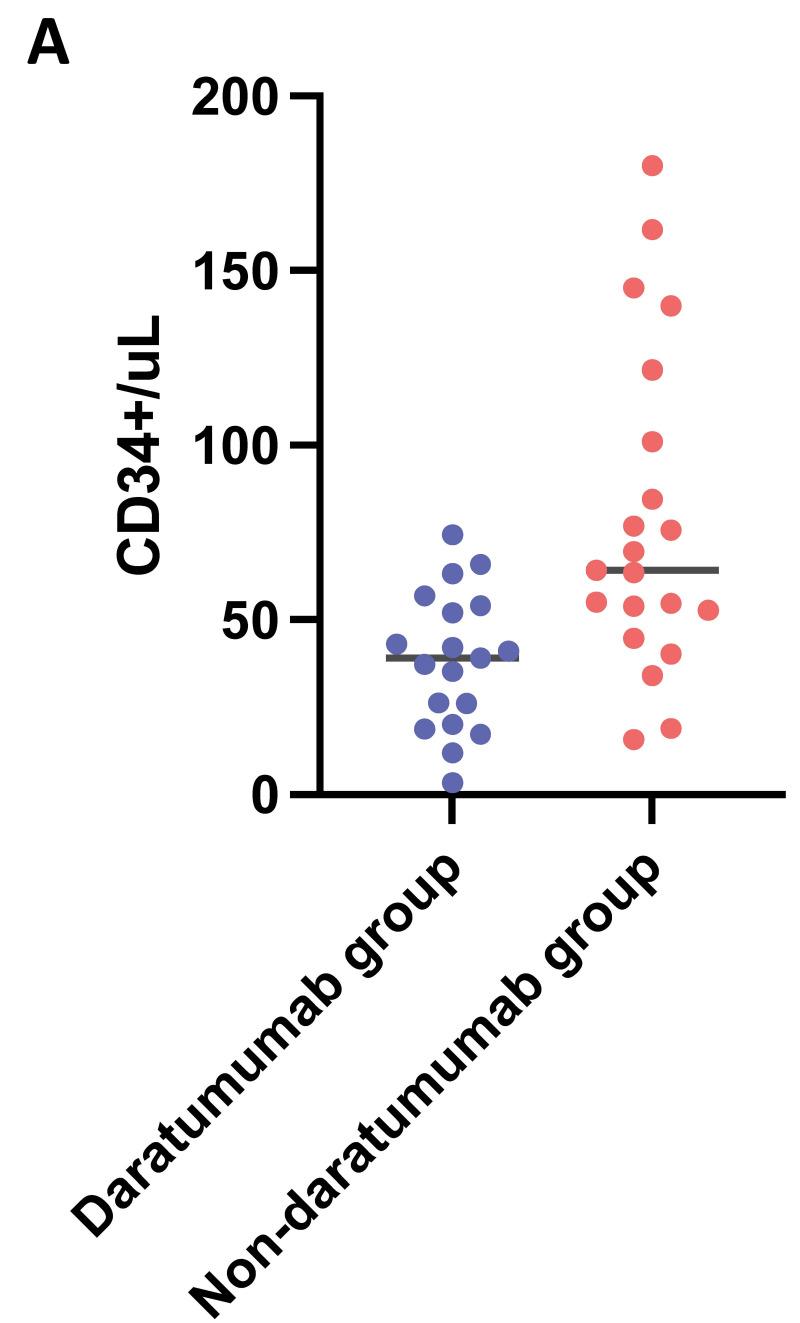
Seventy-five percent of daratumumab-treated patients underwent >1 apheresis, compared to 24% of non-daratumumab patients (p=0.0017). Daratumumab-treated patients had significantly lower CD34+ count (mean 38 vs 79/μL, respectively; p=0.0011), with a median CD34+ harvest of 3.98×10/kg (range 1.68-9.18) vs 6.87×10/kg (range 1.63-16.85) in non-daratumumab-treated (p=0.0006). In multivariate analysis the likelihood of undergoing >1 apheresis was significantly higher in older patients (OR 1.2, 95% CI 1-1.4, Z=2.10, p=0.03) and daratumumab-treated patients (OR 15, 95% CI 2.8-129, p=0.004). Moreover, daratumumab-based induction therapy demonstrated an independent negative association with BFU-E colony formation (p=0.0148), even when accounting for patient age and CD34+ levels.
DISCUSSION
Our findings underscore the impact of daratumumab-based treatment on CD34+ mobilization in a real-life, upfront plerixafor-free population of NDMM patients. Higher probability of requiring multiple apheresis occurred among daratumumab-treated patients. Interestingly, the observation that daratumumab might negatively impact BFU-E colony formation, independent of CD34+ cell count, offers novel biological perspectives. Appropriate strategies should be adopted by the Apheresis teams to mitigate these potential negative effects.
背景
对于适合强化化疗的新诊断多发性骨髓瘤(NDMM)患者,以达雷妥尤单抗为基础的方案诱导联合自体干细胞移植是目前的标准治疗方法。然而,在接受达雷妥尤单抗治疗后,人们对其对 CD34+动员的潜在负面影响表示担忧。在此,我们比较了在未预先使用培洛利珠单抗的情况下,达雷妥尤单抗与非达雷妥尤单抗治疗对 NDMM 患者 CD34+动员和集落生成潜能的影响。
材料与方法
分析了 41 例连续入组的 NDMM 患者的临床、动员和集落生成数据。这些患者于 2021 年 1 月至 2023 年 3 月在意大利米兰 ASST Grande Ospedale Metropolitano Niguarda 进行了自体 CD34+采集。对 BFU-E 和 CFU-GM 进行了集落生成分析。
结果
与非达雷妥尤单抗组患者(24%)相比,75%的达雷妥尤单抗治疗患者需要接受>1 次的单采(p=0.0017)。达雷妥尤单抗治疗组患者的 CD34+计数明显较低(分别为 38 与 79/μL;p=0.0011),且达雷妥尤单抗治疗组患者的中位 CD34+采集量为 3.98×10/kg(范围 1.68-9.18),而非达雷妥尤单抗治疗组患者的中位 CD34+采集量为 6.87×10/kg(范围 1.63-16.85)(p=0.0006)。在多变量分析中,老年患者(OR 1.2,95%CI 1-1.4,Z=2.10,p=0.03)和达雷妥尤单抗治疗患者(OR 15,95%CI 2.8-129,p=0.004)更有可能需要接受>1 次的单采。此外,达雷妥尤单抗诱导治疗与 BFU-E 集落形成呈独立的负相关(p=0.0148),即使考虑到患者年龄和 CD34+水平。
讨论
我们的研究结果强调了达雷妥尤单抗治疗对 NDMM 患者真实世界、无 upfront 培洛利珠单抗治疗中 CD34+动员的影响。达雷妥尤单抗治疗组患者需要多次单采的概率更高。有趣的是,达雷妥尤单抗可能会独立于 CD34+细胞计数对 BFU-E 集落形成产生负面影响,这为其提供了新的生物学视角。为减轻这些潜在的负面影响,应采取适当的策略来管理单采。


 Zotero 插件