
在猪模型中使用电阻抗断层扫描测量无创心输出量和每搏输出量与有创方法的比较。
Comparison of noninvasive cardiac output and stroke volume measurements using electrical impedance tomography with invasive methods in a swine model.
作者信息
Chung Chi Ryang, Ko Ryoung Eun, Jang Geuk Young, Lee Kyounghun, Suh Gee Young, Kim Yongmin, Woo Eung Je
机构信息
Department of Critical Care Medicine, Samsung Medical Center, Sungkyunkwan University School of Medicine, Seoul, Korea.
Department of Biomedical Engineering, College of Medicine, Kyung Hee University, 26 Kyungheedae-ro, Dongdaemun-gu, Seoul, 02447, Korea.
出版信息
Sci Rep. 2024 Feb 5;14(1):2962. doi: 10.1038/s41598-024-53488-0.
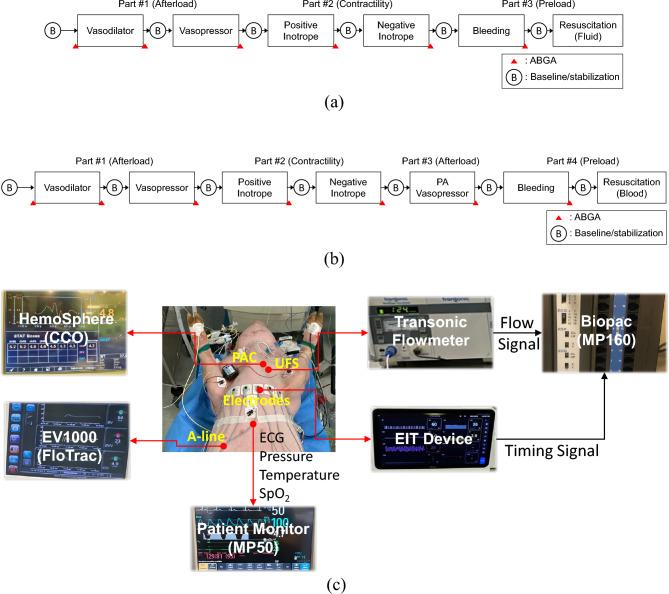
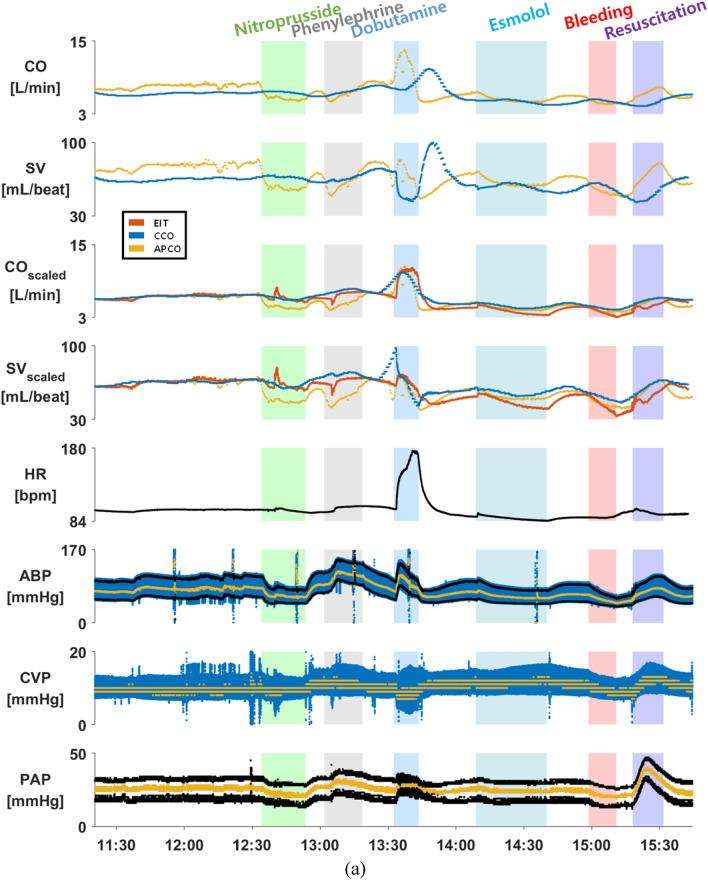
Pulmonary artery catheterization (PAC) has been used as a clinical standard for cardiac output (CO) measurements on humans. On animals, however, an ultrasonic flow sensor (UFS) placed around the ascending aorta or pulmonary artery can measure CO and stroke volume (SV) more accurately. The objective of this paper is to compare CO and SV measurements using a noninvasive electrical impedance tomography (EIT) device and three invasive devices using UFS, PAC-CCO (continuous CO) and arterial pressure-based CO (APCO). Thirty-two pigs were anesthetized and mechanically ventilated. A UFS was placed around the pulmonary artery through thoracotomy in 11 of them, while the EIT, PAC-CCO and APCO devices were used on all of them. Afterload and contractility were changed pharmacologically, while preload was changed through bleeding and injection of fluid or blood. Twenty-three pigs completed the experiment. Among 23, the UFS was used on 7 pigs around the pulmonary artery. The percentage error (PE) between CO and CO was 26.1%, and the 10-min concordance was 92.5%. Between SV and SV, the PE was 24.8%, and the 10-min concordance was 94.2%. On analyzing the data from all 23 pigs, the PE between time-delay-adjusted CO and CO was 34.6%, and the 10-min concordance was 81.1%. Our results suggest that the performance of the EIT device in measuring dynamic changes of CO and SV on mechanically-ventilated pigs under different cardiac preload, afterload and contractility conditions is at least comparable to that of the PAC-CCO device. Clinical studies are needed to evaluate the utility of the EIT device as a noninvasive hemodynamic monitoring tool.
肺动脉导管插入术(PAC)一直被用作测量人体心输出量(CO)的临床标准。然而,对于动物,置于升主动脉或肺动脉周围的超声流量传感器(UFS)能够更准确地测量心输出量和每搏输出量(SV)。本文的目的是比较使用无创电阻抗断层成像(EIT)设备与三种使用UFS的侵入性设备、PAC连续心输出量监测仪(PAC-CCO)和基于动脉压的心输出量监测仪(APCO)来测量心输出量和每搏输出量的情况。32头猪被麻醉并进行机械通气。其中11头猪通过开胸手术将UFS置于肺动脉周围,而所有猪均使用EIT、PAC-CCO和APCO设备。通过药物改变后负荷和收缩力,同时通过放血以及输注液体或血液来改变前负荷。23头猪完成了实验。在这23头猪中,7头猪在肺动脉周围使用了UFS。心输出量测量值之间的百分比误差(PE)为26.1%,10分钟的一致性为92.5%。每搏输出量测量值之间的百分比误差为24.8%,10分钟的一致性为94.2%。在分析所有23头猪的数据时,经延时调整的心输出量测量值与实际心输出量之间的百分比误差为34.6%,10分钟的一致性为81.1%。我们的结果表明,在不同心脏前负荷、后负荷和收缩力条件下,EIT设备在测量机械通气猪的心输出量和每搏输出量动态变化方面的性能至少与PAC-CCO设备相当。需要开展临床研究来评估EIT设备作为无创血流动力学监测工具的实用性。


 Zotero 插件