
什么因素预测了妇女选择在医疗机构分娩?来自 2021 年马达加斯加人口与健康调查的分析。
What predicts health facility delivery among women? analysis from the 2021 Madagascar Demographic and Health Survey.
机构信息
Department of Population and Development, National Research University - Higher School of Economics, Moscow, Russia.
Population Dynamics Sexual and Reproductive Health Unit, African Population and Health Research Center, Nairobi, Kenya.
出版信息
BMC Pregnancy Childbirth. 2024 Feb 7;24(1):116. doi: 10.1186/s12884-024-06252-1.
BACKGROUND
One of the pivotal determinants of maternal and neonatal health outcomes hinges on the choice of place of delivery. However, the decision to give birth within the confines of a health facility is shaped by a complex interplay of sociodemographic, economic, cultural, and healthcare system-related factors. This study examined the predictors of health facility delivery among women in Madagascar.
METHODS
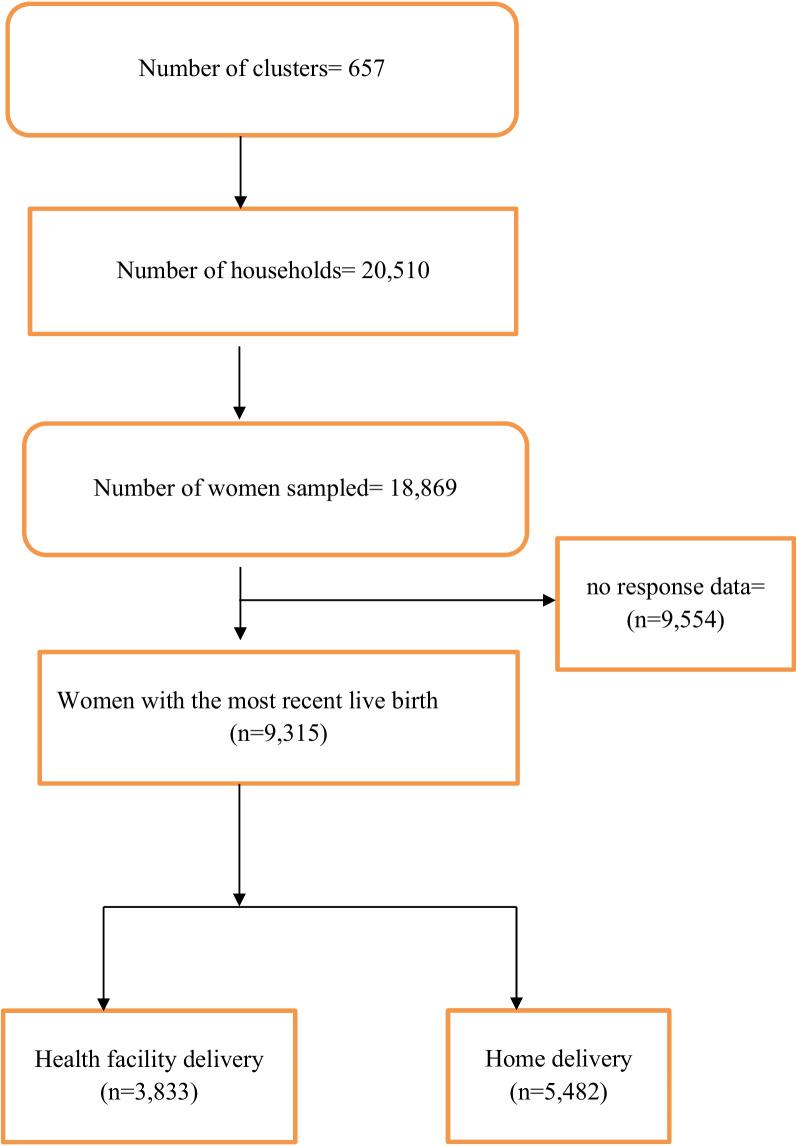
We used data from the 2021 Madagascar Demographic and Health Survey. A total of 9,315 women who had a health facility delivery or delivered elsewhere for the most recent live birth preceding the survey were considered in this analysis. Descriptive analysis, and multilevel regression were carried out to determine the prevalence and factors associated with health facility delivery. The results were presented as frequencies, percentages, crude odds ratios and adjusted odds ratios (aORs) with corresponding 95% confidence intervals (CIs), and a p-value < 0.05 was used to declare statistical significance.
RESULTS
The prevalence of health facility delivery was 41.2% [95% CI: 38.9-43.5%]. In the multilevel analysis, women aged 45-49 [aOR = 2.14, 95% CI = 1.34-3.43], those with secondary/higher education [aOR = 1.62, 95% CI = 1.30-2.01], widowed [aOR = 2.25, 95% CI = 1.43-3.58], and those exposed to mass media [aOR = 1.18, 95% CI = 1.00-1.39] had higher odds of delivering in health facilities compared to those aged 15-49, those with no formal education, women who had never been in union and not exposed to mass media respectively. Women with at least an antenatal care visit [aOR = 6.95, 95% CI = 4.95-9.77], those in the richest wealth index [aOR = 2.74, 95% CI = 1.99-3.77], and women who considered distance to health facility as not a big problem [aOR = 1.28, 95% CI = 1.09-1.50] were more likely to deliver in health facilities compared to those who had no antenatal care visit. Women who lived in communities with high literacy levels [aOR = 1.54, 95% CI = 1.15-2.08], and women who lived in communities with high socioeconomic status [aOR = 1.72, 95% CI = 1.28-2.31] had increased odds of health facility delivery compared to those with low literacy levels and in communities with low socioeconomic status respectively.
CONCLUSION
The prevalence of health facility delivery among women in Madagascar is low in this study. The findings of this study call on stakeholders and the government to strengthen the healthcare system of Madagascar using the framework for universal health coverage. There is also the need to implement programmes and interventions geared towards increasing health facility delivery among adolescent girls and young women, women with no formal education, and those not exposed to media. Also, consideration should be made to provide free maternal health care and a health insurance scheme that can be accessed by women in the poorest wealth index. Health facilities should be provided at places where women have challenges with distance to other health facilities. Education on the importance of antenatal care visits should also be encouraged, especially among women with low literacy levels and in communities with low socioeconomic status.
背景
产妇和新生儿健康结果的关键决定因素之一取决于分娩地点的选择。然而,在卫生机构内分娩的决定受到社会人口、经济、文化和医疗保健系统相关因素的复杂相互作用的影响。本研究调查了马达加斯加妇女选择在卫生机构分娩的预测因素。
方法
我们使用了 2021 年马达加斯加人口与健康调查的数据。共有 9315 名在调查前最近一次活产中在卫生机构分娩或在其他地方分娩的妇女被纳入本分析。进行了描述性分析和多水平回归,以确定卫生机构分娩的流行率和相关因素。结果以频率、百分比、粗比值比和调整比值比(aOR)及其相应的 95%置信区间(CI)和 p 值<0.05 表示,用于宣布统计学意义。
结果
卫生机构分娩的流行率为 41.2%[95%CI:38.9-43.5%]。在多水平分析中,年龄在 45-49 岁的妇女[aOR=2.14,95%CI=1.34-3.43]、接受过中等/高等教育的妇女[aOR=1.62,95%CI=1.30-2.01]、丧偶的妇女[aOR=2.25,95%CI=1.43-3.58]和接触过大众媒体的妇女[aOR=1.18,95%CI=1.00-1.39]与年龄在 15-49 岁、没有接受过正规教育、从未结婚和没有接触过大众媒体的妇女相比,更有可能在卫生机构分娩。至少接受过一次产前护理的妇女[aOR=6.95,95%CI=4.95-9.77]、最富裕的财富指数的妇女[aOR=2.74,95%CI=1.99-3.77]和认为距离卫生机构不是大问题的妇女[aOR=1.28,95%CI=1.09-1.50]与没有接受过产前护理的妇女相比,更有可能在卫生机构分娩。生活在高识字水平社区的妇女[aOR=1.54,95%CI=1.15-2.08]和生活在高社会经济地位社区的妇女[aOR=1.72,95%CI=1.28-2.31]与识字水平低和社会经济地位低的社区相比,更有可能在卫生机构分娩。
结论
马达加斯加妇女在本研究中的卫生机构分娩率较低。本研究的结果呼吁利益相关者和政府利用全民健康覆盖框架加强马达加斯加的医疗保健系统。还需要实施旨在增加少女和年轻妇女、没有接受过正规教育的妇女和没有接触过媒体的妇女在卫生机构分娩的方案和干预措施。此外,应考虑为最贫穷的财富指数的妇女提供免费产妇保健和可获得的健康保险计划。应在妇女难以到达其他卫生机构的地方提供医疗设施。还应鼓励接受产前护理的重要性教育,特别是在识字水平低和社会经济地位低的社区。


 Zotero 插件