
气候变化对欧洲西尼罗河病毒空间扩张的贡献。
Contribution of climate change to the spatial expansion of West Nile virus in Europe.
机构信息
Spatial Epidemiology Lab (SpELL), Université Libre de Bruxelles, Brussels, Belgium.
Department of Water and Climate, Vrije Universiteit Brussel, Brussels, Belgium.
出版信息
Nat Commun. 2024 Feb 8;15(1):1196. doi: 10.1038/s41467-024-45290-3.
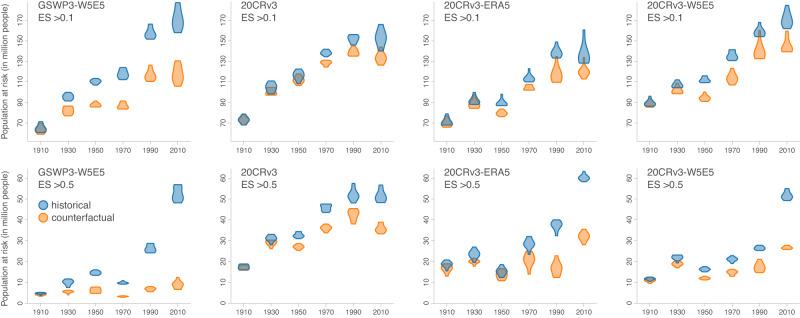
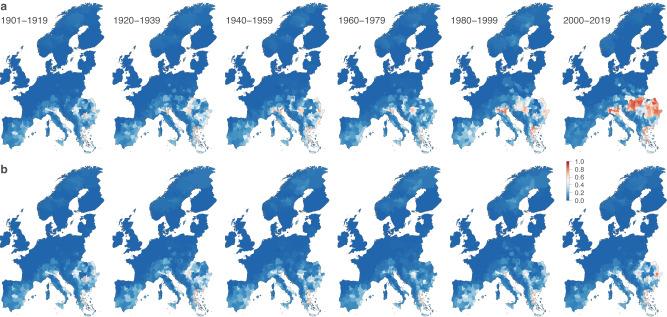
West Nile virus (WNV) is an emerging mosquito-borne pathogen in Europe where it represents a new public health threat. While climate change has been cited as a potential driver of its spatial expansion on the continent, a formal evaluation of this causal relationship is lacking. Here, we investigate the extent to which WNV spatial expansion in Europe can be attributed to climate change while accounting for other direct human influences such as land-use and human population changes. To this end, we trained ecological niche models to predict the risk of local WNV circulation leading to human cases to then unravel the isolated effect of climate change by comparing factual simulations to a counterfactual based on the same environmental changes but a counterfactual climate where long-term trends have been removed. Our findings demonstrate a notable increase in the area ecologically suitable for WNV circulation during the period 1901-2019, whereas this area remains largely unchanged in a no-climate-change counterfactual. We show that the drastic increase in the human population at risk of exposure is partly due to historical changes in population density, but that climate change has also been a critical driver behind the heightened risk of WNV circulation in Europe.
西尼罗河病毒(WNV)是一种在欧洲新兴的蚊媒病原体,它对公共健康构成了新的威胁。虽然气候变化被认为是其在欧洲大陆空间扩张的潜在驱动因素,但对这种因果关系的正式评估还缺乏。在这里,我们研究了气候变化在多大程度上可以解释欧洲 WNV 空间扩张,同时考虑到土地利用和人口变化等其他直接人为因素的影响。为此,我们训练了生态位模型来预测当地 WNV 循环导致人类病例的风险,然后通过将实际模拟与基于相同环境变化但长期趋势已被消除的假设气候的反事实模拟进行比较,来揭示气候变化的单独影响。我们的研究结果表明,在 1901 年至 2019 年期间,WNV 循环的生态适宜面积显著增加,而在没有气候变化的反事实情况下,这个区域基本保持不变。我们表明,暴露风险大幅增加的人口主要是由于人口密度的历史变化,但气候变化也是欧洲 WNV 循环风险增加的关键驱动因素。
 Zotero 插件