
2%羟丙基甲基纤维素和绷带式隐形眼镜用于白内障手术后干眼疾病管理的疗效
Efficacy of 2% Hydroxypropyl Methylcellulose and Bandage Contact Lens for the Management of Dry Eye Disease after Cataract Surgery.
作者信息
Zhao Tianyao, Jiang Xiaodan, Hao Ran, Ding Yi, Jing Dalan, Li Xuemin
机构信息
Department of Ophthalmology, Peking University Third Hospital, Beijing, China.
Beijing Tongren Eye Center, Beijing Tongren Hospital, Capital Medical University, Beijing, China.
出版信息
J Ophthalmol. 2024 Feb 1;2024:8415425. doi: 10.1155/2024/8415425. eCollection 2024.
OBJECTIVES
To investigate the effect of 2% hydroxypropyl methylcellulose (HPMC) and bandage contact lens (BCL) on dry eye disease after cataract surgery.
METHODS
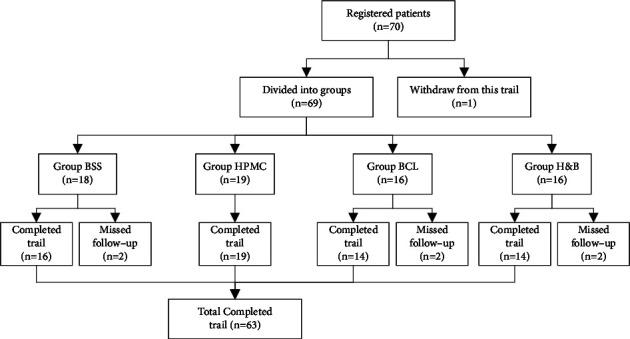
This prospective randomized controlled trial included 63 eyes which were divided into the balanced salt solution (BSS), HPMC, BCL, and combined HPMC and BCL (H&B) groups. The Ocular Surface Disease Index (OSDI), tear meniscus height (TMH), and average tear break-up time were measured before cataract surgery and 30 days postoperatively. Differences in corneal nerve fiber (CNF) and dendritic cell (DC) density in various directions were evaluated and compared. The CNFs and DCs in central and infratemporal directions were observed using confocal microscopy. Data were evaluated using the Kruskal-Wallis rank-sum test and analysis of variance.
RESULTS
The differences in variations in OSDI and TMH after cataract surgery between the four groups were statistically significant ( < 0.05). The postoperative OSDI of the HPMC group decreased compared with their preoperative OSDI. A statistically significant difference in the variations of OSDI score was observed between the HPMC and other groups ( < 0.05). The postoperative variations in TMH in the HPMC group were significantly higher than those observed preoperatively and significantly differed between HPMC and BCL groups and between BCL and H&B groups ( < 0.05). Postoperatively, the density of corneal DCs decreased in BSS and HPMC groups and increased in BCL and H&B groups ( < 0.001).
CONCLUSIONS
The application of 2% HPMC in cataract surgery has a certain effect on managing dry eye after cataract surgery. Although the use of BCLs after cataract surgery has some benefits, it may cause mild ocular surface inflammation. Nevertheless, using 2% HPMC with BCLs in the perioperative phase of cataract surgery can alleviate the subjective discomfort of patients and can safely and effectively replace eye patch after cataract surgery.
目的
探讨2%羟丙基甲基纤维素(HPMC)和绷带式隐形眼镜(BCL)对白内障手术后干眼症的影响。
方法
这项前瞻性随机对照试验纳入了63只眼,分为平衡盐溶液(BSS)组、HPMC组、BCL组和HPMC与BCL联合(H&B)组。在白内障手术前及术后30天测量眼表疾病指数(OSDI)、泪膜半月板高度(TMH)和平均泪膜破裂时间。评估并比较不同方向角膜神经纤维(CNF)和树突状细胞(DC)密度的差异。使用共聚焦显微镜观察中央和颞下方向的CNF和DC。采用Kruskal-Wallis秩和检验和方差分析对数据进行评估。
结果
四组白内障手术后OSDI和TMH变化的差异具有统计学意义(P<0.05)。HPMC组术后OSDI较术前降低。HPMC组与其他组之间OSDI评分变化存在统计学显著差异(P<0.05)。HPMC组术后TMH变化显著高于术前,且与BCL组以及BCL组与H&B组之间存在显著差异(P<0.05)。术后,BSS组和HPMC组角膜DC密度降低,BCL组和H&B组角膜DC密度增加(P<0.001)。
结论
白内障手术中应用2% HPMC对白内障手术后干眼症的处理有一定作用。虽然白内障手术后使用BCL有一些益处,但可能会引起轻度眼表炎症。然而,在白内障手术围手术期将2% HPMC与BCL联合使用可减轻患者的主观不适,并且可以安全有效地替代白内障手术后的眼罩。

 Zotero 插件