
早期生命体型和青春期标志物作为预测晚年乳腺癌风险的指标:一项神经网络分析。
Early life body size and puberty markers as predictors of breast cancer risk later in life: A neural network analysis.
机构信息
Center for Clinical Research and Prevention, Copenhagen University Hospital-Bispebjerg and Frederiksberg, Copenhagen, Denmark.
Danish Cancer Institute, Copenhagen, Denmark.
出版信息
PLoS One. 2024 Feb 9;19(2):e0296835. doi: 10.1371/journal.pone.0296835. eCollection 2024.
BACKGROUND
The early life factors of birthweight, child weight, height, body mass index (BMI) and pubertal timing are associated with risks of breast cancer. However, the predictive value of these factors in relation to breast cancer is largely unknown. Therefore, using a machine learning approach, we examined whether birthweight, childhood weights, heights, BMIs, and pubertal timing individually and in combination were predictive of breast cancer.
METHODS
We used information on birthweight, childhood height and weight, and pubertal timing assessed by the onset of the growth spurt (OGS) from 164,216 girls born 1930-1996 from the Copenhagen School Health Records Register. Of these, 10,002 women were diagnosed with breast cancer during 1977-2019 according to a nationwide breast cancer database. We developed a feed-forward neural network, which was trained and tested on early life body size measures individually and in various combinations. Evaluation metrics were examined to identify the best performing model.
RESULTS
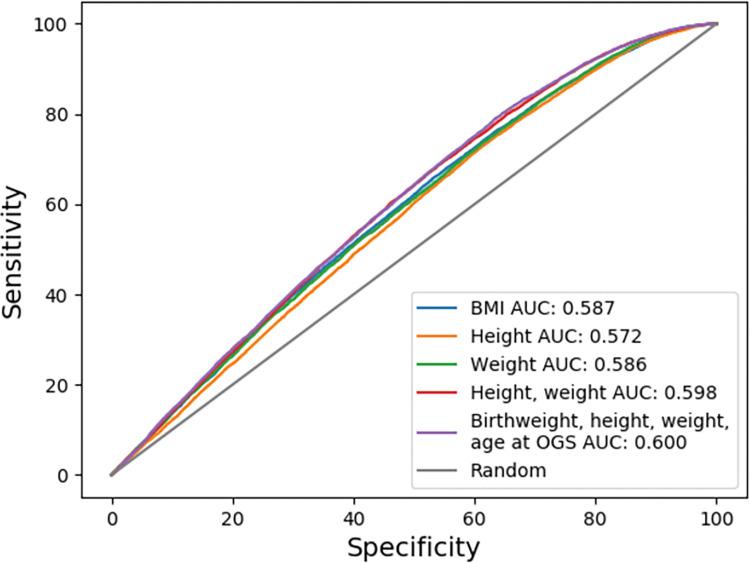
The highest area under the receiver operating curve (AUC) was achieved in a model that included birthweight, childhood heights, weights and age at OGS (AUC = 0.600). A model based on childhood heights and weights had a comparable AUC value (AUC = 0.598), whereas a model including only childhood heights had the lowest AUC value (AUC = 0.572). The sensitivity of the models ranged from 0.698 to 0.760 while the precision ranged from 0.071 to 0.076.
CONCLUSION
We found that the best performing network was based on birthweight, childhood weights, heights and age at OGS as the input features. Nonetheless, this performance was only slightly better than the model including childhood heights and weights. Further, although the performance of our networks was relatively low, it was similar to those from previous studies including well-established risk factors. As such, our results suggest that childhood body size may add additional value to breast cancer prediction models.
背景
出生体重、儿童体重、身高、体重指数(BMI)和青春期时间等早期生命因素与乳腺癌风险相关。然而,这些因素与乳腺癌的预测价值在很大程度上尚不清楚。因此,我们采用机器学习方法,检查出生体重、儿童期体重和身高、青春期时间单独和组合是否可预测乳腺癌。
方法
我们使用了来自哥本哈根学校健康记录登记处的 1930-1996 年出生的 164216 名女孩的出生体重、儿童期身高和体重以及青春期时间(由生长突增开始评估)信息。其中,根据全国乳腺癌数据库,1977-2019 年期间有 10002 名女性被诊断患有乳腺癌。我们开发了一个前馈神经网络,该网络在单独和各种组合的早期生命体型测量值上进行了训练和测试。评估指标用于确定表现最佳的模型。
结果
在包含出生体重、儿童期身高、体重和 OGS 年龄的模型中,获得了最高的接收者操作特征曲线(AUC)面积(AUC=0.600)。基于儿童期身高和体重的模型具有相当的 AUC 值(AUC=0.598),而仅包含儿童期身高的模型具有最低的 AUC 值(AUC=0.572)。模型的灵敏度范围为 0.698 至 0.760,而精度范围为 0.071 至 0.076。
结论
我们发现表现最佳的网络基于出生体重、儿童期体重、身高和 OGS 年龄作为输入特征。尽管如此,这种表现仅略优于包含儿童期身高和体重的模型。此外,尽管我们网络的性能相对较低,但与包括既定风险因素的先前研究相似。因此,我们的研究结果表明,儿童期体型可能为乳腺癌预测模型增加额外的价值。


 Zotero 插件