
在 48 周内,Vamorolone 在患有杜氏肌营养不良症的男孩中的疗效和安全性:一项随机对照试验。
Efficacy and Safety of Vamorolone Over 48 Weeks in Boys With Duchenne Muscular Dystrophy: A Randomized Controlled Trial.
机构信息
From Carleton University (U.J.D.), Ottawa, Ontario, Canada; ReveraGen BioPharma (J.M.D., J.N.V.D.A., E.P.H.), Rockville, MD; John Walton Muscular Dystrophy Research Centre (M.G., V.S.), Newcastle Hospitals NHS Foundation Trust and Newcastle University, United Kingdom; University of Pittsburgh School of Medicine and Department of Veterans Affairs Medical Center (P.R.C.), PA; University of Washington School of Medicine (S.J.P.), Seattle; Duke University School of Medicine (E.C.S.), Durham, NC; Royal Hospital for Children (I.H.), Glasgow, United Kingdom; Nemours Children's Hospital (R.S.F.), Orlando, FL. Dr. Finkel is now with St. Jude Children's Research Hospital, Memphis, TN; Alberta Children's Hospital Research Institute (J.K.M.), University of Calgary, Canada; Neuromuscular Reference Center (NMRC) (N.D.), UZ Ghent; KU Leuven Department of Development and Regeneration (N.M.G., L.D.W.); Department of Paediatric Neurology (N.M.G., L.D.W.), University Hospitals Leuven, Belgium; Neuromuscular Centre (J.H.), Department of Pediatric Neurology Motol University Hospital; 2nd School of Medicine Charles University in Prague (J.H.), Czech Republic; The Camden Group (L.M.-G., B.D.S.), St. Louis, MO; Children's Hospital of Richmond (A.H.), Richmond, VA; UCLA Medical School (P.B.S.), Los Angeles, CA; UT Southwestern Medical Center (D.C.), Dallas, TX; University of Colorado School of Medicine (M.L.Y.), Children's Hospital Colorado, Aurora; The Royal Children's Hospital (M.M.R.); Murdoch Children's Research Institute (M.M.R.), Melbourne, Victoria, Australia; University of California, Davis (C.M.M.), Sacramento; Queen Silvia Children's Hospital (M.T.), Gothenburg, Sweden; Kids Neuroscience Centre (R.I.W.), The Children's Hospital at Westmead, Australia; University of Ottawa (H.J.M.), Ontario, Canada; Ann & Robert H. Lurie Children's Hospital (N.K., V.K.R.), Chicago, IL; The Dubowitz Neuromuscular Centre (G.B.), National Institute for Health Research Great Ormond Street Hospital Biomedical Research Centre, Great Ormond Street Institute of Child Health University College, London; Alder Hey Children's NHS Foundation Trust (S.S.), Liverpool; Leeds Teaching Hospitals Trust (A.-M.C.), United Kingdom; Montreal Children's Hospital (A.M.S.), Quebec; BC Children's Hospital Research Institute (K.A.S.), Vancouver, Canada; Nemours Children's Hospital (M.M.), Orlando, FL. Dr. Monduy is now with Nicklaus Children's Hospital, Miami, FL; Schneider Children's Medical Center (Y.N.), Tel Aviv University, Israel; Hospital Quirónsalud Valencia (J.J.V.), Spain; Neuropaediatrics Department (A.N.-O.), Institut de Recerca Pediàtrica Hospital Sant Joan de Déu, Barcelona, Spain; Department of Neurology (E.H.N.), Leiden University Medical Center; Radboud University Medical Center (I.J.M.D.G.), Nijmegen, the Netherlands; "P&A Kyriakou" Children's Hospital (M.K.), Athens, Greece; Children's National Medical Center (J.N.V.D.A.), Washington, DC; Children's Hospital of Eastern Ontario (CHEO) Research Institute (L.M.W.), Ottawa, Ontario, Canada; Santhera Pharmaceuticals (M.L.), Prattein, Switzerland; TRiNDS (A.L.D.A.), Pittsburgh, PA; and Binghamton University-State University of New York (E.P.H.), Binghamton.
出版信息
Neurology. 2024 Mar 12;102(5):e208112. doi: 10.1212/WNL.0000000000208112. Epub 2024 Feb 9.
BACKGROUND AND OBJECTIVES
Vamorolone is a dissociative agonist of the glucocorticoid receptor that has shown similar efficacy and reduced safety concerns in comparison with prednisone in Duchenne muscular dystrophy (DMD). This study was conducted to determine the efficacy and safety of vamorolone over 48 weeks and to study crossover participants (prednisone to vamorolone; placebo to vamorolone).
METHODS
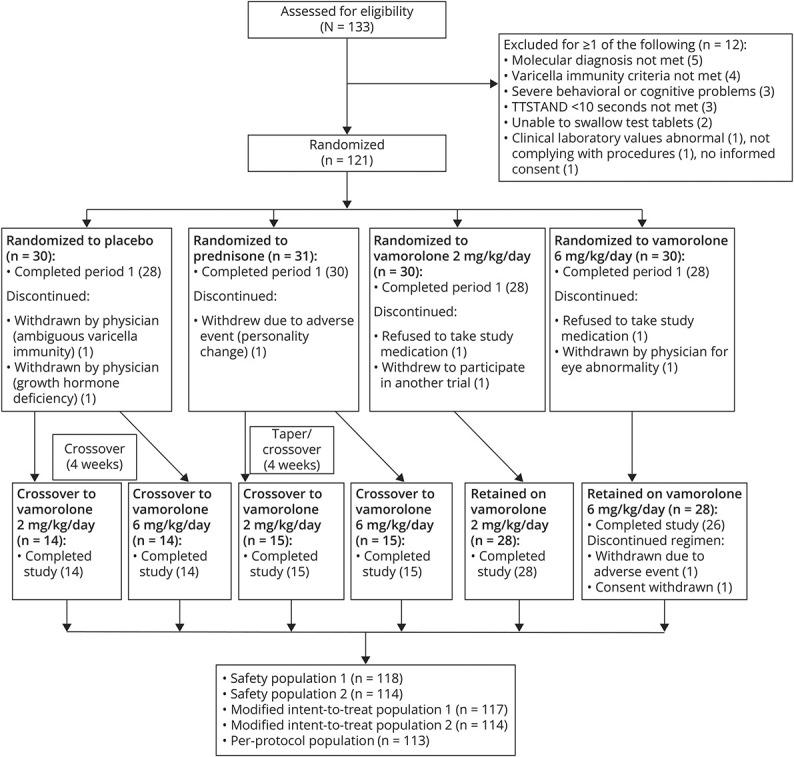
A randomized, double-blind, placebo-controlled and prednisone-controlled clinical trial of 2 doses of vamorolone was conducted in participants with DMD, in the ages from 4 years to younger than 7 years at baseline. The interventions were 2 mg/kg/d of vamorolone and 6 mg/kg/d of vamorolone for 48 weeks (period 1: 24 weeks + period 2: 24 weeks) and 0.75 mg/kg/d of prednisone and placebo for the first 24 weeks (before crossover). Efficacy was evaluated through gross motor outcomes and safety through adverse events, growth velocity, body mass index (BMI), and bone turnover biomarkers. This analysis focused on period 2.
RESULTS
A total of 121 participants with DMD were randomized. Vamorolone at a dose of 6 mg/kg/d showed maintenance of improvement for all motor outcomes to week 48 (e.g., for primary outcome, time to stand from supine [TTSTAND] velocity, week 24 least squares mean [LSM] [SE] 0.052 [0.0130] rises/s vs week 48 LSM [SE] 0.0446 [0.0138]). After 48 weeks, vamorolone at a dose of 2 mg/kg/d showed similar improvements as 6 mg/kg/d for North Star Ambulatory Assessment (NSAA) (vamorolone 6 mg/kg/d-vamorolone 2 mg/kg/d LSM [SE] 0.49 [1.14]; 95% CI -1.80 to 2.78, = 0.67), but less improvement for other motor outcomes. The placebo to vamorolone 6 mg/kg/d group showed rapid improvements after 20 weeks of treatment approaching benefit seen with 48-week 6 mg/kg/d of vamorolone treatment for TTSTAND, time to run/walk 10 m, and NSAA. There was significant improvement in linear growth after crossover in the prednisone to vamorolone 6 mg/kg/d group, and rapid reversal of prednisone-induced decline in bone turnover biomarkers in both crossover groups. There was an increase in BMI after 24 weeks of treatment that then stabilized for both vamorolone groups.
DISCUSSION
Improvements of motor outcomes seen with 6 mg/kg/d of vamorolone at 24 weeks of treatment were maintained to 48 weeks of treatment. Vamorolone at a dose of 6 mg/kg/d showed better maintenance of effect compared with vamorolone at a dose of 2 mg/kg/d for most (3/5) motor outcomes. Bone morbidities of prednisone (stunting of growth and declines in serum bone biomarkers) were reversed when treatment transitioned to vamorolone.
TRIAL REGISTRATION INFORMATION
ClinicalTrials.gov Identifier: NCT03439670.
CLASSIFICATION OF EVIDENCE
This study provides Class I evidence that for boys with DMD, the efficacy of vamorolone at a dose of 6 mg/kg/d was maintained over 48 weeks.
背景与目的
Vamorolone 是一种糖皮质激素受体的离解激动剂,与泼尼松龙相比,在杜氏肌营养不良症(DMD)中显示出相似的疗效和降低的安全性问题。本研究旨在确定 vamorolone 在 48 周内的疗效和安全性,并研究交叉参与者(泼尼松龙到 vamorolone;安慰剂到 vamorolone)。
方法
在基线年龄为 4 岁以下至 7 岁的 DMD 参与者中进行了一项随机、双盲、安慰剂对照和泼尼松龙对照的 2 种 vamorolone 剂量的临床试验。干预措施为 2mg/kg/d 的 vamorolone 和 6mg/kg/d 的 vamorolone,共 48 周(第 1 期:24 周+第 2 期:24 周),以及第 1 期的前 24 周(交叉前)0.75mg/kg/d 的泼尼松龙和安慰剂。通过总运动结果评估疗效,通过不良事件、生长速度、体重指数(BMI)和骨转换生物标志物评估安全性。本分析重点关注第 2 期。
结果
共有 121 名 DMD 参与者被随机分配。Vamorolone 6mg/kg/d 剂量组的所有运动结果在第 48 周时均保持改善(例如,主要结局为从仰卧位站立的时间[TTSTAND]速度,第 24 周最小二乘均值[LSM] [SE]为 0.052 [0.0130]升高/秒,第 48 周 LSM [SE]为 0.0446 [0.0138])。在第 48 周后,Vamorolone 2mg/kg/d 剂量组与 6mg/kg/d 剂量组的北星可移动性评估(NSAA)相似(Vamorolone 6mg/kg/d-Vamorolone 2mg/kg/d LSM [SE]为 0.49 [1.14];95%CI-1.80 至 2.78,=0.67),但其他运动结果的改善较少。安慰剂到 vamorolone 6mg/kg/d 组在接受 20 周治疗后迅速改善,接近 48 周 6mg/kg/d 的 vamorolone 治疗的 TTSTAND、10 米跑/走时间和 NSAA 的获益。在交叉治疗后,泼尼松龙到 vamorolone 6mg/kg/d 组的线性生长显著改善,在两个交叉组中,泼尼松诱导的骨转换生物标志物下降迅速逆转。在治疗 24 周后,BMI 增加,然后在两个 vamorolone 组中稳定下来。
讨论
在 24 周治疗时,Vamorolone 6mg/kg/d 治疗的运动结果改善持续到 48 周治疗。与 2mg/kg/d 剂量的 vamorolone 相比,Vamorolone 6mg/kg/d 剂量对大多数(5 个中的 3 个)运动结果的维持效果更好。当治疗转换为 vamorolone 时,泼尼松龙的骨骼发病率(生长发育迟缓,血清骨骼生物标志物下降)得到逆转。
试验注册信息
ClinicalTrials.gov 标识符:NCT03439670。
证据分类
本研究提供了 I 级证据,表明对于患有 DMD 的男孩,Vamorolone 6mg/kg/d 的疗效可维持 48 周。



 Zotero 插件