
静脉注射羧麦芽糖铁与静脉注射去铁胺麦芽糖铁及口服硫酸亚铁治疗产后贫血后的产妇疲劳:一项随机对照试验
Maternal Fatigue after Postpartum Anemia Treatment with Intravenous Ferric Carboxymaltose vs. Intravenous Ferric Derisomaltose vs. Oral Ferrous Sulphate: A Randomized Controlled Trial.
作者信息
Bombač Tavčar Lea, Hrobat Hana, Gornik Lea, Preložnik Zupan Irena, Vidmar Šimic Marijana, Pečlin Polona, Kavšek Gorazd, Lučovnik Miha
机构信息
Department of Perinatology, Division of Gynecology and Obstetrics, University Medical Centre Ljubljana, Šlajmerjeva 3, 1000 Ljubljana, Slovenia.
Faculty of Medicine, University of Ljubljana, Vrazov trg 2, 1000 Ljubljana, Slovenia.
出版信息
J Clin Med. 2024 Jan 28;13(3):758. doi: 10.3390/jcm13030758.
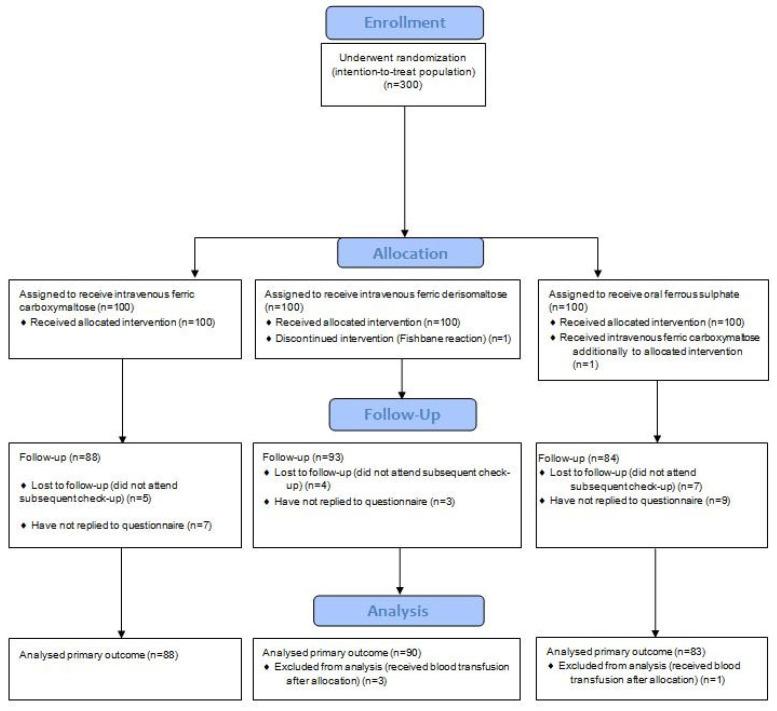
(1) Postpartum anemia is a common maternal complication and is recognized as a cause of impaired quality of life, reduced cognitive abilities, and fatigue. Efficient iron supplementation for the treatment of postpartum anemia is an essential component of high-quality maternal care. The optimal mode of iron supplementation has not been determined yet, whether oral or intravenous. The objective of this study was to compare postpartum anemia treatment with intravenous ferric carboxymaltose, intravenous ferric derisomaltose, and oral ferrous sulfate. (2) A single-center, open-label, randomized controlled trial. Women with hemoglobin < 100 g/L within 48 h postpartum were randomly allocated to receive intravenous ferric carboxymaltose, intravenous ferric derisomaltose, or oral ferrous sulfate. Intravenous iron was given in one or two doses, while ferrous sulfate was given as two 80 mg tablets once daily. The primary outcome was maternal fatigue measured by the Multidimensional Fatigue Inventory (MFI) six weeks postpartum. Hemoglobin, ferritin, and transferrin saturation levels were analyzed as secondary outcomes. A Kruskal-Wallis test was used for group comparison ( < 0.05 significant). (3) Three hundred women were included. The MFI score at six weeks postpartum did not differ between groups (median 38 (inter-quartile range (IQR) 29-47) in the ferric carboxymaltose group, median 34 (IQR 26-42) in the ferric derisomaltose group, and median 36 (IQR 25-47) in the ferrous sulfate group; = 0.26). Participants receiving oral iron had lower levels of hemoglobin (135 (131-139) vs. 134 (129-139) vs. 131 (125-137) g/L; = 0.008), ferritin (273 (198-377) vs. 187 (155-246) vs. 24 (17-37) µg/L; < 0.001) and transferrin saturation (34 (28-38) vs. 30 (23-37) vs. 24 (17-37) %; < 0.001) than those receiving ferric carboxymaltose or ferric derisomaltose. (4) Intravenous ferric carboxymaltose, intravenous ferric derisomaltose, and oral ferrous sulfate had similar impacts on maternal fatigue at six weeks postpartum despite improved laboratory parameters in the intravenous groups.
(1) 产后贫血是一种常见的孕产妇并发症,被认为是生活质量受损、认知能力下降和疲劳的原因。高效补铁治疗产后贫血是高质量孕产妇护理的重要组成部分。无论是口服还是静脉补铁,最佳补铁方式尚未确定。本研究的目的是比较静脉注射羧麦芽糖铁、静脉注射异麦芽糖铁和口服硫酸亚铁治疗产后贫血的效果。(2) 一项单中心、开放标签、随机对照试验。产后48小时内血红蛋白<100 g/L的女性被随机分配接受静脉注射羧麦芽糖铁、静脉注射异麦芽糖铁或口服硫酸亚铁。静脉补铁分一或两剂给药,而硫酸亚铁则每日服用两片80毫克片剂。主要结局是产后六周通过多维疲劳量表(MFI)测量的产妇疲劳程度。血红蛋白、铁蛋白和转铁蛋白饱和度水平作为次要结局进行分析。采用Kruskal-Wallis检验进行组间比较(P<0.05为有统计学意义)。(3) 共纳入300名女性。产后六周时,各组的MFI评分无差异(羧麦芽糖铁组中位数为38(四分位间距(IQR)29 - 47),异麦芽糖铁组中位数为34(IQR 26 - 42),硫酸亚铁组中位数为36(IQR 25 - 47);P = 0.26)。接受口服铁剂的参与者血红蛋白水平较低(分别为135(131 - 139)、134(129 - 139)和131(125 - 137)g/L;P = 0.008),铁蛋白水平较低(分别为273(198 - 377)、187(155 - 246)和24(17 - 37)μg/L;P<0.001),转铁蛋白饱和度较低(分别为34(28 - 38)、30(23 - 37)和24(17 - 37)%;P<0.001),低于接受羧麦芽糖铁或异麦芽糖铁的参与者。(4) 尽管静脉补铁组的实验室指标有所改善,但静脉注射羧麦芽糖铁、静脉注射异麦芽糖铁和口服硫酸亚铁在产后六周对产妇疲劳的影响相似。
 Zotero 插件