
使用智能手机可连接便携式设备测量泪液半月板高度的可行性以及结果与标准裂隙灯检查的一致性。
Feasibility of Tear Meniscus Height Measurements Obtained with a Smartphone-Attachable Portable Device and Agreement of the Results with Standard Slit Lamp Examination.
作者信息
Borselli Massimiliano, Toro Mario Damiano, Rossi Costanza, Taloni Andrea, Khemlani Rohan, Nakayama Shintato, Nishimura Hiroki, Shimizu Eisuke, Scorcia Vincenzo, Giannaccare Giuseppe
机构信息
Department of Ophthalmology, University Magna Græcia of Catanzaro, 88100 Catanzaro, Italy.
Department of Ophthalmology, Federico II University Hospital, 80131 Naples, Italy.
出版信息
Diagnostics (Basel). 2024 Feb 1;14(3):316. doi: 10.3390/diagnostics14030316.
PURPOSE
We aimed to evaluate the feasibility of using a novel device, the Smart Eye Camera (SEC), for assessing tear meniscus height (TMH) after fluorescein staining and the agreement of the results with measurements obtained using standard slit lamp examination.
METHODS
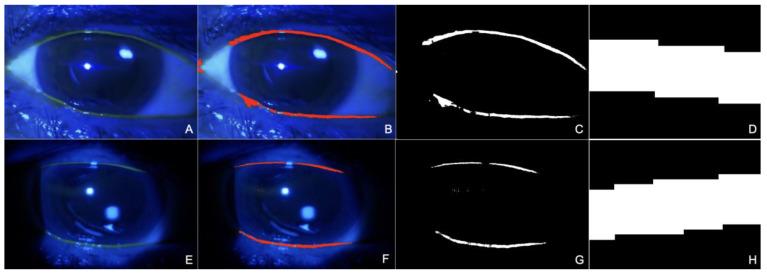
TMH was assessed using both SEC and conventional slit lamp examination. The images were analyzed using the software ImageJ 1.53t (National Institutes of Health, Bethesda, MD, USA). A common measurement unit scale was established based on a paper strip, which was used as a calibration marker to convert pixels into metric scale. A color threshold was applied using uniform parameters for brightness, saturation, and hue. The images were then binarized to black and white to enhance the representation of the tear menisci. A 2 mm area around the upper and lower meniscus in the central eye lid zone was selected and magnified 3200 times to facilitate manual measurement. The values obtained using SEC were compared with those obtained with a slit lamp.
RESULTS
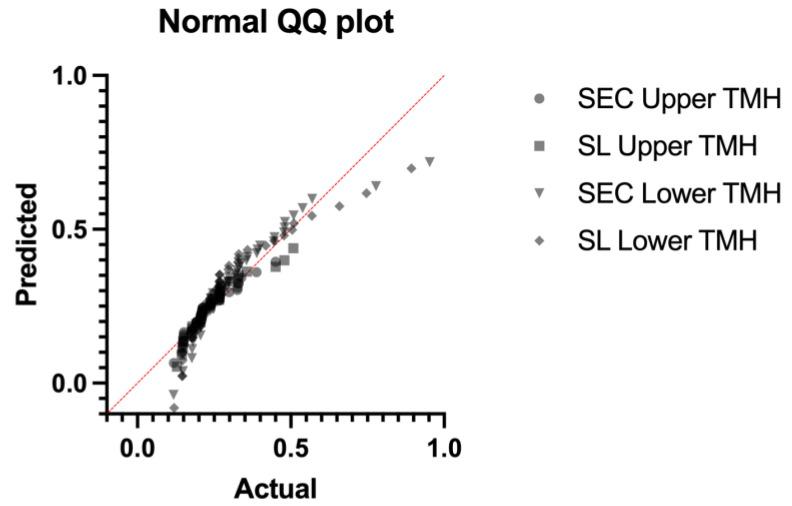
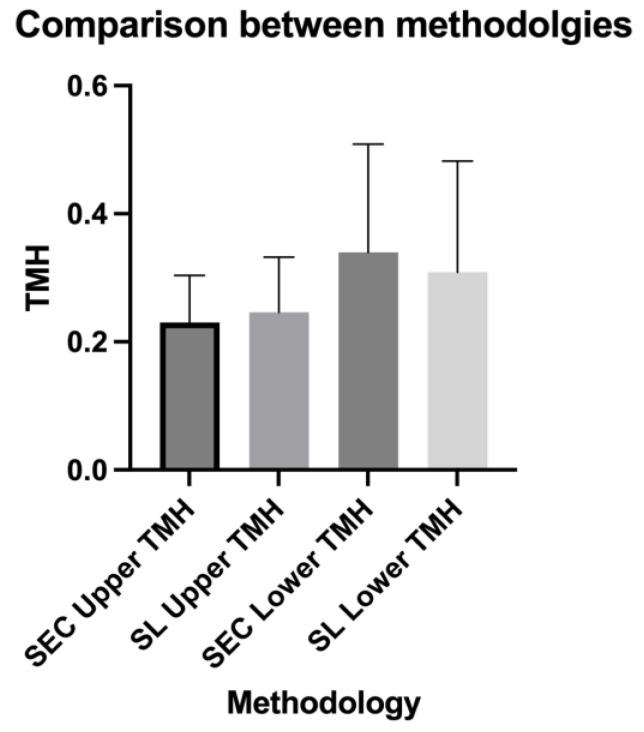
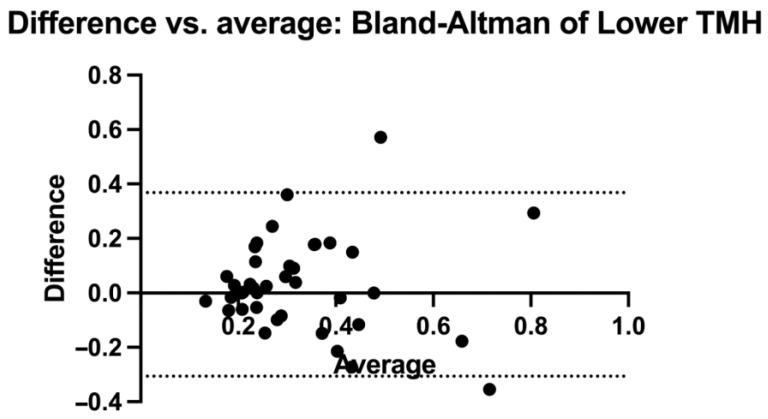
The upper and lower TMH values measured using the SEC were not statistically different from those obtained with a slit lamp (0.209 ± 0.073 mm vs. 0.235 ± 0.085, = 0.073, and 0.297 ± 0.168 vs. 0.260 ± 0.173, = 0.275, respectively). The results of Bland-Altman analysis demonstrated strong agreement between the two instruments, with a mean bias of -0.016 mm (agreement limits: -0.117 to 0.145 mm) for upper TMH and 0.031 mm (agreement limits: -0.306 to 0.368 mm) for lower TMH.
CONCLUSIONS
The SEC demonstrated sufficient validity and reliability for assessing TMH in healthy eyes in a clinical setting, demonstrating concordance with the conventional slit lamp examination.
目的
我们旨在评估使用一种新型设备——智能眼相机(SEC)在荧光素染色后评估泪膜半月板高度(TMH)的可行性,以及结果与使用标准裂隙灯检查所获测量值的一致性。
方法
使用SEC和传统裂隙灯检查来评估TMH。图像使用ImageJ 1.53t软件(美国国立卫生研究院,马里兰州贝塞斯达)进行分析。基于一条纸带建立了一个通用测量单位尺度,该纸带用作校准标记以将像素转换为公制尺度。使用亮度、饱和度和色调的统一参数应用颜色阈值。然后将图像二值化为黑白图像以增强泪膜半月板的显示。在中央眼睑区域的上下半月板周围选择2毫米区域并放大3200倍以方便手动测量。将使用SEC获得的值与使用裂隙灯获得的值进行比较。
结果
使用SEC测量的上下TMH值与使用裂隙灯获得的值在统计学上无差异(分别为0.209±0.073毫米对0.235±0.085,P = 0.073;以及0.297±0.168对0.260±0.173,P = 0.275)。Bland-Altman分析结果表明两种仪器之间具有很强的一致性,上TMH的平均偏差为-0.016毫米(一致性界限:-0.117至0.145毫米),下TMH的平均偏差为0.031毫米(一致性界限:-0.306至0.368毫米)。
结论
在临床环境中,SEC在评估健康眼睛的TMH方面显示出足够的有效性和可靠性,与传统裂隙灯检查结果一致。

 Zotero 插件