
神经退行性疾病的早期诊断:为推动从 PET 向荧光示踪剂的转变而开展的工作。
Early Diagnosis of Neurodegenerative Diseases: What Has Been Undertaken to Promote the Transition from PET to Fluorescence Tracers.
机构信息
Université Paris-Saclay, CNRS, BioCIS, Bat. Henri Moissan, 17, Av. des Sciences, 91400 Orsay, France.
Department of Life Sciences, University of Modena and Reggio Emilia, Via Giuseppe Campi 103, 41125 Modena, Italy.
出版信息
Molecules. 2024 Feb 4;29(3):722. doi: 10.3390/molecules29030722.
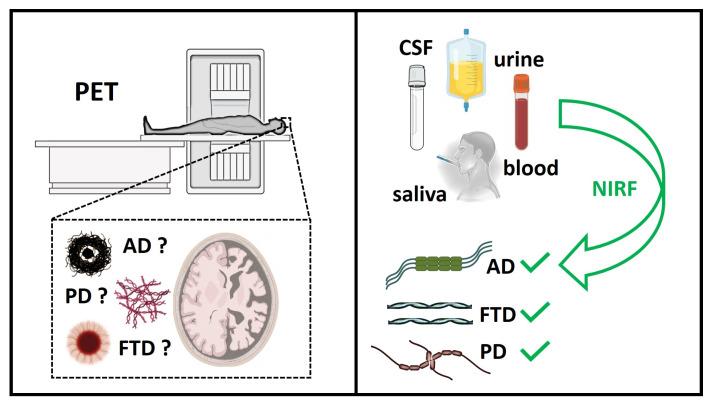
Alzheimer's Disease (AD) and Parkinson's Disease (PD) represent two among the most frequent neurodegenerative diseases worldwide. A common hallmark of these pathologies is the misfolding and consequent aggregation of amyloid proteins into soluble oligomers and insoluble β-sheet-rich fibrils, which ultimately lead to neurotoxicity and cell death. After a hundred years of research on the subject, this is the only reliable histopathological feature in our hands. Since AD and PD are diagnosed only once neuronal death and the first symptoms have appeared, the early detection of these diseases is currently impossible. At present, there is no effective drug available, and patients are left with symptomatic and inconclusive therapies. Several reasons could be associated with the lack of effective therapeutic treatments. One of the most important factors is the lack of selective probes capable of detecting, as early as possible, the most toxic amyloid species involved in the onset of these pathologies. In this regard, chemical probes able to detect and distinguish among different amyloid aggregates are urgently needed. In this article, we will review and put into perspective results from ex vivo and in vivo studies performed on compounds specifically interacting with such early species. Following a general overview on the three different amyloid proteins leading to insoluble β-sheet-rich amyloid deposits (amyloid β peptide, Tau, and α-synuclein), a list of the advantages and disadvantages of the approaches employed to date is discussed, with particular attention paid to the translation of fluorescence imaging into clinical applications. Furthermore, we also discuss how the progress achieved in detecting the amyloids of one neurodegenerative disease could be leveraged for research into another amyloidosis. As evidenced by a critical analysis of the state of the art, substantial work still needs to be conducted. Indeed, the early diagnosis of neurodegenerative diseases is a priority, and we believe that this review could be a useful tool for better investigating this field.
阿尔茨海默病(AD)和帕金森病(PD)是全球最常见的神经退行性疾病中的两种。这些疾病的一个共同特征是淀粉样蛋白错误折叠,随后聚集形成可溶性寡聚物和不溶性β-折叠丰富的纤维,最终导致神经毒性和细胞死亡。在对该主题进行了一百年的研究之后,这是我们手中唯一可靠的组织病理学特征。由于 AD 和 PD 仅在神经元死亡和出现第一个症状后才被诊断出来,因此目前无法早期发现这些疾病。目前,尚无有效的药物可用,患者只能接受对症治疗,尚无定论。缺乏有效的治疗方法可能与以下几个原因有关。其中最重要的因素之一是缺乏能够尽早检测到参与这些疾病发作的最有毒淀粉样物种的选择性探针。在这方面,迫切需要能够检测和区分不同淀粉样聚集物的化学探针。在本文中,我们将回顾和展望专门与这些早期物种相互作用的化合物的离体和体内研究结果。在概述导致不溶性β-折叠丰富的淀粉样沉积物的三种不同淀粉样蛋白(淀粉样β肽、Tau 和 α-突触核蛋白)之后,讨论了迄今为止采用的方法的优缺点列表,特别关注荧光成像技术向临床应用的转化。此外,我们还讨论了如何利用一种神经退行性疾病中淀粉样蛋白的检测进展来研究另一种淀粉样变性。通过对最新技术的批判性分析可以证明,仍需要进行大量的工作。事实上,神经退行性疾病的早期诊断是当务之急,我们相信,这篇综述可以为更好地研究这一领域提供有用的工具。


 Zotero 插件