
新冠后患者会遭受嗅觉味觉、三叉神经和唾液腺功能紊乱。
Post-COVID-19 patients suffer from chemosensory, trigeminal, and salivary dysfunctions.
机构信息
Department of Cariology and Gerodontology, Faculty of Dentistry, University of Oslo, Geitmyrsveien 71, 0455, Oslo, Norway.
Department of Oral Surgery and Oral Medicine, Faculty of Dentistry, University of Oslo, Oslo, Norway.
出版信息
Sci Rep. 2024 Feb 11;14(1):3455. doi: 10.1038/s41598-024-53919-y.
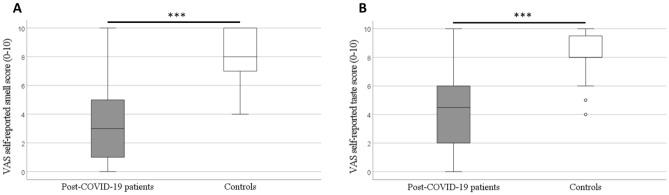
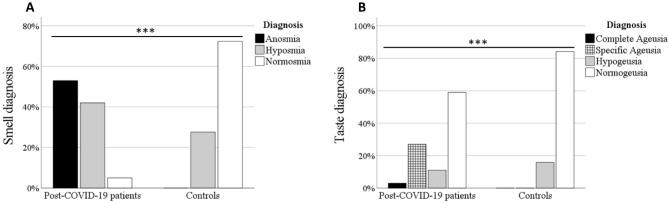
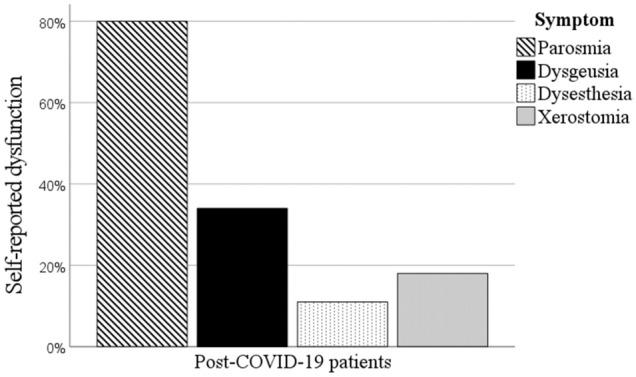
Recent literature indicates that post-COVID-19 patients suffer from a plethora of complications, including chemosensory dysfunction. However, little attention has been given to understand the interactions between chemosensory, trigeminal, and salivary dysfunctions in these patients. The aims of this study were (1) to investigate the prevalence and combinations of chemosensory, trigeminal, and salivary dysfunctions, (2) to identify the odorants/tastants that are compromised, and (3) to explore possible associations between the four dysfunctions in post-COVID-19 patients. One hundred post-COVID-19 patients and 76 healthy controls (pre-COVID-19) were included in this cross-sectional, case-controlled study. Participants' smell, taste, trigeminal, and salivary functions were assessed. The patients had a significantly higher prevalence of parosmia (80.0%), hyposmia (42.0%), anosmia (53.0%), dysgeusia (34.0%), complete ageusia (3.0%), specific ageusia (27.0%), dysesthesia (11.0%) and dry mouth (18.0%) compared to controls (0.0% for all parameters, except 27.6% for hyposmia). Complete loss of bitter taste was the most prevalent specific ageusia (66.7%) and coffee was the most common distorted smell (56.4%). Seven different combinations of dysfunction were observed in the patients, the most common being a combination of olfactory and gustatory dysfunction (48.0%). These findings indicate that post-COVID-19 patients experience a range of chemosensory, trigeminal, and salivary disturbances, occurring in various combinations.
最近的文献表明,新冠后患者会遭受多种并发症,包括嗅觉味觉障碍。然而,对于理解这些患者的嗅觉、三叉神经和唾液功能障碍之间的相互作用,关注甚少。本研究的目的是:(1) 调查新冠后患者的嗅觉味觉、三叉神经和唾液功能障碍的患病率和组合;(2) 确定受影响的气味/味道;(3) 探索新冠后患者的这四种功能障碍之间可能存在的关联。本横断面病例对照研究纳入了 100 名新冠后患者和 76 名健康对照者(新冠前)。评估了参与者的嗅觉、味觉、三叉神经和唾液功能。与对照组(除嗅觉障碍 27.6%外,所有参数均为 0.0%)相比,患者的幻嗅(80.0%)、嗅觉减退(42.0%)、嗅觉丧失(53.0%)、味觉障碍(34.0%)、完全味觉丧失(3.0%)、特定味觉丧失(27.0%)、感觉异常(11.0%)和口干(18.0%)的患病率显著更高。苦味完全丧失是最常见的特定味觉丧失(66.7%),咖啡是最常见的异味(56.4%)。在患者中观察到七种不同的功能障碍组合,最常见的是嗅觉和味觉功能障碍的组合(48.0%)。这些发现表明,新冠后患者经历了一系列的嗅觉、三叉神经和唾液功能障碍,且以各种组合出现。


 Zotero 插件