
精神分裂症患者脑容量的纵向减少及其与认知功能的关联。
Longitudinal reduction in brain volume in patients with schizophrenia and its association with cognitive function.
作者信息
Yamazaki Ryuichi, Matsumoto Junya, Ito Satsuki, Nemoto Kiyotaka, Fukunaga Masaki, Hashimoto Naoki, Kodaka Fumitoshi, Takano Harumasa, Hasegawa Naomi, Yasuda Yuka, Fujimoto Michiko, Yamamori Hidenaga, Watanabe Yoshiyuki, Miura Kenichiro, Hashimoto Ryota
机构信息
Department of Pathology of Mental Diseases, National Institute of Mental Health, National Center of Neurology and Psychiatry, Kodaira, Japan.
Department of Psychiatry, The Jikei University School of Medicine, Tokyo, Japan.
出版信息
Neuropsychopharmacol Rep. 2024 Mar;44(1):206-215. doi: 10.1002/npr2.12423. Epub 2024 Feb 13.
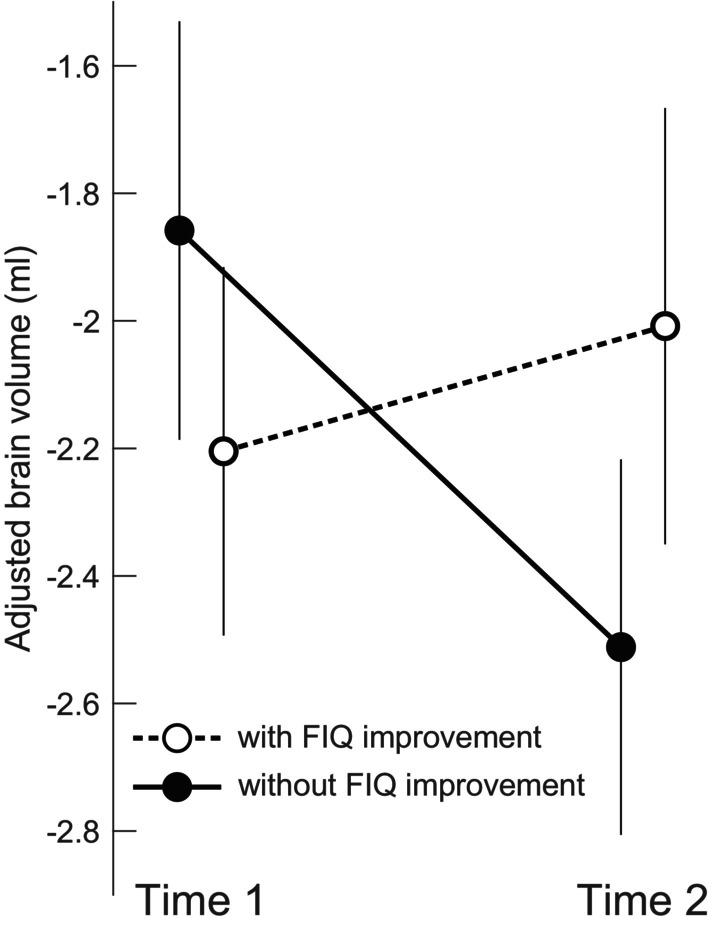
Establishing a brain biomarker for schizophrenia is strongly desirable not only to support diagnosis by psychiatrists but also to help track the progressive changes in the brain over the course of the illness. A brain morphological signature of schizophrenia was reported in a recent study and is defined by clusters of brain regions with reduced volume in schizophrenia patients compared to healthy individuals. This signature was proven to be effective at differentiating patients with schizophrenia from healthy individuals, suggesting that it is a good candidate brain biomarker of schizophrenia. However, the longitudinal characteristics of this signature have remained unclear. In this study, we examined whether these changes occurred over time and whether they were associated with clinical outcomes. We found a significant change in the brain morphological signature in schizophrenia patients with more brain volume loss than the natural, age-related reduction in healthy individuals, suggesting that this change can capture a progressive morphological change in the brain. We further found a significant association between changes in the brain morphological signature and changes in the full-scale intelligence quotient (IQ). The patients with IQ improvement showed preserved brain morphological signatures, whereas the patients without IQ improvement showed progressive changes in the brain morphological signature, suggesting a link between potential recovery of intellectual abilities and the speed of brain pathology progression. We conclude that the brain morphological signature is a brain biomarker that can be used to evaluate progressive changes in the brain that are associated with cognitive impairment due to schizophrenia.
建立精神分裂症的脑生物标志物非常必要,这不仅有助于精神科医生进行诊断,还能帮助追踪疾病过程中大脑的渐进性变化。最近的一项研究报告了精神分裂症的脑形态学特征,其定义为与健康个体相比,精神分裂症患者脑容量减少的脑区簇。该特征已被证明能有效区分精神分裂症患者和健康个体,表明它是精神分裂症脑生物标志物的良好候选者。然而,这一特征的纵向特性仍不清楚。在本研究中,我们研究了这些变化是否随时间发生,以及它们是否与临床结果相关。我们发现,精神分裂症患者的脑形态学特征有显著变化,其脑容量损失比健康个体自然的、与年龄相关的减少更多,这表明这种变化可以捕捉大脑的渐进性形态变化。我们还进一步发现,脑形态学特征的变化与全量表智商(IQ)的变化之间存在显著关联。智商提高的患者脑形态学特征保持不变,而智商未提高的患者脑形态学特征则有渐进性变化,这表明智力能力的潜在恢复与脑病理进展速度之间存在联系。我们得出结论,脑形态学特征是一种脑生物标志物,可用于评估与精神分裂症所致认知障碍相关的大脑渐进性变化。

 Zotero 插件