
未来患者参与研究的方向:加拿大患者伙伴和学术研究人员的参与式研讨会。
Future directions for patient engagement in research: a participatory workshop with Canadian patient partners and academic researchers.
机构信息
College of Pharmacy, Rady Faculty of Health Sciences, University of Manitoba, CR3024-369 Tache Avenue, Winnipeg, MB, R2H 2A6, Canada.
Horizon Health Network, 80 Woodbridge Street, Fredericton, NB, E3B 4R3, Canada.
出版信息
Health Res Policy Syst. 2024 Feb 14;22(1):24. doi: 10.1186/s12961-024-01106-w.
BACKGROUND
Patient engagement in research (also commonly referred to as patient or patient and public involvement in research) strives to transform health research wherein patients (including caregivers and the public) are regularly and actively engaged as multidisciplinary research team members (i.e. patient partners) working jointly towards improved health outcomes and an enhanced healthcare system. To support its mindful evolution into a staple of health research, this participatory study aimed to identify future directions for Canadian patient engagement in research and discusses its findings in the context of the international literature.
METHODS
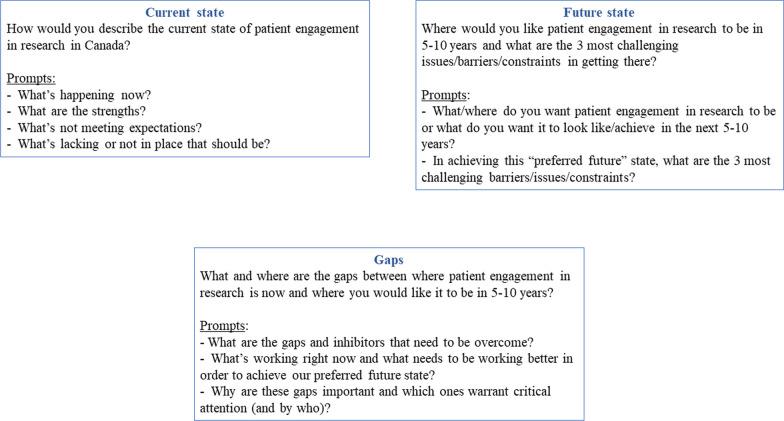
The study met its aim through a multi-meeting pan-Canadian virtual workshop. Participants (n = 30) included Strategy for Patient-Oriented Research-funded academic researchers and patient partners identified through a publicly available database, personal and professional networks and social media. All spoke English, could access the workshop virtually, and provided written informed consent. The workshop was composed of four, 1.5-3-h virtual meetings wherein participants discussed the current and preferred future states of Canadian patient engagement in research. Workshop discussions (i.e. data) were video and audio recorded. Themes were generated through an iterative process of inductive thematic analysis that occurred concurrently with the multi-week workshop.
RESULTS
Our participatory and iterative process identified 10 targetable areas of focus for the future of Canadian patient engagement in research. Five were categorized as system-level (systemic integration; academic culture; engagement networks; funding models; compensation models), one as researcher-level (engagement processes), and four crossed both levels (awareness; diversity and recruitment; training, tools and education; evaluation and impact). System level targetable areas called for reshaping the patient engagement ecosystem to create a legitimized and supportive space for patient engagement to be a staple component of a learning health system. Researcher level targetable areas called for academic researchers and patient partners to collaboratively generate evidence and apply knowledge to inform values and behaviours necessary to foster and sustain supportive health research spaces that are accessible to all.
CONCLUSIONS
Future directions for Canadian patient engagement in research span 10 interconnected targetable areas that require strong leadership and joint action between patient partners, academic researchers, and health and research institutions if patient engagement is to become a ubiquitous component of a learning health system.
背景
患者参与研究(也通常称为患者或患者和公众参与研究)旨在转变健康研究,使患者(包括护理人员和公众)作为多学科研究团队成员(即患者伙伴)定期积极参与,共同努力改善健康结果和加强医疗保健系统。为了支持其有意识地发展成为健康研究的一个重要组成部分,这项参与性研究旨在确定加拿大患者参与研究的未来方向,并结合国际文献讨论其研究结果。
方法
该研究通过多次在加拿大范围内举行的虚拟研讨会实现了其目标。参与者(n=30)包括由患者导向研究战略资助的学术研究人员和通过公开数据库、个人和专业网络以及社交媒体确定的患者伙伴。所有参与者都说英语,能够虚拟参加研讨会,并提供书面知情同意书。研讨会由四次 1.5-3 小时的虚拟会议组成,参与者在会议上讨论了加拿大患者参与研究的现状和首选未来状态。研讨会讨论(即数据)进行了视频和音频记录。主题通过与多周研讨会同时进行的归纳主题分析的迭代过程生成。
结果
我们的参与式和迭代过程确定了加拿大患者参与研究未来的 10 个可瞄准的重点领域。其中 5 个被归类为系统层面(系统集成;学术文化;参与网络;资助模式;补偿模式),1 个为研究人员层面(参与过程),4 个跨越两个层面(意识;多样性和招募;培训、工具和教育;评估和影响)。系统层面的可瞄准领域呼吁重塑患者参与生态系统,为患者参与成为学习型健康系统的一个基本组成部分创造一个合法化和支持性的空间。研究人员层面的可瞄准领域呼吁学术研究人员和患者伙伴共同生成证据并应用知识,以告知促进和维持对所有人开放的支持性健康研究空间所需的价值观和行为。
结论
加拿大患者参与研究的未来方向涵盖 10 个相互关联的可瞄准领域,如果患者参与要成为学习型健康系统的一个普遍组成部分,需要患者伙伴、学术研究人员和卫生及研究机构的强有力领导和共同行动。

 Zotero 插件