
水莲蚜 Rhopalosiphum nymphaeae 的高质量基因组组装。
A high-quality genome assembly of the waterlily aphid Rhopalosiphum nymphaeae.
机构信息
Institute of Organismic and Molecular Evolution (iomE), Johannes Gutenberg University Mainz, 55128, Mainz, Germany.
Institute for Evolution and Biodiversity, University of Münster, 48161, Münster, Germany.
出版信息
Sci Data. 2024 Feb 13;11(1):194. doi: 10.1038/s41597-024-03043-3.
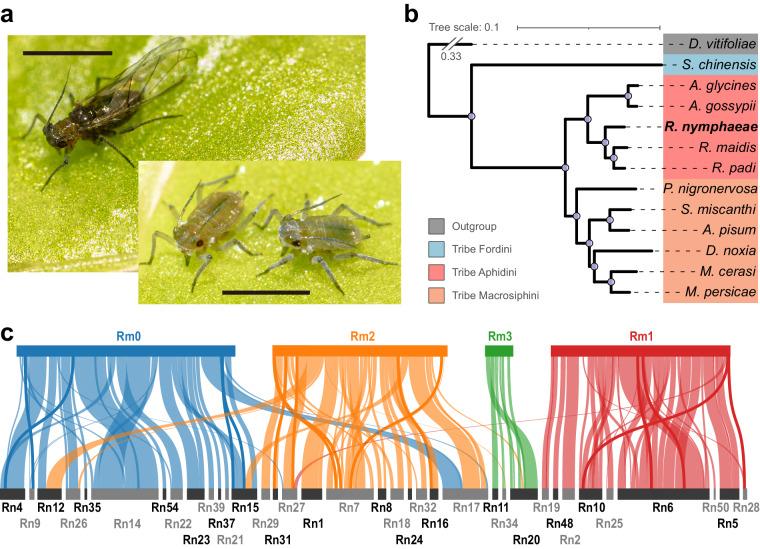
Waterlily aphid, Rhopalosiphum nymphaeae (Linnaeus), is a host-alternating aphid known to feed on both terrestrial and aquatic hosts. It causes damage through direct herbivory and acting as a vector for plant viruses, impacting worldwide Prunus spp. fruits and aquatic plants. Interestingly, R. nymphaeae's ability to thrive in both aquatic and terrestrial conditions sets it apart from other aphids, offering a unique perspective on adaptation. We present the first high-quality R. nymphaeae genome assembly with a size of 324.4 Mb using PacBio long-read sequencing. The resulting assembly is highly contiguous with a contig N50 reached 12.7 Mb. The BUSCO evaluation suggested a 97.5% completeness. The R. nymphaeae genome consists of 16.9% repetitive elements and 16,834 predicted protein-coding genes. Phylogenetic analysis positioned R. nymphaeae within the Aphidini tribe, showing close relations to R. maidis and R. padi. The high-quality reference genome R. nymphaeae provides a unique resource for understanding genome evolution in aphids and paves the foundation for understanding host plant adaptation mechanisms and developing pest control strategies.
水莲蚜,Rhopalosiphum nymphaeae(Linnaeus),是一种已知会在陆地和水生宿主之间交替取食的蚜虫。它通过直接取食和充当植物病毒的载体来造成损害,影响全球范围内的李属果实和水生植物。有趣的是,R. nymphaeae 在水生和陆地条件下都能茁壮成长的能力使其有别于其他蚜虫,为适应能力提供了独特的视角。我们使用 PacBio 长读测序技术,首次构建了大小为 324.4Mb 的高质量 R. nymphaeae 基因组组装。该组装具有高度连续性,contig N50 达到 12.7Mb。BUSCO 评估表明其完整性达到了 97.5%。R. nymphaeae 基因组由 16.9%的重复元件和 16834 个预测的蛋白质编码基因组成。系统发育分析将 R. nymphaeae 定位在蚜科的 Aphidini 部落内,与 R. maidis 和 R. padi 关系密切。高质量的 R. nymphaeae 参考基因组为理解蚜虫的基因组进化提供了独特的资源,并为理解宿主植物适应机制和开发害虫控制策略奠定了基础。
 Zotero 插件