
米赞特皮大学教学医院结核患者的营养状况和治疗结果:一项为期五年的回顾性研究。
Nutritional status and treatment outcomes of tuberculosis in Mizan Tepi University Teaching Hospital, a five -year retrospective study.
机构信息
Department of Medical Laboratory Sciences, College of Medicine and Health Sciences, Wolkite University, Wolkite, Ethiopia.
Department of Medical Laboratory Sciences, College of Medicine and Health Sciences, Mizan Tepi University, Mizan-Aman, Ethiopia.
出版信息
PLoS One. 2024 Feb 15;19(2):e0298244. doi: 10.1371/journal.pone.0298244. eCollection 2024.
BACKGROUND
Public health problems related to tuberculosis (TB) remain substantial globally, particularly in resource-limited countries. Determining TB treatment outcomes and identifying contributing factors are the basic components of the TB control strategy. In Ethiopia, different studies have been done on treatment outcomes and multiple associated factors, and there is also a little information on the effect of nutritional status on TB treatment outcomes. So there is a need for comprehensive research that examines the combined effects of multiple factors along with nutritional status.
METHODS
A five-year institution-based retrospective cross-sectional study was conducted at Mizan Tepi University Teaching Hospital, South West Ethiopia. This study included all tuberculosis patients who were documented in the TB registration and had known treatment outcomes at the treatment facility between January 1, 2016, and December 31, 2020. Data was collected through a pretested structured data extraction checklist. Data were entered into Epidata version 3.1 and analyzed through SPSS version 22. Multiple logistic regression was employed to assess the association between dependent and independent variables. A p-value of less than 0.05 was considered statistically significant.
RESULT
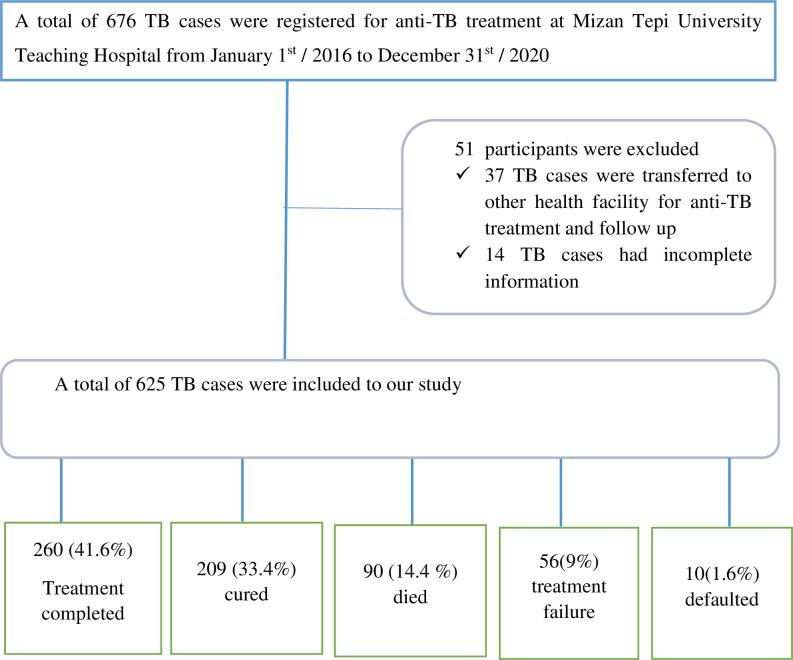
Of the total 625 TB patients, 283 (45.3%), 175 (28%), and 167 (26.7%) had smear-positive, extra-pulmonary, and smear-negative tuberculosis, respectively. The majority of study participants had normal weight (62.2%), were in the age group of 15-44 (67.4%), were new cases (73.8%), and were from urban areas (69.4%). About 32.2% of cases were HIV-positive. The overall unsuccessful treatment rate was 25%. From the total unsuccessful treatment rates, the highest proportion was a death rate of 90 (14.4%), followed by a treatment failure of 56 (9%). Being female (AOR = 1.7, 95% CI: 1.2-2.5), HIV positive (AOR = 2.7, 95% CI: 1.9-4.1), undernutrition (BMI<18.5kg/m2) (AOR = 1.9, 95% CI: 1.3-2.9), and smear-negative pulmonary TB (AOR = 1.6, 95% CI: 1-2.5) were independent predictors of unsuccessful treatment outcomes.
CONCLUSION
The treatment success rate in the study area is very poor. Poor treatment outcomes were associated with undernutrition, female gender, HIV positivity and smear-negative pulmonary TB. So, continuous and serious supervision and monitoring of directly observed treatment short course (DOTS) program accomplishment, early detection of HIV and TB, prompt anti TB and antiretroviral treatment initiation and adherence, enhanced nutritional assessment, and counseling services need to be strengthened to improve treatment outcomes.
背景
与结核病(TB)相关的公共卫生问题在全球范围内仍然很严重,特别是在资源有限的国家。确定结核病治疗结果并确定相关因素是结核病控制策略的基本组成部分。在埃塞俄比亚,已经针对治疗结果和多个相关因素进行了不同的研究,并且关于营养状况对结核病治疗结果的影响也有一些信息。因此,需要进行全面的研究,以检查多种因素与营养状况的综合影响。
方法
这是一项在埃塞俄比亚西南部米赞提皮大学教学医院进行的为期五年的基于机构的回顾性横断面研究。本研究包括 2016 年 1 月 1 日至 2020 年 12 月 31 日期间在治疗机构中记录在结核病登记册中且已知治疗结果的所有结核病患者。通过预测试的结构化数据提取检查表收集数据。数据输入到 EpiData 版本 3.1 并通过 SPSS 版本 22 进行分析。采用多变量逻辑回归评估因变量和自变量之间的关系。p 值小于 0.05 被认为具有统计学意义。
结果
在总共 625 例结核病患者中,283 例(45.3%)、175 例(28%)和 167 例(26.7%)分别为涂片阳性、肺外和涂片阴性结核病。大多数研究参与者的体重正常(62.2%),年龄在 15-44 岁之间(67.4%),为新发病例(73.8%),来自城市地区(69.4%)。大约 32.2%的病例为 HIV 阳性。总的治疗失败率为 25%。在总治疗失败率中,死亡率最高,为 90 例(14.4%),其次是治疗失败 56 例(9%)。女性(AOR=1.7,95%CI:1.2-2.5)、HIV 阳性(AOR=2.7,95%CI:1.9-4.1)、营养不良(BMI<18.5kg/m2)(AOR=1.9,95%CI:1.3-2.9)和涂片阴性肺结核(AOR=1.6,95%CI:1-2.5)是治疗结果不良的独立预测因素。
结论
研究区域的治疗成功率非常低。不良的治疗结果与营养不良、女性、HIV 阳性和涂片阴性肺结核有关。因此,需要加强对直接观察治疗短期疗程(DOTS)计划完成情况的持续和严格监督与监测、早期发现 HIV 和结核病、及时启动抗结核和抗逆转录病毒治疗并坚持治疗、加强营养评估和咨询服务,以改善治疗结果。
 Zotero 插件