
罗沙司他对儿科镰状细胞病患者脑血流和氧摄取的影响。
The influence of voxelotor on cerebral blood flow and oxygen extraction in pediatric sickle cell disease.
机构信息
Wallace H. Coulter Department of Biomedical Engineering, Georgia Institute of Technology and Emory University, Atlanta, GA.
Department of Radiology and Imaging Sciences, Children's Healthcare of Atlanta and Emory University, Atlanta, GA.
出版信息
Blood. 2024 May 23;143(21):2145-2151. doi: 10.1182/blood.2023022011.
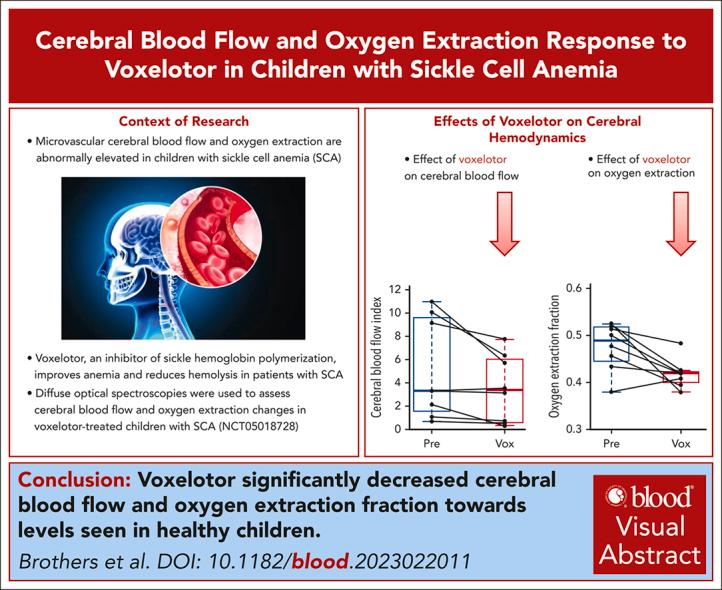
Voxelotor is an inhibitor of sickle hemoglobin polymerization that is used to treat sickle cell disease. Although voxelotor has been shown to improve anemia, the clinical benefit on the brain remains to be determined. This study quantified the cerebral hemodynamic effects of voxelotor in children with sickle cell anemia (SCA) using noninvasive diffuse optical spectroscopies. Specifically, frequency-domain near-infrared spectroscopy combined with diffuse correlation spectroscopy were used to noninvasively assess regional oxygen extraction fraction (OEF), cerebral blood volume, and an index of cerebral blood flow (CBFi). Estimates of CBFi were first validated against arterial spin-labeled magnetic resonance imaging (ASL-MRI) in 8 children with SCA aged 8 to 18 years. CBFi was significantly positively correlated with ASL-MRI-measured blood flow (R2 = 0.651; P = .015). Next, a single-center, open-label pilot study was completed in 8 children with SCA aged 4 to 17 years on voxelotor, monitored before treatment initiation and at 4, 8, and 12 weeks (NCT05018728). By 4 weeks, both OEF and CBFi significantly decreased, and these decreases persisted to 12 weeks (both P < .05). Decreases in CBFi were significantly correlated with increases in blood hemoglobin (Hb) concentration (P = .025), whereas the correlation between decreases in OEF and increases in Hb trended toward significance (P = .12). Given that previous work has shown that oxygen extraction and blood flow are elevated in pediatric SCA compared with controls, these results suggest that voxelotor may reduce cerebral hemodynamic impairments. This trial was registered at www.ClinicalTrials.gov as #NCT05018728.
沃瑟罗特是一种镰状血红蛋白聚合抑制剂,用于治疗镰状细胞病。尽管沃瑟罗特已被证明可改善贫血,但对大脑的临床益处仍有待确定。本研究使用非侵入性漫射光学光谱技术量化了儿童镰状细胞贫血(SCA)患者中沃瑟罗特的脑血流动力学效应。具体而言,频域近红外光谱与漫射相关光谱相结合,用于非侵入性评估区域氧提取分数(OEF)、脑血容量和脑血流指数(CBFi)。在 8 名年龄为 8 至 18 岁的 SCA 儿童中,首先通过动脉自旋标记磁共振成像(ASL-MRI)验证了 CBFi 的估计值。CBFi 与 ASL-MRI 测量的血流呈显著正相关(R2=0.651;P=0.015)。接下来,在 8 名年龄为 4 至 17 岁的 SCA 儿童中进行了一项单中心、开放标签的先导研究,在治疗开始前和第 4、8 和 12 周进行监测(NCT05018728)。到第 4 周,OEF 和 CBFi 均显著降低,且这种降低持续到第 12 周(均 P<0.05)。CBFi 的降低与血液血红蛋白(Hb)浓度的增加显著相关(P=0.025),而 OEF 的降低与 Hb 的增加呈显著相关(P=0.12)。鉴于先前的研究表明,与对照相比,儿科 SCA 患者的氧提取和血流增加,这些结果表明沃瑟罗特可能会降低脑血流动力学障碍。该试验在 www.ClinicalTrials.gov 上注册为 #NCT05018728。
 Zotero 插件