
室内空气污染对埃塞俄比亚吉马儿童线性生长的影响。
Impact of indoor Air Pollution on the Linear growth of children in Jimma, Ethiopia.
机构信息
Department of Biomedical Sciences, Institute of Health, Jimma University, Jimma, Ethiopia.
Department of Nutrition and Dietetics, Food and Nutrition Research Institute, Jimma University, Jimma, Ethiopia.
出版信息
BMC Public Health. 2024 Feb 16;24(1):488. doi: 10.1186/s12889-024-17975-3.
BACKGROUND
Stunting in children is the term for reduced linear growth and development, which is frequently brought on by a persistently inadequate diet, recurrent infections and chronic diseases or poor health conditions. Apart from the classic covariates of stunting, which include diet and illness, the relative contribution of household air pollution to chronic nutrition conditions is least studied. Hence, this study is conducted to investigate the impact of household air pollution on the linear growth of under-five children in Jimma town, Ethiopia.
METHODS
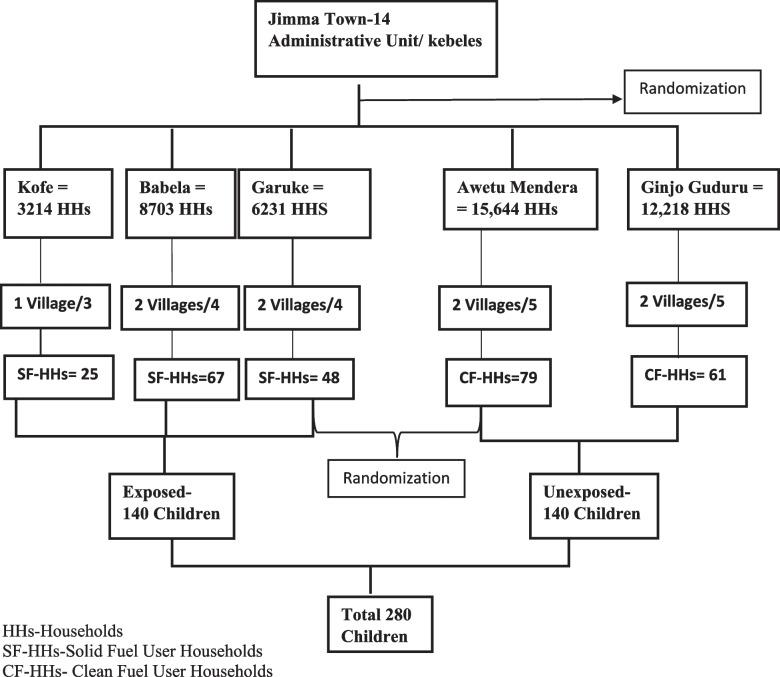
A prospective cohort study was employed to collect data from 280 under-five children who lived in households using solid fuel (exposed group, n = 140) and clean fuel (unexposed group, n = 140). Height-for-age Z scores were compared in both groups over a 12-month follow-up period. The difference in differences estimators were used for comparison of changes in the height-for-age Z scores from baseline to end line in exposed and non-exposed groups. The independent effect of the use of solid fuels on height-for-age Z scores was analyzed through a multivariable linear regression model. Statistical Significances were declared at P < 0.05 and 95% CI level.
RESULTS
In an unadjusted model (Model 1), compared with the clean fuel type, the mean difference in the height-for-age Z score of children in households using solid fuel was lower by 0.54 (-0.54, 95% CI -0.97, -0.12, P = 0.011). The beta coefficient remained negative after adjusting for age and sex (Model 2 -0.543, 95% CI -1.373, -0.563) and sociodemographic variables (Model 3: -0.543, 95% CI -1.362, -0.575). In the final model (Model 4), which adjusted for wealth quantile, dietary practice, water, sanitation and hygiene status and household food insecurity access scale, the beta coefficient held the same and significant (beta: -0.543, 95% CI -1.357, -0.579, P < 0.001). Higher HAZ scores were observed among female child (β: = 0.48, 95%CI: 0.28, 0.69), Child with father attended higher education (β: = 0.304 95%CI: 0.304, 95% CI 0.19, 0.41) as compared to male gender and those who did not attend a formal education, respectively. In contrast, child living in households with poor hygiene practices had lower HAZ score (β: -0.226, 95% CI: -0.449, -0.003), P < 0.001.
CONCLUSIONS
Exposure to indoor air pollution was inversely related to linear growth. Furthermore, sex, educational status and hygiene were found relevant predictors of linear growth. In such a setting, there is a need to step up efforts to design and implement public education campaigns regarding the health risks associated with exposure to household air pollution. Promoting improvements to kitchen ventilation and the use of improved cooking stoves, which will help to mitigate the detrimental effects of indoor air pollution on child growth impairment and its long-term effects.
背景
儿童发育迟缓是指线性生长和发育受限,这通常是由持续摄入不足的饮食、反复感染和慢性疾病或健康状况不佳引起的。除了发育迟缓的经典协变量,包括饮食和疾病外,家庭空气污染对慢性营养状况的相对贡献研究最少。因此,本研究旨在调查家庭空气污染对埃塞俄比亚吉姆马镇五岁以下儿童线性生长的影响。
方法
采用前瞻性队列研究,对 280 名使用固体燃料(暴露组,n=140)和清洁燃料(未暴露组,n=140)的五岁以下儿童进行数据收集。在 12 个月的随访期间,比较两组儿童的身高年龄 Z 评分。采用差值差异估计值比较暴露组和未暴露组身高年龄 Z 评分从基线到终点的变化。通过多变量线性回归模型分析固体燃料使用对身高年龄 Z 评分的独立影响。统计显著性在 P<0.05 和 95%CI 水平上宣布。
结果
在未调整模型(模型 1)中,与清洁燃料类型相比,使用固体燃料的家庭中儿童的身高年龄 Z 评分平均差异较低,为 0.54(-0.54,95%CI-0.97,-0.12,P=0.011)。在调整年龄和性别(模型 2-0.543,95%CI-1.373,-0.563)和社会人口学变量(模型 3:-0.543,95%CI-1.362,-0.575)后,β系数仍然为负值。在最终模型(模型 4)中,调整了财富分位数、饮食实践、水、环境卫生状况和家庭粮食不安全获取情况后,β系数保持不变且具有统计学意义(β:-0.543,95%CI-1.357,-0.579,P<0.001)。与男性相比,女性儿童(β:=0.48,95%CI:0.28,0.69)和父亲受过高等教育的儿童(β:=0.304,95%CI:0.304,95%CI 0.19,0.41)身高年龄 Z 评分更高,而那些没有接受正规教育的儿童分别为男性和未接受正规教育的儿童。相比之下,生活在卫生条件差的家庭中的儿童身高年龄 Z 评分较低(β:-0.226,95%CI:-0.449,-0.003),P<0.001。
结论
暴露于室内空气污染与线性生长呈负相关。此外,性别、教育程度和卫生条件是线性生长的相关预测因素。在这种情况下,需要加紧努力设计和实施公共教育活动,宣传与家庭空气污染相关的健康风险。促进厨房通风的改善和使用改进的炉灶,这将有助于减轻室内空气污染对儿童生长发育受损及其长期影响的不利影响。
 Zotero 插件