
吸入环境和工程纳米颗粒的有效密度及其对肺部沉积和剂量学的影响。
Effective density of inhaled environmental and engineered nanoparticles and its impact on the lung deposition and dosimetry.
机构信息
Nanoscience and Advanced Materials Center (NAMC), Environmental and Occupational Health Science Institute, School of Public Health, Rutgers, The State University of New Jersey, 170 Frelinghuysen Road, Piscataway, NJ, 08854, USA.
Particle Technology Laboratory, Department of Mechanical and Process Engineering, Institute of Process Engineering, ETH Zürich, Sonneggstrasse 3, 8092, Zurich, Switzerland.
出版信息
Part Fibre Toxicol. 2024 Feb 17;21(1):7. doi: 10.1186/s12989-024-00567-9.
BACKGROUND
Airborne environmental and engineered nanoparticles (NPs) are inhaled and deposited in the respiratory system. The inhaled dose of such NPs and their deposition location in the lung determines their impact on health. When calculating NP deposition using particle inhalation models, a common approach is to use the bulk material density, ρ, rather than the effective density, ρ. This neglects though the porous agglomerate structure of NPs and may result in a significant error of their lung-deposited dose and location.
RESULTS
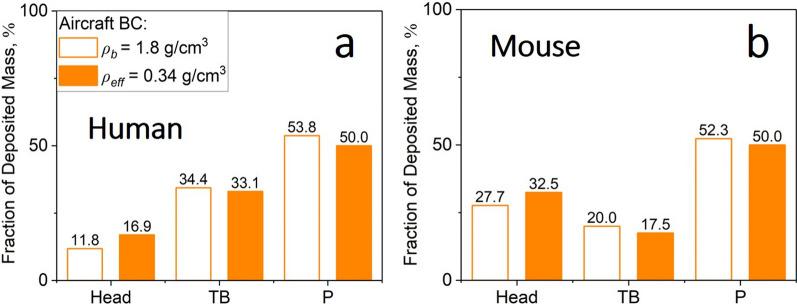
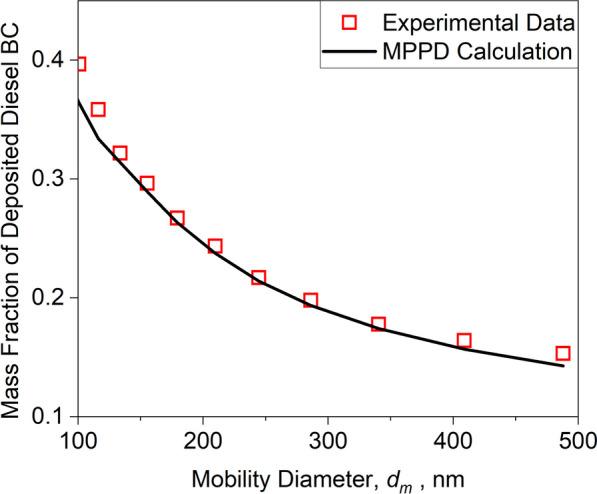
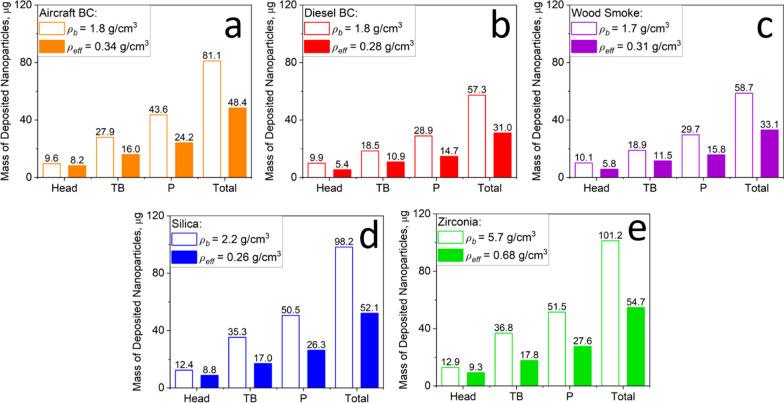
Here, the deposition of various environmental NPs (aircraft and diesel black carbon, wood smoke) and engineered NPs (silica, zirconia) in the respiratory system of humans and mice is calculated using the Multiple-Path Particle Dosimetry model accounting for their realistic structure and effective density. This is done by measuring the NP ρ which was found to be up to one order of magnitude smaller than ρ. Accounting for the realistic ρ of NPs reduces their deposited mass in the pulmonary region of the respiratory system up to a factor of two in both human and mouse models. Neglecting the ρ of NPs does not alter significantly the distribution of the deposited mass fractions in the human or mouse respiratory tract that are obtained by normalizing the mass deposited at the head, tracheobronchial and pulmonary regions by the total deposited mass. Finally, the total deposited mass fraction derived this way is in excellent agreement with those measured in human studies for diesel black carbon.
CONCLUSIONS
The doses of inhaled NPs are overestimated by inhalation particle deposition models when the ρ is used instead of the real-world effective density which can vary significantly due to the porous agglomerate structure of NPs. So the use of realistic ρ, which can be measured as described here, is essential to determine the lung deposition and dosimetry of inhaled NPs and their impact on public health.
背景
空气传播的环境和工程纳米颗粒(NPs)被吸入并沉积在呼吸系统中。吸入的 NPs 剂量及其在肺部的沉积位置决定了它们对健康的影响。在使用颗粒吸入模型计算 NP 沉积时,一种常见的方法是使用 bulk material density,ρ,而不是 effective density,ρ。尽管如此,这种方法忽略了 NPs 的多孔团聚体结构,可能导致它们在肺部沉积的剂量和位置出现显著误差。
结果
本文使用多路径颗粒剂量模型,计算了各种环境 NPs(飞机和柴油机黑碳、木烟)和工程 NPs(二氧化硅、氧化锆)在人体和小鼠呼吸系统中的沉积,该模型考虑了它们的真实结构和有效密度。具体方法是测量 NP 的 ρ,发现其值比 ρ 小一个数量级。考虑到 NPs 的真实 ρ,可以将其在人体和小鼠模型中肺部区域的沉积质量减少到原来的一半。忽略 NPs 的 ρ 不会显著改变通过将沉积在头部、气管支气管和肺部的质量与总沉积质量相除而得到的沉积质量分数在人体或小鼠呼吸道中的分布。最后,以这种方式得出的总沉积质量分数与柴油机黑碳在人体研究中测量的结果非常吻合。
结论
当使用 ρ 而不是真实世界的有效密度时,吸入颗粒沉积模型会高估吸入 NPs 的剂量,因为 NP 的多孔团聚体结构可能导致其有效密度发生显著变化。因此,使用真实的 ρ 是确定吸入 NPs 的肺部沉积和剂量学及其对公众健康影响的关键。


 Zotero 插件