
针刺疗法对胃癌和结直肠癌术后胃肠功能障碍的影响:一项伞状综述
Effect of acupuncture therapy for postoperative gastrointestinal dysfunction in gastric and colorectal cancers: an umbrella review.
作者信息
Wang Yuhan, Wang Linjia, Ni Xixiu, Jiang Minjiao, Zhao Ling
机构信息
Acupuncture and Moxibustion College, Chengdu University of Traditional Chinese Medicine, Chengdu, Sichuan, China.
Acupuncture and Moxibustion College, Nanjing University of Traditional Chinese Medicine, Nanjing, Jiangsu, China.
出版信息
Front Oncol. 2024 Feb 5;14:1291524. doi: 10.3389/fonc.2024.1291524. eCollection 2024.
BACKGROUND
Gastrointestinal dysfunction is a prevalent postoperative complication in patients undergoing surgery for gastric cancer and colorectal cancer. Acupuncture holds promise as a great potential therapeutic intervention. The efficacy of acupuncture therapy for postoperative gastrointestinal dysfunction has been assessed in some studies, however, the variability in results and study quality influences practical clinical application. Therefore, it is necessary to summarize and analyze the published clinical research data in this field.
OBJECTIVE
This study aimed to synthesize evidence from systematic reviews and meta-analyses in order to assess the efficacy of acupuncture therapy for postoperative gastrointestinal dysfunction in patients with gastric and colorectal cancer.
DESIGN
Umbrella review of systematic reviews and meta-analyses.
METHODS
We searched China National Knowledge Infrastructure (CNKI), Wanfang Data Knowledge Service Platform (Wanfang), China Science and Technology Journal Database (VIP), Chinese biomedical literature service system (SinoMed), PubMed, Embase, Cochrane Library, and Web of Science for all systematic review/meta-analysis of acupuncture for postoperative gastrointestinal dysfunction in gastric and colorectal cancers. From the establishment of the database to July 8, 2023. Two independent reviewers conducted literature extraction and evaluation. The quality of included studies was assessed using The preferred reporting items for systematic reviews and meta-analysis statements 2020 (PRISMA2020), the quality of the methods was assessed using a measuring tool to assess systematic reviews 2 (AMSTAR 2), and the level of evidence was assessed using the grading of recommendations assessment, development, and evaluation (GRADE). The statistical analysis was conducted using RevMan 5.4, and the effect size was expressed as Odds Ratio (OR), Mean Difference (MD), and 95% confidence interval (CI) based on the extracted data type (test level α= 0.05). The heterogeneity was assessed using the statistic and Q-test (χ). The outcome indicators such as time to first defecation and time to first flatus were utilized as endpoints to assess the efficacy of different acupuncture therapies.
RESULTS
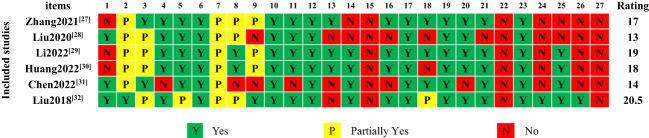
A total of six systematic reviews/meta-analyses were included in this study, involving 12 different acupuncture therapies. PRISMA 2020 indicated that the studies all scored between 13-20.5. There were deficiencies in protocol and registration, assessment of the quality of evidence for outcome indicators, risk of bias, and declaration of conflict of interest. The AMSTAR 2 evaluations showed that five studies were very low quality and one was low quality. The level of evidence for various acupuncture interventions varied from very low to moderate.For patients with gastrointestinal dysfunction after gastric cancer surgery, ear acupressure [MD=-11.92, 95% (-14.39,-9.44), <0.00001], moxibustion [MD=-19.16, 95% (-23.00,-16.22), <0.00001], warm needling [MD=-12.81, 95% (-17.61,-8.01), <0.00001], acupoint application [MD=-6.40, 95% (-10.26,-2.54), =0.001], manual acupuncture [MD=-18.32, 95% (-26.31,-10.39), <0.00001] and transcutaneous electrical acupoint stimulation (TEAS) [MD=-5.17, 95% (-9.59,-0.74), =0.02] could promote the recovery of gastrointestinal function after surgery.For postoperative colorectal cancer patients, electroacupuncture [MD=-15.17, 95% (-28.81,-1.54), <0.05], manual acupuncture [MD=-20.51, 95% (-39.19,-1.84), <0.05], warm needling [MD=-18.55, 95% (-23.86,-13.24), <0.05], ear acupressure [MD=-5.38, 95% (-9.80,-0.97), <0.05], acupoint application [MD=-26.30, 95% (-32.81,-19.79), <0.05], ear acupressure+acupressure [MD=-9.67, 95% (-13.58,-5.76), <0.05], ear acupressure+manual acupuncture [MD=-18.70, 95% (-21.01,-16.39), <0.05], ear acupressure+moxibustion [MD=-22.90, 95% (-30.10,-15.70), <0.05], moxibustion+acupressure [MD=-14.77, 95% (-20.59,-8.95), <0.05] improved postoperative gastrointestinal function. In addition, the efficacy of acupressure [MD=-12.00, 95% (-31.60,7.60), >0.05] needed to be further demonstrated.
CONCLUSION
Acupuncture therapy has a positive therapeutic impact on postoperative gastrointestinal dysfunction in gastric and colorectal cancers, but this finding should still be taken with caution.
背景
胃肠功能障碍是胃癌和结直肠癌手术患者常见的术后并发症。针灸有望成为一种极具潜力的治疗干预措施。一些研究评估了针刺疗法对术后胃肠功能障碍的疗效,然而,结果的变异性和研究质量影响了其在实际临床中的应用。因此,有必要总结和分析该领域已发表的临床研究数据。
目的
本研究旨在综合系统评价和荟萃分析的证据,以评估针刺疗法对胃癌和结直肠癌患者术后胃肠功能障碍的疗效。
设计
对系统评价和荟萃分析的伞状综述。
方法
我们检索了中国知网(CNKI)、万方数据知识服务平台(万方)、维普中文科技期刊数据库(VIP)、中国生物医学文献服务系统(SinoMed)、PubMed、Embase、Cochrane图书馆和Web of Science,以获取所有关于针刺治疗胃癌和结直肠癌术后胃肠功能障碍的系统评价/荟萃分析。从数据库建立至2023年7月8日。两名独立的评审员进行文献提取和评估。采用《系统评价和荟萃分析报告规范2020》(PRISMA2020)评估纳入研究的质量,使用系统评价测量工具2(AMSTAR 2)评估方法质量,使用推荐分级评估、制定和评价(GRADE)评估证据水平。使用RevMan 5.4进行统计分析,根据提取的数据类型,效应大小以比值比(OR)、平均差(MD)和95%置信区间(CI)表示(检验水准α=0.05)。使用I²统计量和Q检验(χ²)评估异质性。将首次排便时间和首次排气时间等结局指标作为评估不同针刺疗法疗效的终点。
结果
本研究共纳入6项系统评价/荟萃分析,涉及12种不同的针刺疗法。PRISMA 2020表明,这些研究的得分均在13 - 20.5之间。在方案和注册、结局指标证据质量评估、偏倚风险和利益冲突声明方面存在不足。AMSTAR 2评估显示,5项研究质量极低,1项研究质量低。各种针刺干预的证据水平从极低到中等不等。对于胃癌手术后胃肠功能障碍患者,耳穴按压[MD=-11.92,95%置信区间(-14.39,-9.44),P<0.00001]、艾灸[MD=-19.16,95%置信区间(-23.00,-16.22),P<0.00001]、温针[MD=-1十二点八一,95%置信区间(-17.61,-8.01),P<0.00001]、穴位贴敷[MD=-6.40,95%置信区间(-10.26,-2.54),P=0.001]、手针[MD=-18.32,95%置信区间(-26.31,-10.39),P<0.00001]和经皮穴位电刺激(TEAS)[MD=-5.17,95%置信区间(-9.59,-0.74),P=0.02]可促进术后胃肠功能恢复。对于结直肠癌术后患者,电针[MD=-15.17,95%置信区间(-28.81,-1.54),P<0.05]、手针[MD=-20.51,95%置信区间(-39.19,-1.84),P<0.05]、温针[MD=-18.55,95%置信区间(-23.八十七,-13.24),P<0.05]、耳穴按压[MD=-5.38,95%置信区间(-9.80,-0.97),P<0.05]、穴位贴敷[MD=-26.30,95%置信区间(-32.81,-19.79),P<0.05]、耳穴按压+指压[MD=-9.67,95%置信区间(-13.58,-5.76),P<0.05]、耳穴按压+手针[MD=-18.70,95%置信区间(-21.01,-16.39),P<0.05]、耳穴按压+艾灸[MD=-22.90,95%置信区间(-30.10,-15.70),P<0.05]、艾灸+指压[MD=-14.77,95%置信区间(-20.59,-8.95),P<0.05]可改善术后胃肠功能。此外,指压的疗效[MD=-12.00,95%置信区间(-31.60,7.60),P>0.05]尚需进一步证实。
结论
针刺疗法对胃癌和结直肠癌术后胃肠功能障碍有积极的治疗作用,但这一发现仍应谨慎对待。


 Zotero 插件