
宿主E3泛素连接酶ITCH介导效应子GRA35触发的NLRP1炎性小体激活和细胞自主免疫。
Host E3 ubiquitin ligase ITCH mediates effector GRA35-triggered NLRP1 inflammasome activation and cell-autonomous immunity.
作者信息
Wang Yifan, Hollingsworth L Robert, Sangaré Lamba Omar, Paredes-Santos Tatiana C, Krishnamurthy Shruthi, Penn Bennett H, Wu Hao, Saeij Jeroen P J
机构信息
Department of Pathology, Microbiology & Immunology, School of Veterinary Medicine, University of California, Davis, California, USA.
Department of Microbiology and Immunology, University of Michigan Medical School, Ann Arbor, Michigan, USA.
出版信息
mBio. 2024 Mar 13;15(3):e0330223. doi: 10.1128/mbio.03302-23. Epub 2024 Feb 20.
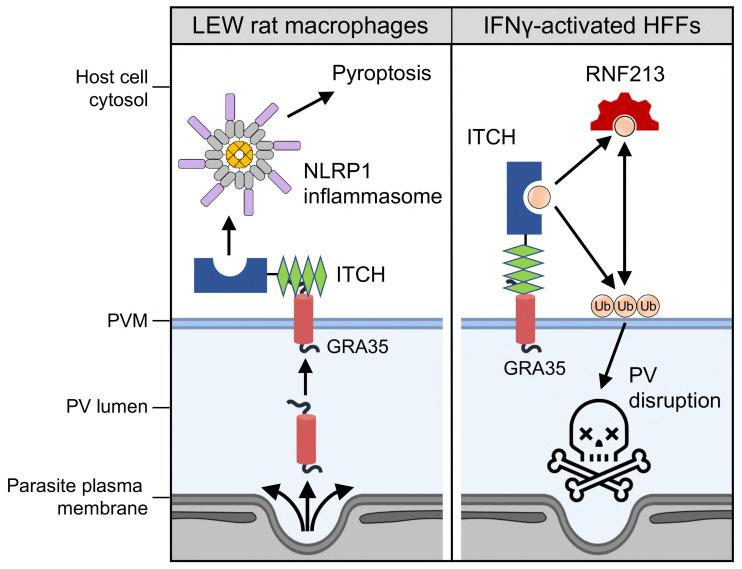
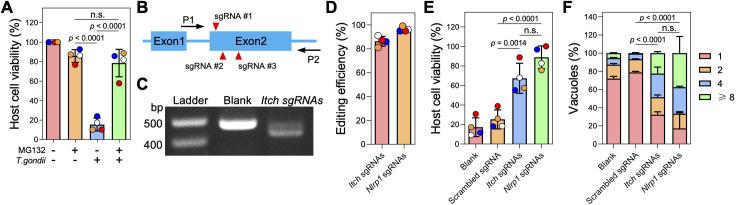
is an intracellular parasite that can activate the NLRP1 inflammasome leading to macrophage pyroptosis in Lewis rats, but the underlying mechanism is not well understood. In this study, we performed a genome-wide CRISPR screen and identified the dense granule proteins GRA35, GRA42, and GRA43 as the effectors mediating cell death in Lewis rat macrophages. GRA35 localizes on the parasitophorous vacuole membrane, where it interacts with the host E3 ubiquitin ligase ITCH. Inhibition of proteasome activity or ITCH knockout prevented pyroptosis in -infected Lewis rat macrophages, consistent with the "NLRP1 functional degradation model." However, there was no evidence that ITCH directly ubiquitinates or interacts with rat NLRP1. We also found that GRA35-ITCH interaction affected fitness in IFNγ-activated human fibroblasts, likely due to ITCH's role in recruiting ubiquitin and the parasite-restriction factor RNF213 to the parasitophorous vacuole membrane. These findings identify a new role of host E3 ubiquitin ligase ITCH in mediating effector-triggered immunity, a critical concept that involves recognizing intracellular pathogens and initiating host innate immune responses.IMPORTANCEEffector-triggered immunity represents an innate immune defense mechanism that plays a crucial role in sensing and controlling intracellular pathogen infection. The NLRP1 inflammasome in the Lewis rats can detect infection, which triggers proptosis in infected macrophages and eliminates the parasite's replication niche. The work reported here revealed that host E3 ubiquitin ligase ITCH is able to recognize and interact with effector protein GRA35 localized on the parasite-host interface, leading to NLRP1 inflammasome activation in Lewis rat macrophages. Furthermore, ITCH-GRA35 interaction contributes to the restriction of in human fibroblasts stimulated by IFNγ. Thus, this research provides valuable insights into understanding pathogen recognition and restriction mediated by host E3 ubiquitin ligase.
是一种细胞内寄生虫,可激活NLRP1炎性小体,导致Lewis大鼠巨噬细胞发生焦亡,但其潜在机制尚不清楚。在本研究中,我们进行了全基因组CRISPR筛选,并确定致密颗粒蛋白GRA35、GRA42和GRA43是介导Lewis大鼠巨噬细胞死亡的效应蛋白。GRA35定位于寄生泡膜上,在那里它与宿主E3泛素连接酶ITCH相互作用。蛋白酶体活性的抑制或ITCH基因敲除可阻止感染的Lewis大鼠巨噬细胞发生焦亡,这与“NLRP1功能降解模型”一致。然而,没有证据表明ITCH直接泛素化大鼠NLRP1或与大鼠NLRP1相互作用。我们还发现GRA35-ITCH相互作用影响了IFNγ激活的人成纤维细胞中的适应性,这可能是由于ITCH在将泛素和寄生虫限制因子RNF213募集到寄生泡膜中的作用。这些发现确定了宿主E3泛素连接酶ITCH在介导效应物触发的免疫中的新作用,这是一个涉及识别细胞内病原体和启动宿主先天免疫反应的关键概念。重要性效应物触发的免疫是一种先天免疫防御机制,在感知和控制细胞内病原体感染中起关键作用。Lewis大鼠中的NLRP1炎性小体可以检测感染,这会触发感染巨噬细胞中的焦亡并消除寄生虫的复制位点。本文报道的工作表明,宿主E3泛素连接酶ITCH能够识别并与位于寄生虫-宿主界面的效应蛋白GRA35相互作用,导致Lewis大鼠巨噬细胞中NLRP1炎性小体激活。此外,ITCH-GRA35相互作用有助于在IFNγ刺激的人成纤维细胞中限制。因此,这项研究为理解宿主E3泛素连接酶介导的病原体识别和限制提供了有价值的见解。



 Zotero 插件