
全身性骨关节炎:对一种连续性病症进行明确命名的困难。
Systemic osteoarthritis: the difficulty of categorically naming a continuous condition.
作者信息
Herrero-Beaumont Gabriel, Castro-Dominguez Francisco, Migliore Alberto, Naredo Esperanza, Largo Raquel, Reginster Jean-Yves
机构信息
Bone and Joint Research Unit, Rheumatology Dept, IIS-Fundación Jiménez Díaz UAM, Madrid, Spain.
Rheumatology Department, Teknon Medical Center, Quironsalud Group, Barcelona, Spain.
出版信息
Aging Clin Exp Res. 2024 Feb 20;36(1):45. doi: 10.1007/s40520-024-02714-w.
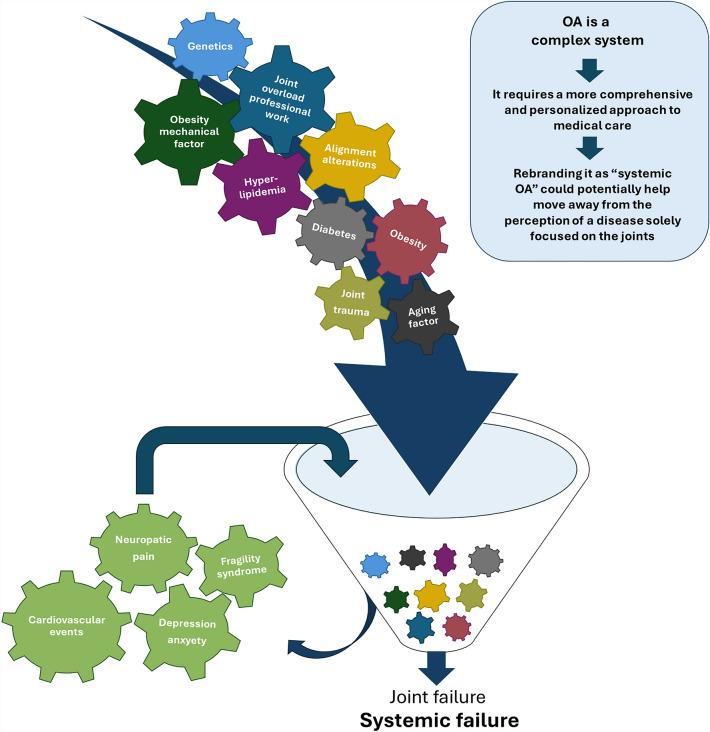
Osteoarthritis (OA) is a disease with systemic implications that go beyond joint problems. Its pathogenic mechanisms involve a variety of systemic conditions that contribute to joint damage. These include metabolic dysfunction, chronic low-grade inflammation, neuroplastic pain, and the influence of the central nervous system in the development of neuropathic pain. Besides, OA can negatively affect other aspects of health, such as quality of life, reduced physical activity, social isolation, depression, and anxiety. OA can be considered a complex system in which pathological interactions involve not only obesity and metabolic dysfunction, but also fragility syndrome, sarcopenia, neurological complications, and systemic energy redistribution. Complex systems are composed of multiple interacting and dynamic parts and exhibit emergent properties that cannot be fully explained by examining their individual components. Chronic low-grade inflammation is characteristic of OA, occurring both in the affected joint, and systemically, mainly due to adipose tissue inflammation in obese patients. Obesity is a key factor in the progression of OA, so primary treatment should focus on its control, while maintaining muscle health. The chronic inflammation could lead to changes in energy distribution among the affected joint tissues. Therefore, OA should be approached as a systemic disease, considering individual patient factors, such as genetics, inflammatory response, and lifestyle. Medical care should be more holistic and personalized. Consideration of a name change, such as "systemic OA", could help to move away from the perception of a disease focused only on the joints.
骨关节炎(OA)是一种具有全身性影响的疾病,其影响范围超出关节问题。其致病机制涉及多种导致关节损伤的全身性状况。这些状况包括代谢功能障碍、慢性低度炎症、神经可塑性疼痛以及中枢神经系统在神经性疼痛发展过程中的影响。此外,骨关节炎会对健康的其他方面产生负面影响,如生活质量下降、身体活动减少、社交孤立、抑郁和焦虑。骨关节炎可被视为一个复杂的系统,其中病理相互作用不仅涉及肥胖和代谢功能障碍,还涉及脆性综合征、肌肉减少症、神经并发症和全身能量重新分配。复杂系统由多个相互作用的动态部分组成,并表现出一些通过检查其各个组成部分无法完全解释的涌现特性。慢性低度炎症是骨关节炎的特征,在受影响的关节以及全身均会出现,主要是由于肥胖患者的脂肪组织炎症所致。肥胖是骨关节炎进展的关键因素,因此主要治疗应侧重于对其进行控制,同时维持肌肉健康。慢性炎症可能导致受影响关节组织之间的能量分布发生变化。因此,应将骨关节炎视为一种全身性疾病,考虑个体患者因素,如遗传、炎症反应和生活方式。医疗护理应更加全面和个性化。考虑更改疾病名称,如“全身性骨关节炎”,可能有助于摆脱仅关注关节疾病的观念。
 Zotero 插件