
自由空间中的衍射光学计算。
Diffractive optical computing in free space.
作者信息
Hu Jingtian, Mengu Deniz, Tzarouchis Dimitrios C, Edwards Brian, Engheta Nader, Ozcan Aydogan
机构信息
Electrical and Computer Engineering Department, University of California, Los Angeles, CA, 90095, USA.
Bioengineering Department, University of California, Los Angeles, CA, 90095, USA.
出版信息
Nat Commun. 2024 Feb 20;15(1):1525. doi: 10.1038/s41467-024-45982-w.
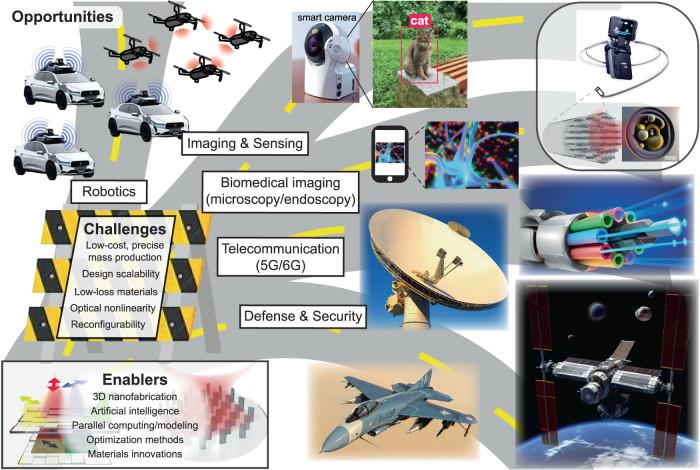
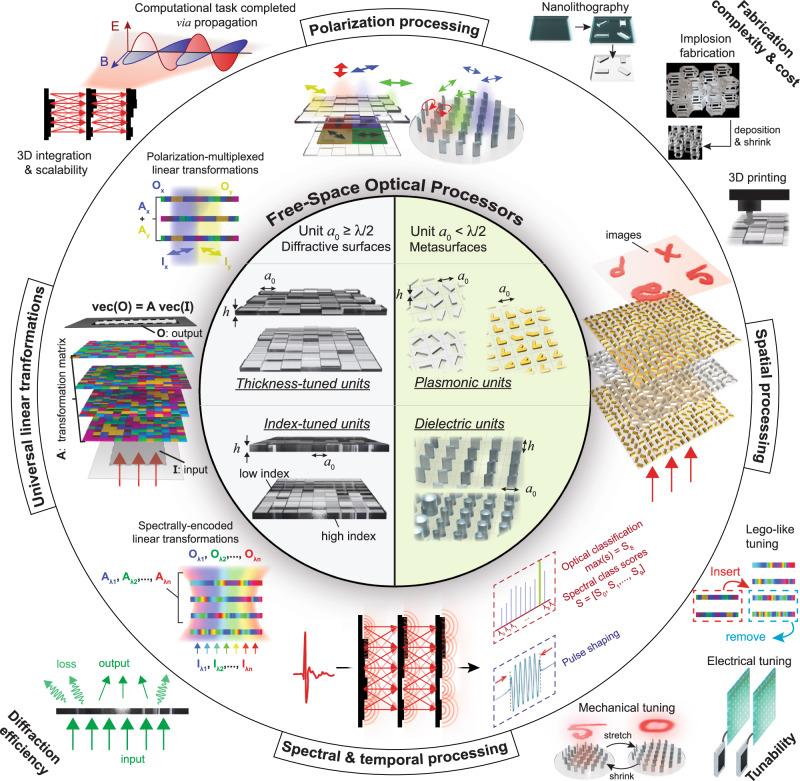
Structured optical materials create new computing paradigms using photons, with transformative impact on various fields, including machine learning, computer vision, imaging, telecommunications, and sensing. This Perspective sheds light on the potential of free-space optical systems based on engineered surfaces for advancing optical computing. Manipulating light in unprecedented ways, emerging structured surfaces enable all-optical implementation of various mathematical functions and machine learning tasks. Diffractive networks, in particular, bring deep-learning principles into the design and operation of free-space optical systems to create new functionalities. Metasurfaces consisting of deeply subwavelength units are achieving exotic optical responses that provide independent control over different properties of light and can bring major advances in computational throughput and data-transfer bandwidth of free-space optical processors. Unlike integrated photonics-based optoelectronic systems that demand preprocessed inputs, free-space optical processors have direct access to all the optical degrees of freedom that carry information about an input scene/object without needing digital recovery or preprocessing of information. To realize the full potential of free-space optical computing architectures, diffractive surfaces and metasurfaces need to advance symbiotically and co-evolve in their designs, 3D fabrication/integration, cascadability, and computing accuracy to serve the needs of next-generation machine vision, computational imaging, mathematical computing, and telecommunication technologies.
结构化光学材料利用光子创造了新的计算范式,对包括机器学习、计算机视觉、成像、电信和传感在内的各个领域产生了变革性影响。本文阐述了基于工程表面的自由空间光学系统在推进光学计算方面的潜力。新兴的结构化表面以前所未有的方式操纵光,实现了各种数学函数和机器学习任务的全光实现。特别是,衍射网络将深度学习原理引入自由空间光学系统的设计和运行中,以创造新的功能。由深亚波长单元组成的超表面正在实现奇异的光学响应,能够对光的不同特性进行独立控制,并可为自由空间光学处理器的计算吞吐量和数据传输带宽带来重大进展。与需要预处理输入的基于集成光子学的光电子系统不同,自由空间光学处理器可以直接访问所有携带输入场景/物体信息的光学自由度,而无需对信息进行数字恢复或预处理。为了充分发挥自由空间光学计算架构的潜力,衍射表面和超表面需要在设计、3D制造/集成、级联性和计算精度方面协同发展,以满足下一代机器视觉、计算成像、数学计算和电信技术的需求。


 Zotero 插件