
计算重要的内容:评估痴呆养老院居民的生活质量及其社会决定因素。
Counting what counts: assessing quality of life and its social determinants among nursing home residents with dementia.
机构信息
School of Health Policy and Management, Faculty of Health, York University, Room 301E Stong College, 4700 Keele StreetON, Toronto, M3J 1P3, Canada.
Faculty of Nursing, College of Health Sciences, University of Alberta, Edmonton, AB, Canada.
出版信息
BMC Geriatr. 2024 Feb 21;24(1):177. doi: 10.1186/s12877-024-04710-1.
BACKGROUND
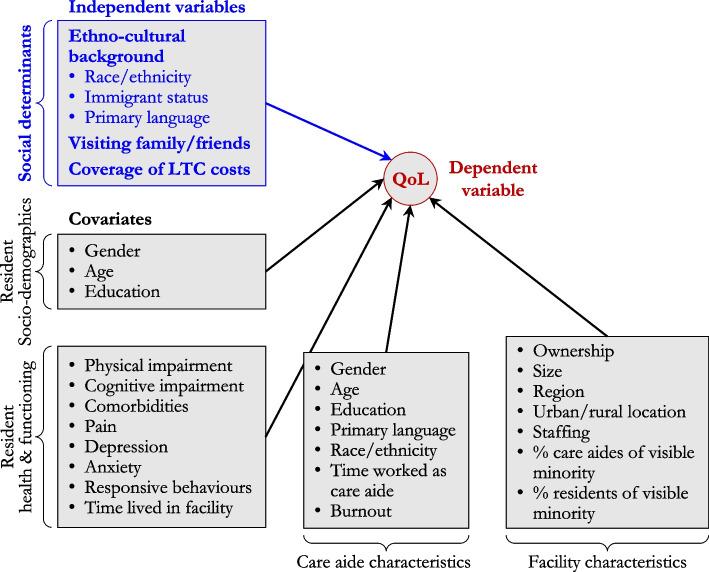
Maximizing quality of life (QoL) is a major goal of care for people with dementia in nursing homes (NHs). Social determinants are critical for residents' QoL. However, similar to the United States and other countries, most Canadian NHs routinely monitor and publicly report quality of care, but not resident QoL and its social determinants. Therefore, we lack robust, quantitative studies evaluating the association of multiple intersecting social determinants with NH residents' QoL. The goal of this study is to address this critical knowledge gap.
METHODS
We will recruit a random sample of 80 NHs from 5 Canadian provinces (Alberta, British Columbia, Manitoba, Nova Scotia, Ontario). We will stratify facilities by urban/rural location, for-profit/not-for-profit ownership, and size (above/below median number of beds among urban versus rural facilities in each province). In video-based structured interviews with care staff, we will complete QoL assessments for each of ~ 4,320 residents, using the DEMQOL-CH, a validated, feasible tool for this purpose. We will also assess resident's social determinants of QoL, using items from validated Canadian population surveys. Health and quality of care data will come from routinely collected Resident Assessment Instrument - Minimum Data Set 2.0 records. Knowledge users (health system decision makers, Alzheimer Societies, NH managers, care staff, people with dementia and their family/friend caregivers) have been involved in the design of this study, and we will partner with them throughout the study. We will share and discuss study findings with knowledge users in web-based summits with embedded focus groups. This will provide much needed data on knowledge users' interpretations, usefulness and intended use of data on NH residents' QoL and its health and social determinants.
DISCUSSION
This large-scale, robust, quantitative study will address a major knowledge gap by assessing QoL and multiple intersecting social determinants of QoL among NH residents with dementia. We will also generate evidence on clusters of intersecting social determinants of QoL. This study will be a prerequisite for future studies to investigate in depth the mechanisms leading to QoL inequities in LTC, longitudinal studies to identify trajectories in QoL, and robust intervention studies aiming to reduce these inequities.
背景
提高生活质量(QoL)是养老院(NH)中痴呆症患者护理的主要目标。社会决定因素对居民的 QoL 至关重要。然而,与美国和其他国家一样,大多数加拿大 NH 通常会监测和公开报告护理质量,但不监测居民的 QoL 和其社会决定因素。因此,我们缺乏评估多个相互交叉的社会决定因素与 NH 居民 QoL 之间关联的强有力的定量研究。本研究的目的是解决这一关键的知识空白。
方法
我们将从加拿大 5 个省(艾伯塔省、不列颠哥伦比亚省、马尼托巴省、新斯科舍省、安大略省)中随机抽取 80 家 NH。我们将根据地理位置(城市/农村)、所有制(营利/非营利)和规模(每个省城市与农村设施中床位中位数以上/以下)对设施进行分层。在与护理人员进行的基于视频的结构化访谈中,我们将使用经过验证的、适用于此目的的 DEMQOL-CH 工具,对大约 4320 名居民中的每一位进行 QoL 评估。我们还将使用来自经过验证的加拿大人口调查的项目评估居民 QoL 的社会决定因素。健康和护理质量数据将来自常规收集的居民评估工具-最低数据集中 2.0 记录。知识使用者(卫生系统决策者、阿尔茨海默病协会、NH 经理、护理人员、痴呆症患者及其家庭/朋友护理人员)参与了本研究的设计,我们将在整个研究过程中与他们合作。我们将在网络研讨会上分享和讨论研究结果,并在其中嵌入焦点小组,以便与知识使用者进行讨论。这将提供有关 NH 居民 QoL 及其健康和社会决定因素的知识使用者解释、有用性和预期用途的数据,这是非常需要的。
讨论
这项大规模、稳健的定量研究将通过评估患有痴呆症的 NH 居民的 QoL 和多个相互交叉的 QoL 社会决定因素来解决一个主要的知识空白。我们还将生成有关 QoL 社会决定因素聚类的证据。这项研究将是未来研究调查长期护理中 QoL 不平等现象的机制、确定 QoL 轨迹以及开展旨在减少这些不平等现象的强有力干预研究的前提。
 Zotero 插件