
下颌骨缺损的一种新分类以及在采用游离腓骨瓣进行下颌骨重建后髁突的变化。
A new classification of mandible defects and condyle changed after mandible reconstruction with FFF.
作者信息
Wang Yaxi, Chen Guosheng, Zhou Nuo, Huang Xuanping
机构信息
Guangxi Medical University, Nanning, 530021, PR China.
Department of Oral and Maxillofacial Surgery, The Affiliated Stomatology Hospital of Guangxi Medical University, Nanning, 530021, PR China.
出版信息
Heliyon. 2024 Feb 10;10(4):e25831. doi: 10.1016/j.heliyon.2024.e25831. eCollection 2024 Feb 29.
OBJECTIVES
To explore a new classification of mandibular defects and changes in the preserved condyle after mandibular reconstruction with free fibular flap(FFF).
STUDY DESIGN
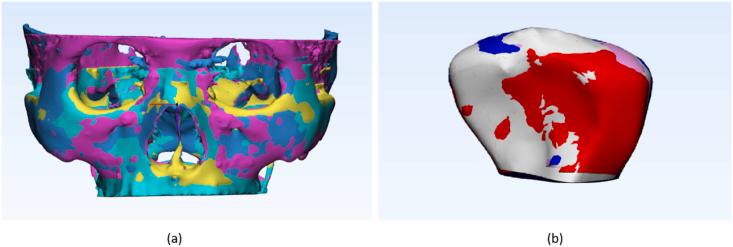
We reviewed patients who underwent mandibular reconstruction with FFF from 2015 to 2021 and classified the mandibular defects into five categories: classⅠ(unilateral-mandibular excluding condyle), classⅡ(unilateral-mandibular including condyle), classⅢ(bilateral-mandibular excluding condyle), classⅣ(bilateral-mandibular including one condyle), and classⅤ(bilateral-mandibular including both condyles). Cone Beam Computed Tomography (CBCT) data were collected preoperatively(T0), at 7-10 postoperative days(T1), 6 postoperative months(T2), and 1 postoperative year(T3). We calculated the condylar surface area, volume, and displacement.
RESULTS
62 cases were collected. The condylar surface areas and volumes in T2 and T3 values were lower than those of T0 and T1(P < 0.01) The condylar displacement was the lowest in ClassI and the largest in ClassⅣ(P < 0.01), while no significant differences in classesⅠ-Ⅲ(P < 0.05). Displacement during T1-T0 was greater than that during T2-T0 and T3-T0(P < 0.05).
CONCLUSION
Mandibular reconstruction with FFF results in displacement and alteration of the condyle within a time interval, and this alteration stabilizes after 6 months. Mandibular defects that do not reach the midline, surgical alteration to preserve the condyle are not required. However, when the defects cross the midline, the condyle should be preserved as much as possible.
目的
探索下颌骨缺损的新分类方法以及游离腓骨瓣(FFF)下颌骨重建术后保留髁突的变化。
研究设计
我们回顾了2015年至2021年接受FFF下颌骨重建的患者,并将下颌骨缺损分为五类:Ⅰ类(单侧下颌骨,不包括髁突)、Ⅱ类(单侧下颌骨,包括髁突)、Ⅲ类(双侧下颌骨,不包括髁突)、Ⅳ类(双侧下颌骨,包括一个髁突)和Ⅴ类(双侧下颌骨,包括两个髁突)。术前(T0)、术后7 - 10天(T1)、术后6个月(T2)和术后1年(T3)收集锥形束计算机断层扫描(CBCT)数据。我们计算了髁突表面积、体积和位移。
结果
共收集62例病例。T2和T3时的髁突表面积和体积值低于T0和T1(P < 0.01)。髁突位移在Ⅰ类中最低,在Ⅳ类中最大(P < 0.01),而Ⅰ - Ⅲ类之间无显著差异(P < 0.05)。T1 - T0期间的位移大于T2 - T0和T3 - T0期间的位移(P < 0.05)。
结论
FFF下颌骨重建在一定时间间隔内会导致髁突位移和改变,这种改变在6个月后稳定。未达中线的下颌骨缺损,无需手术改变以保留髁突。然而,当缺损越过中线时,应尽可能保留髁突。



 Zotero 插件