
在地面和虚拟全方位跑步机上行走时的步态模式。
Gait patterns during overground and virtual omnidirectional treadmill walking.
机构信息
Department of Biomedical Engineering, Cleveland Clinic, Cleveland, OH, USA.
School of Medicine, Case Western Reserve University, Cleveland, OH, USA.
出版信息
J Neuroeng Rehabil. 2024 Feb 22;21(1):29. doi: 10.1186/s12984-023-01286-6.
BACKGROUND
Omnidirectional treadmills (ODTs) offer a promising solution to the virtual reality (VR) locomotion problem, which describes the mismatch between visual and somatosensory information and contributes to VR sickness. However, little is known about how walking on ODTs impacts the biomechanics of gait. This project aimed to compare overground and ODT walking and turning in healthy young adults.
METHODS
Fifteen young adults completed forward walk, 180° turn, and 360° turn tasks under three conditions: (1) overground, (2) on the Infinadeck ODT in a virtual environment without a handrail, and (3) on the ODT with a handrail. Kinematic data for all walking trials were gathered using 3D optical motion capture.
RESULTS
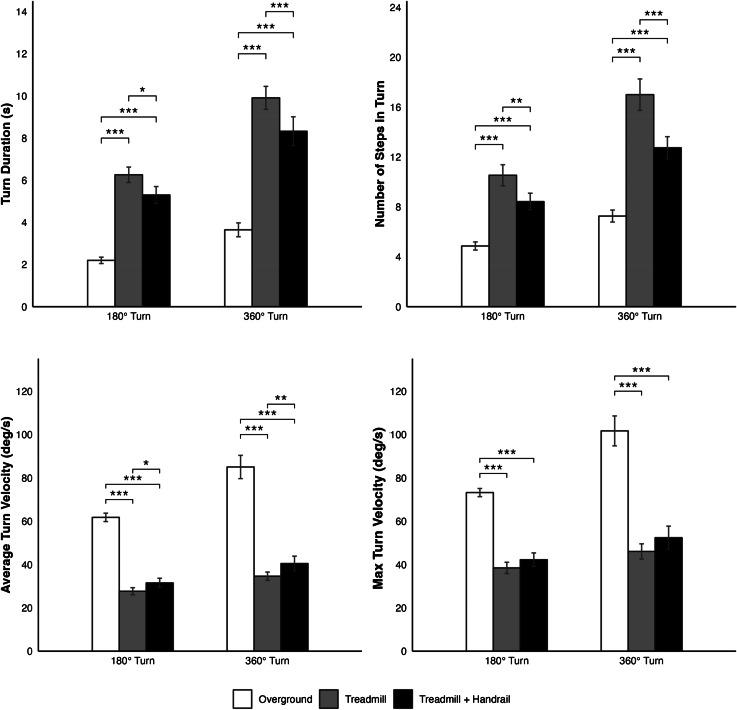
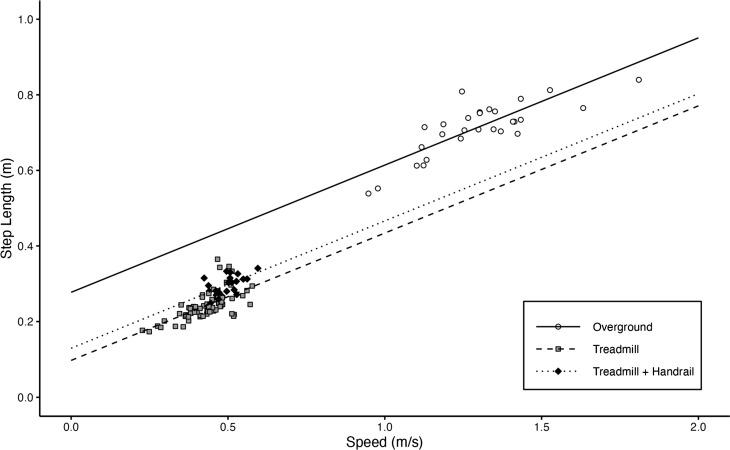
Overall, gait speed was slower during ODT walking than overground. When controlling for gait speed, ODT walking resulted in shorter steps and greater variability in step length. There were no significant differences in other spatiotemporal metrics between ODT and overground walking. Turning on the ODT required more steps and slower rotational speeds than overground turns. The addition of the stability handrail to the ODT resulted in decreased gait variability relative to the ODT gait without the handrail.
CONCLUSION
Walking on an ODT resembles natural gait patterns apart from slower gait speed and shorter step length. Slower walking and shorter step length are likely due to the novelty of physically navigating a virtual environment which may result in a more conservative approach to gait. Future work will evaluate how older adults and those with neurological disease respond to ODT walking.
背景
全方位跑步机(ODT)为虚拟现实(VR)运动问题提供了一个有前途的解决方案,该问题描述了视觉和体感信息之间的不匹配,导致 VR 病。然而,关于在 ODT 上行走如何影响步态的生物力学知之甚少。本项目旨在比较健康年轻人在 ODT 上和在地面上的行走和转弯。
方法
15 名年轻人在三种条件下完成了前进走、180°转弯和 360°转弯任务:(1)在地面上,(2)在没有扶手的虚拟环境中的 Infinadeck ODT 上,以及(3)在带有扶手的 ODT 上。所有行走试验的运动学数据均使用 3D 光学运动捕捉收集。
结果
总体而言,ODT 行走时的步速比在地面上慢。当控制步速时,ODT 行走导致步长更短且步长变化更大。ODT 和在地面上行走的其他时空度量之间没有显着差异。在 ODT 上转弯需要比在地面上转弯更多的步骤和更慢的旋转速度。将稳定性扶手添加到 ODT 上会导致相对于没有扶手的 ODT 步态,步态变化减小。
结论
除了较慢的步速和较短的步长外,在 ODT 上行走类似于自然的步态模式。较慢的行走和较短的步长可能是由于身体在虚拟环境中导航的新颖性,这可能导致对步态的更保守方法。未来的工作将评估老年人和患有神经疾病的人对 ODT 行走的反应。


 Zotero 插件