
生命周期中的昼夜节律紊乱会损害成年小鼠的葡萄糖稳态和胰岛素敏感性。
Circadian Disruption across Lifespan Impairs Glucose Homeostasis and Insulin Sensitivity in Adult Mice.
作者信息
Her Tracy K, Li Jin, Lin Hao, Liu Dong, Root Kate M, Regal Jean F, Alejandro Emilyn U, Cao Ruifeng
机构信息
Department of Integrative Biology and Physiology, University of Minnesota Medical School, Minneapolis, MN 55455, USA.
Department of Biomedical Sciences, University of Minnesota Medical School, Duluth, MN 55812, USA.
出版信息
Metabolites. 2024 Feb 16;14(2):126. doi: 10.3390/metabo14020126.
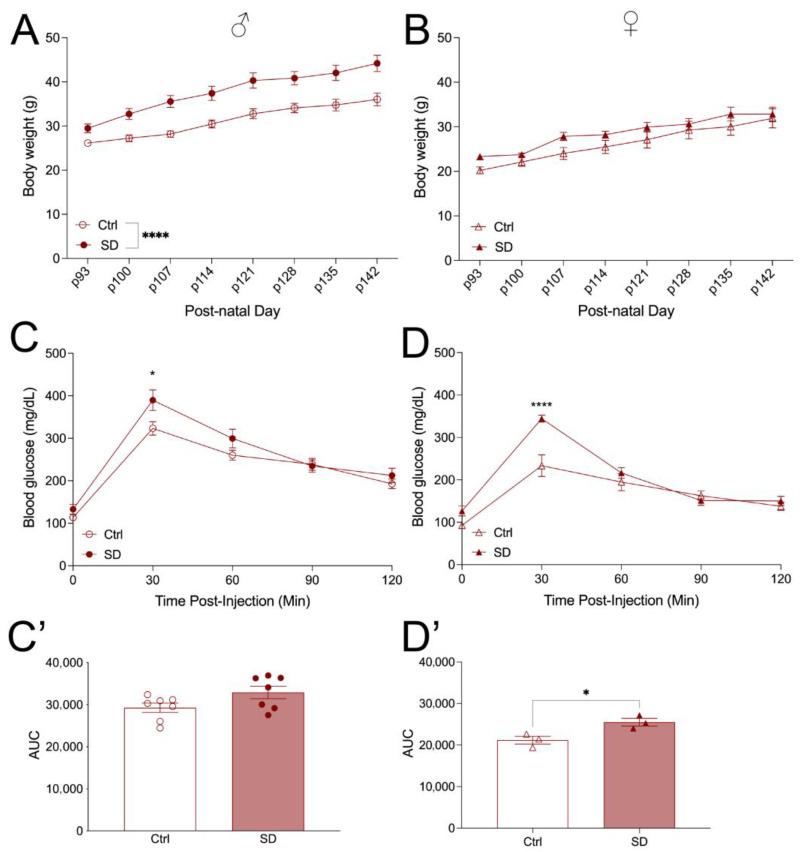
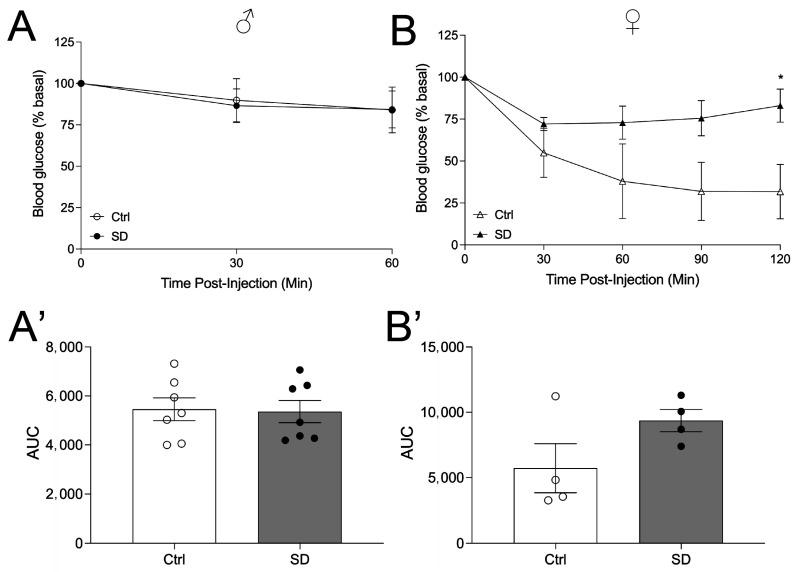
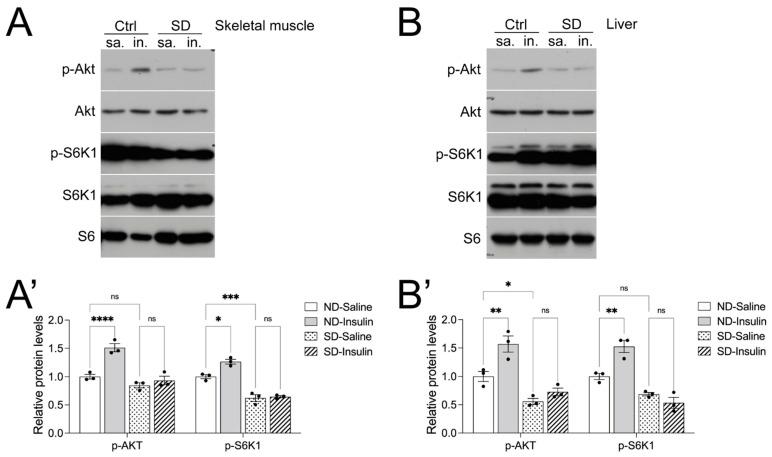
Circadian rhythm disruption is associated with impaired glucose homeostasis and type 2 diabetes. For example, night shift work is associated with an increased risk of gestational diabetes. However, the effects of chronic circadian disruption since early life on adult metabolic health trajectory remain unknown. Here, using the "Short Day" (SD) mouse model, in which an 8 h/8 h light/dark (LD) cycle was used to disrupt mouse circadian rhythms across the lifespan, we investigated glucose homeostasis in adult mice. Adult SD mice were fully entrained into the 8 h/8 h LD cycle, and control mice were entrained into the 12 h/12 h LD cycle. Under a normal chow diet, female and male SD mice displayed a normal body weight trajectory. However, female but not male SD mice under a normal chow diet displayed glucose intolerance and insulin resistance, which are associated with impaired insulin signaling/AKT in the skeletal muscle and liver. Under high-fat diet (HFD) challenges, male but not female SD mice demonstrated increased body weight gain compared to controls. Both male and female SD mice developed glucose intolerance under HFD. Taken together, these results demonstrate that environmental disruption of circadian rhythms contributes to obesity in a sexually dimorphic manner but increases the risk of glucose intolerance and insulin resistance in both males and females.
昼夜节律紊乱与葡萄糖稳态受损和2型糖尿病有关。例如,夜班工作与妊娠期糖尿病风险增加有关。然而,早年开始的慢性昼夜节律紊乱对成年后代谢健康轨迹的影响尚不清楚。在此,我们使用“短日照”(SD)小鼠模型,其中采用8小时/8小时光照/黑暗(LD)循环在小鼠整个生命周期内扰乱其昼夜节律,我们研究了成年小鼠的葡萄糖稳态。成年SD小鼠完全适应了8小时/8小时LD循环,对照小鼠则适应了12小时/12小时LD循环。在正常饲料饮食下,雌性和雄性SD小鼠的体重轨迹正常。然而,正常饲料饮食下的雌性而非雄性SD小鼠表现出葡萄糖不耐受和胰岛素抵抗,这与骨骼肌和肝脏中胰岛素信号/AKT受损有关。在高脂饮食(HFD)挑战下,与对照相比,雄性而非雌性SD小鼠体重增加更多。雄性和雌性SD小鼠在HFD下均出现葡萄糖不耐受。综上所述,这些结果表明,昼夜节律的环境扰乱以性别差异的方式导致肥胖,但增加了雄性和雌性葡萄糖不耐受和胰岛素抵抗的风险。


 Zotero 插件