
当前对免疫性血小板减少症的认识:发病机制和治疗选择的综述。
Current Understanding of Immune Thrombocytopenia: A Review of Pathogenesis and Treatment Options.
机构信息
Department of Hematology, Carol Davila University of Medicine and Pharmacy, Emergency University Hospital of Bucharest, 050098 Bucharest, Romania.
Department of Physiology, Carol Davila University of Medicine and Pharmacy, 050471 Bucharest, Romania.
出版信息
Int J Mol Sci. 2024 Feb 10;25(4):2163. doi: 10.3390/ijms25042163.
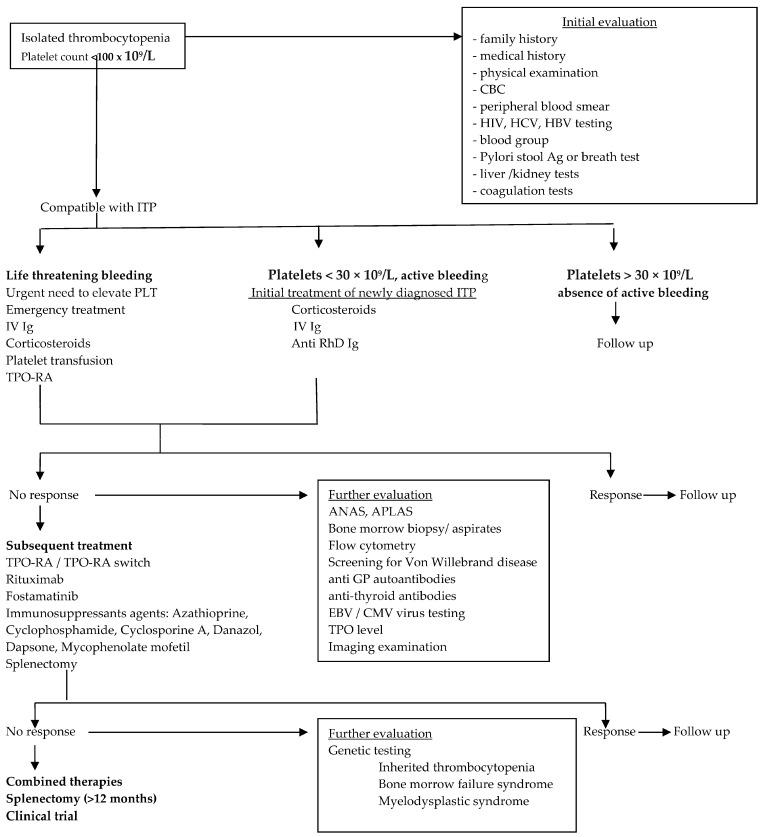
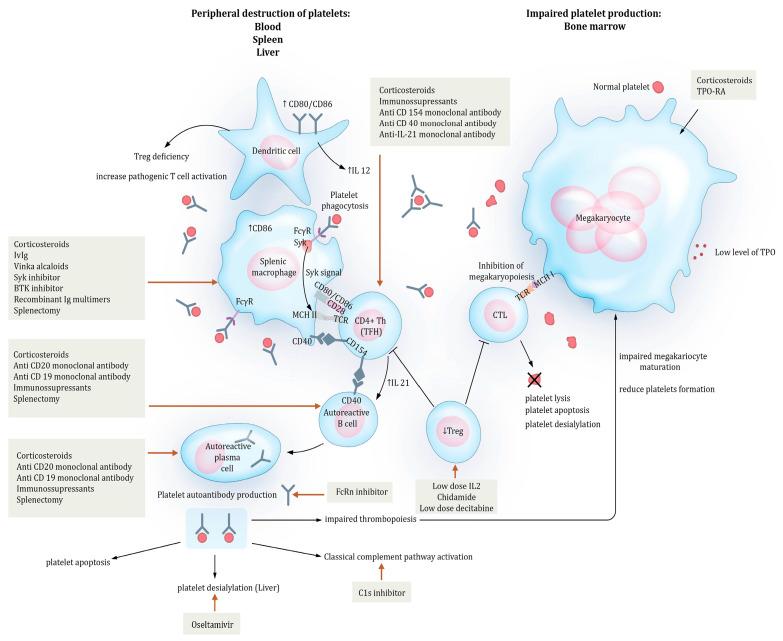
The management of immune thrombocytopenia (ITP) and the prediction of patient response to therapy still represent a significant and constant challenge in hematology. ITP is a heterogeneous disease with an unpredictable evolution. Although the pathogenesis of ITP is currently better known and its etiology has been extensively studied, up to 75% of adult patients with ITP may develop chronicity, which represents a significant burden on patients' quality of life. A major risk of ITP is bleeding, but knowledge on the exact relationship between the degree of thrombocytopenia and bleeding symptoms, especially at a lower platelet count, is lacking. The actual management of ITP is based on immune suppression (corticosteroids and intravenous immunoglobulins), or the use of thrombopoietin receptor agonists (TPO-RAs), rituximab, or spleen tyrosine kinase (Syk) inhibitors. A better understanding of the underlying pathology has facilitated the development of a number of new targeted therapies (Bruton's tyrosine kinase inhibitors, neonatal Fc receptors, strategies targeting B and plasma cells, strategies targeting T cells, complement inhibitors, and newer TPO-RAs for improving megakaryopoiesis), which seem to be highly effective and well tolerated and result in a significant improvement in patients' quality of life. The disadvantage is that there is a lack of knowledge of the predictive factors of response to treatments, which would help in the development of an optimized treatment algorithm for selected patients.
免疫性血小板减少症 (ITP) 的管理和对治疗反应的预测仍然是血液学领域的一个重大挑战。ITP 是一种异质性疾病,具有不可预测的演变。尽管 ITP 的发病机制目前更为了解,其病因也得到了广泛研究,但高达 75%的成人 ITP 患者可能发展为慢性疾病,这对患者的生活质量造成了重大负担。ITP 的一个主要风险是出血,但对血小板减少症程度与出血症状之间的确切关系(尤其是在血小板计数较低时)的了解还很有限。ITP 的实际管理基于免疫抑制(皮质类固醇和静脉注射免疫球蛋白),或使用血小板生成素受体激动剂 (TPO-RA)、利妥昔单抗或脾酪氨酸激酶 (Syk) 抑制剂。对潜在病理学的更好理解促进了许多新的靶向治疗方法(布鲁顿酪氨酸激酶抑制剂、新生 Fc 受体、针对 B 细胞和浆细胞的策略、针对 T 细胞的策略、补体抑制剂和新型 TPO-RA 以改善巨核细胞生成)的发展,这些方法似乎非常有效且耐受良好,可显著改善患者的生活质量。缺点是缺乏对治疗反应的预测因素的了解,这有助于为选定的患者制定优化的治疗算法。
 Zotero 插件