
电针通过小鼠大脑中神经元/小胶质细胞失活和Toll样受体4减轻纤维肌痛疼痛:化学遗传学的精确解释
Electroacupuncture Reduces Fibromyalgia Pain via Neuronal/Microglial Inactivation and Toll-like Receptor 4 in the Mouse Brain: Precise Interpretation of Chemogenetics.
作者信息
Tsai Sheng-Ta, Yang Chia-Chun, Liao Hsien-Yin, Lin Yi-Wen
机构信息
Department of Neurology, China Medical University Hospital, Taichung 404332, Taiwan.
School of Medicine, China Medical University, Taichung 404328, Taiwan.
出版信息
Biomedicines. 2024 Feb 7;12(2):387. doi: 10.3390/biomedicines12020387.
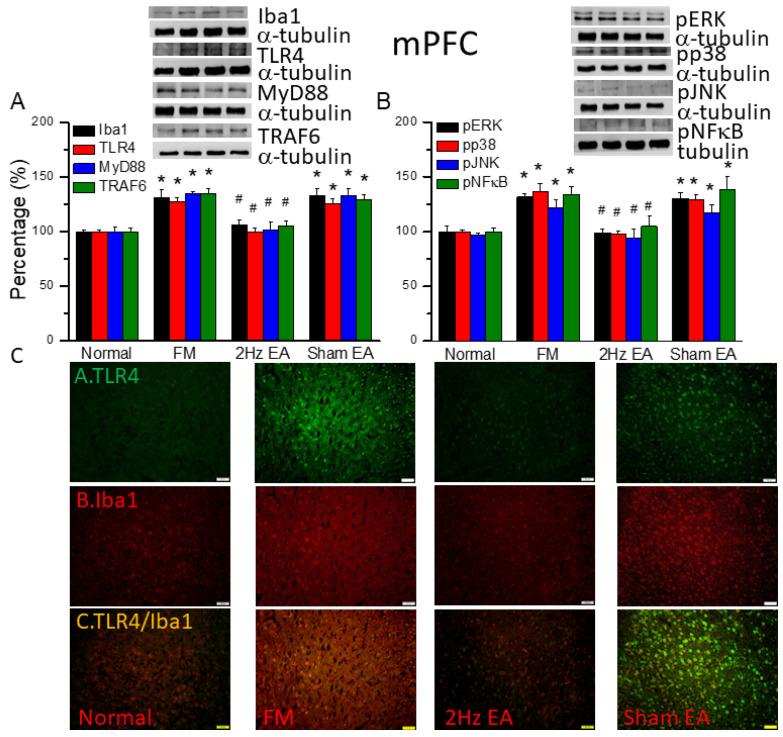
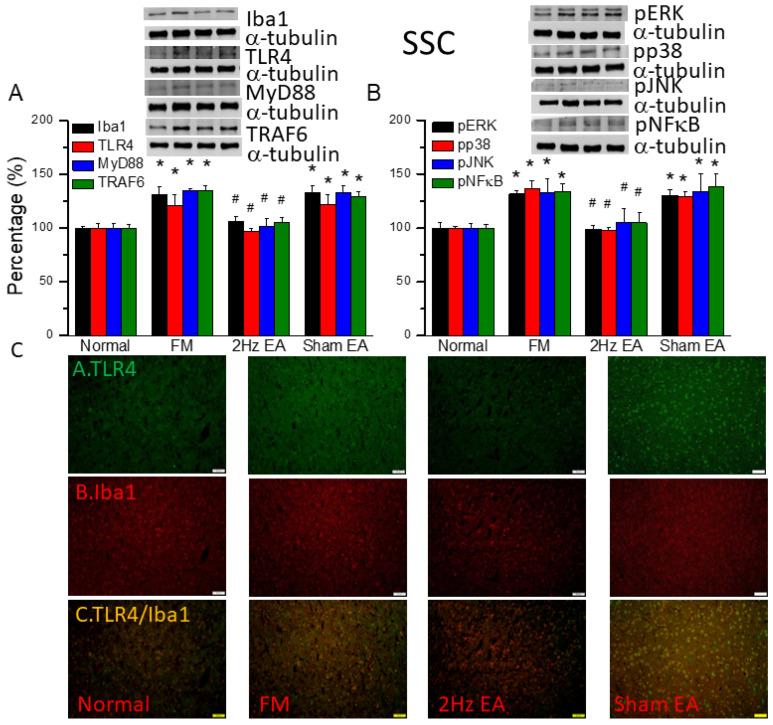
Fibromyalgia (FM) is a complex, chronic, widespread pain syndrome that can cause significant health and economic burden. Emerging evidence has shown that neuroinflammation is an underlying pathological mechanism in FM. Toll-like receptors (TLRs) are key mediators of the immune system. TLR4 is expressed primarily in microglia and regulates downstream signaling pathways, such as MyD88/NF-κB and TRIF/IRF3. It remains unknown whether electroacupuncture (EA) has therapeutic benefit in attenuating FM pain and what role the TLR4 pathway may play in this effect. We compared EA with sham EA to eliminate the placebo effect due to acupuncture. We demonstrated that intermittent cold stress significantly induced an increase in mechanical and thermal FM pain in mice (mechanical: 2.48 ± 0.53 g; thermal: 5.64 ± 0.32 s). EA but not sham EA has an analgesic effect on FM mice. TLR4 and inflammatory mediator-related molecules were increased in the thalamus, medial prefrontal cortex, somatosensory cortex (SSC), and amygdala of FM mice, indicating neuroinflammation and microglial activation. These molecules were reduced by EA but not sham EA. Furthermore, a new chemogenetics method was used to precisely inhibit SSC activity that displayed an anti-nociceptive effect through the TLR4 pathway. Our results imply that the analgesic effect of EA is associated with TLR4 downregulation. We provide novel evidence that EA modulates the TLR4 signaling pathway, revealing potential therapeutic targets for FM pain.
纤维肌痛(FM)是一种复杂的慢性广泛性疼痛综合征,可造成重大的健康和经济负担。新出现的证据表明,神经炎症是FM的一种潜在病理机制。Toll样受体(TLR)是免疫系统的关键介质。TLR4主要在小胶质细胞中表达,并调节下游信号通路,如MyD88/NF-κB和TRIF/IRF3。电针(EA)在减轻FM疼痛方面是否具有治疗益处以及TLR4通路在这种作用中可能发挥什么作用仍不清楚。我们将EA与假EA进行比较,以消除针刺引起的安慰剂效应。我们证明,间歇性冷应激显著诱导小鼠机械性和热性FM疼痛增加(机械性:2.48±0.53克;热性:5.64±0.32秒)。EA而非假EA对FM小鼠具有镇痛作用。FM小鼠的丘脑、内侧前额叶皮质、体感皮质(SSC)和杏仁核中TLR4和炎症介质相关分子增加,表明存在神经炎症和小胶质细胞激活。这些分子被EA而非假EA降低。此外,我们使用一种新的化学遗传学方法精确抑制SSC活性,其通过TLR4通路显示出抗伤害感受作用。我们的结果表明,EA的镇痛作用与TLR4下调有关。我们提供了新的证据,表明EA调节TLR4信号通路,揭示了FM疼痛的潜在治疗靶点。




 Zotero 插件