
头颅放疗与阿特珠单抗治疗非小细胞肺癌的潜在协同效应:来自七项前瞻性试验的个体患者数据分析
Potential synergistic effects of cranial radiotherapy and atezolizumab in non-small cell lung cancer: an analysis of individual patient data from seven prospective trials.
作者信息
Guo Tiantian, Zhou Yue, Liang Fei, Wang Zezhou, Bourbonne Vincent, Käsmann Lukas, Sundahl Nora, Wu Abraham Jing-Ching, Ni Jianjiao, Zhu Zhengfei
机构信息
Department of Radiation Oncology, Fudan University Shanghai Cancer Center, Shanghai, China.
Department of Oncology, Shanghai Medical College, Fudan University, Shanghai, China.
出版信息
Transl Lung Cancer Res. 2024 Jan 31;13(1):126-138. doi: 10.21037/tlcr-23-792. Epub 2024 Jan 29.
BACKGROUND
The impact of cranial radiotherapy (RT) on overall survival (OS) of patients with brain metastasis (BM) from non-small cell lung cancer (NSCLC) receiving programmed death 1/programmed death-ligand 1 (PD-1/PD-L1) inhibitors remains unclear. We aimed to examine the effect of previous cranial RT on the efficacy and neurological toxicity of PD-1/PD-L1 inhibitors in the treatment of patients with NSCLC.
METHODS
Patient-level data from seven prospective trials involving atezolizumab for the treatment of NSCLC [BIRCH (NCT02031458), FIR (NCT01846416), IMpower130 (NCT02367781), IMpower131 (NCT02367794), IMpower150 (NCT02366143), OAK (NCT02008227), and POPLAR (NCT01903993)] were pooled. Patients with baseline BM were divided into two subgroups based on previous cranial RT before initiation of treatment: patients with previously irradiated BM (iBM) and patients with non-irradiated BMs (niBM).
RESULTS
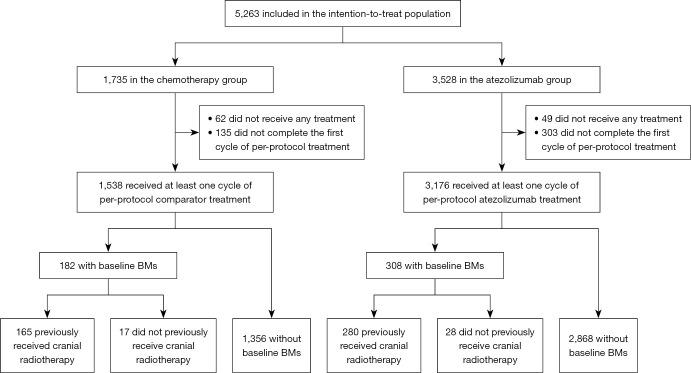
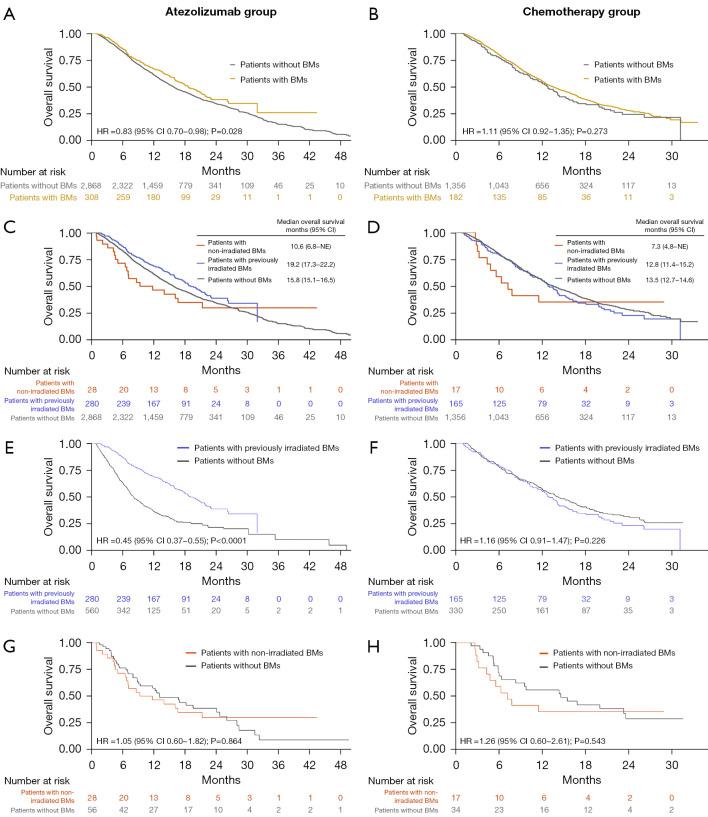
The per-protocol population consisted of 4,714 patients, including 3,176 in the atezolizumab group and 1,538 in the comparator chemotherapy group. In the atezolizumab group, OS was better in patients with BM (n=308) compared to patients without BM (n=2,868) [hazard ratio (HR): 0.83; 95% confidence interval (CI): 0.70-0.98; P=0.028]. Among patients with BM, patients with iBM (n=280) had a numerically longer OS (HR: 0.66; 95% CI: 0.41-1.07; P=0.090) than those with niBM (n=28). Intriguingly, OS was longer in patients with iBM than those without BM before (HR: 0.83; 95% CI: 0.70-0.99; P=0.043) and after (HR: 0.40; 95% CI: 0.32-0.49; P<0.0001) propensity score matching, while OS was similar between patients with niBM and those without BM. The survival advantage of patients with iBM over those without BM was not observed in the chemotherapy group. Atezolizumab-related serious neurological adverse events occurred in 16 (0.6%) patients without BM, none in those with niBM, and 2 (0.7%) patients with iBM.
CONCLUSIONS
These data suggest potential synergistic effects of cranial RT and anti-PD-(L)1 therapy in NSCLC patients, which warrants further validation.
背景
对于接受程序性死亡蛋白1/程序性死亡配体1(PD-1/PD-L1)抑制剂治疗的非小细胞肺癌(NSCLC)脑转移(BM)患者,颅脑放疗(RT)对总生存期(OS)的影响尚不清楚。我们旨在研究既往颅脑放疗对PD-1/PD-L1抑制剂治疗NSCLC患者的疗效和神经毒性的影响。
方法
汇总了七项关于阿替利珠单抗治疗NSCLC的前瞻性试验[BIRCH(NCT02031458)、FIR(NCT01846416)、IMpower130(NCT02367781)、IMpower131(NCT02367794)、IMpower150(NCT02366143)、OAK(NCT02008227)和POPLAR(NCT01903993)]的患者水平数据。将基线有BM的患者根据治疗开始前是否接受过颅脑放疗分为两个亚组:既往接受过放疗的BM患者(iBM)和未接受过放疗的BM患者(niBM)。
结果
符合方案人群包括4714例患者,其中阿替利珠单抗组3176例,对照化疗组1538例。在阿替利珠单抗组中,有BM的患者(n=308)的OS优于无BM的患者(n=2868)[风险比(HR):0.83;95%置信区间(CI):0.70-0.98;P=0.028]。在有BM的患者中,iBM患者(n=280)的OS在数值上长于niBM患者(n=28)(HR:0.66;95%CI:0.41-1.07;P=0.090)。有趣的是,在倾向评分匹配前(HR:0.83;95%CI:0.70-0.99;P=0.043)和匹配后(HR:0.40;95%CI:0.32-0.49;P<0.0001),iBM患者的OS均长于无BM的患者,而niBM患者和无BM患者的OS相似。在化疗组中未观察到iBM患者相对于无BM患者的生存优势。阿替利珠单抗相关的严重神经不良事件在16例(0.6%)无BM的患者中发生,niBM患者中无发生,2例(0.7%)iBM患者中发生。
结论
这些数据表明颅脑放疗和抗PD-(L)1治疗在NSCLC患者中可能存在协同作用,值得进一步验证。

 Zotero 插件