
用于外泌体分离的超滤、沉淀和超速离心方法的效率比较。
Comparison of the efficiency of ultrafiltration, precipitation, and ultracentrifugation methods for exosome isolation.
作者信息
Ansari Farshid Jaberi, Tafti Hossein Ahmadi, Amanzadeh Amir, Rabbani Shahram, Shokrgozar Mohammad Ali, Heidari Reza, Behroozi Javad, Eyni Hossein, Uversky Vladimir N, Ghanbari Hossein
机构信息
Department of Medical Nanotechnology, Faculty of Advanced Technologies in Medicine, Tehran University of Medical Sciences, Tehran, Iran.
Research Center for Advanced Technologies in Cardiovascular Medicine, Cardiovascular Disease Research Institute, Tehran Heart Center Hospital, Tehran University of Medical Sciences, Tehran, Iran.
出版信息
Biochem Biophys Rep. 2024 Feb 21;38:101668. doi: 10.1016/j.bbrep.2024.101668. eCollection 2024 Jul.
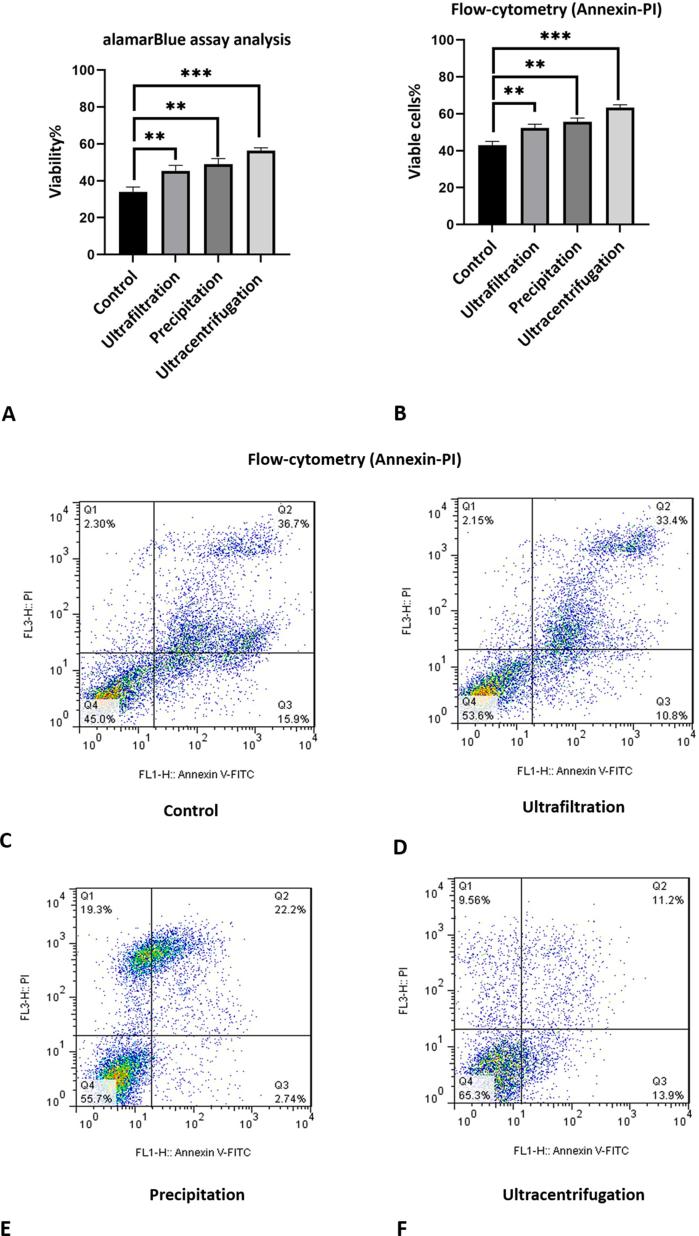
Extracellular vesicles (EVs) are enclosed by a lipid-bilayer membrane and secreted by all types of cells. They are classified into three groups: apoptotic bodies, microvesicles, and exosomes. Exosomes play a number of important roles in the intercellular communication and crosstalk between tissues in the body. In this study, we use three common methods based on different principles for exosome isolation, namely ultrafiltration, precipitation, and ultracentrifugation. We use field emission scanning electron microscopy (FESEM) and dynamic light scattering (DLS) analyses for characterization of exosomes. The functionality and effect of isolated exosomes on the viability of hypoxic cells was investigated by alamarBlue and Flow-cytometry. The results of the FESEM study show that the ultrafiltration method isolates vesicles with higher variability of shapes and sizes when compared to the precipitation and ultracentrifugation methods. DLS results show that mean size of exosomes isolated by ultrafiltration, precipitation, and ultracentrifugation methods are 122, 89, and 60 nm respectively. AlamarBlue analysis show that isolated exosomes increase the viability of damaged cells by 11%, 15%, and 22%, respectively. Flow-cytometry analysis of damaged cells also show that these vesicles increase the content of live cells by 9%, 15%, and 20%, respectively. This study shows that exosomes isolated by the ultracentrifugation method are characterized by smaller size and narrow size distribution. Furthermore, more homogenous particles isolated by this method show increased efficiency of the protection of hypoxic cells in comparison with the exosomes isolated by the two other methods.
细胞外囊泡(EVs)被脂质双分子膜包裹,由所有类型的细胞分泌。它们被分为三组:凋亡小体、微囊泡和外泌体。外泌体在体内组织间的细胞通讯和相互作用中发挥着许多重要作用。在本研究中,我们基于不同原理使用三种常见方法分离外泌体,即超滤、沉淀和超速离心。我们使用场发射扫描电子显微镜(FESEM)和动态光散射(DLS)分析对外泌体进行表征。通过alamarBlue和流式细胞术研究分离的外泌体对缺氧细胞活力的功能和影响。FESEM研究结果表明,与沉淀法和超速离心法相比,超滤法分离的囊泡形状和大小的变异性更高。DLS结果表明,通过超滤、沉淀和超速离心法分离的外泌体的平均大小分别为122、89和60纳米。alamarBlue分析表明,分离的外泌体分别使受损细胞的活力提高了11%、15%和22%。对受损细胞的流式细胞术分析还表明,这些囊泡分别使活细胞含量增加了9%、15%和20%。本研究表明,通过超速离心法分离的外泌体具有尺寸较小且尺寸分布窄的特点。此外,与通过其他两种方法分离的外泌体相比,通过该方法分离的更均匀的颗粒对缺氧细胞的保护效率更高。


 Zotero 插件