
正常肺实质和小气道疾病的局部异质性与 COPD 的严重程度和进展有关。
Local heterogeneity of normal lung parenchyma and small airways disease are associated with COPD severity and progression.
机构信息
Department of Radiology, University of Michigan, 109 Zina Pitcher Place BSRB A506, Ann Arbor, MI, 48109-2200, USA.
Department of Internal Medicine, Division of Pulmonary and Critical Care Medicine, University of Michigan, Ann Arbor, MI, USA.
出版信息
Respir Res. 2024 Feb 28;25(1):106. doi: 10.1186/s12931-024-02729-x.
BACKGROUND
Small airways disease (SAD) is a major cause of airflow obstruction in COPD patients and has been identified as a precursor to emphysema. Although the amount of SAD in the lungs can be quantified using our Parametric Response Mapping (PRM) approach, the full breadth of this readout as a measure of emphysema and COPD progression has yet to be explored. We evaluated topological features of PRM-derived normal parenchyma and SAD as surrogates of emphysema and predictors of spirometric decline.
METHODS
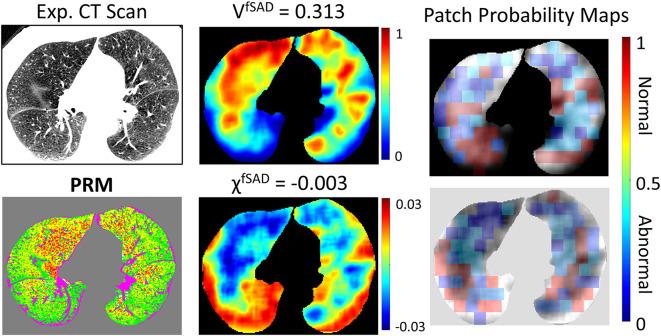
PRM metrics of normal lung (PRM) and functional SAD (PRM) were generated from CT scans collected as part of the COPDGene study (n = 8956). Volume density (V) and Euler-Poincaré Characteristic (χ) image maps, measures of the extent and coalescence of pocket formations (i.e., topologies), respectively, were determined for both PRM and PRM. Association with COPD severity, emphysema, and spirometric measures were assessed via multivariable regression models. Readouts were evaluated as inputs for predicting FEV decline using a machine learning model.
RESULTS
Multivariable cross-sectional analysis of COPD subjects showed that V and χ measures for PRM and PRM were independently associated with the amount of emphysema. Readouts χ (β of 0.106, p < 0.001) and V (β of 0.065, p = 0.004) were also independently associated with FEV% predicted. The machine learning model using PRM topologies as inputs predicted FEV decline over five years with an AUC of 0.69.
CONCLUSIONS
We demonstrated that V and χ of fSAD and Norm have independent value when associated with lung function and emphysema. In addition, we demonstrated that these readouts are predictive of spirometric decline when used as inputs in a ML model. Our topological PRM approach using PRM and PRM may show promise as an early indicator of emphysema onset and COPD progression.
背景
小气道疾病(SAD)是 COPD 患者气流阻塞的主要原因,并已被确定为肺气肿的前兆。虽然我们的参数响应映射(PRM)方法可以量化肺部的 SAD 量,但作为肺气肿和 COPD 进展的衡量标准,这种读数的全貌尚未得到探索。我们评估了 PRM 衍生的正常实质和 SAD 的拓扑特征,作为肺气肿和预测肺功能下降的替代指标。
方法
从 COPDGene 研究中收集的 CT 扫描中生成了 PRM 指标(PRM)和功能性 SAD(PRM)(n=8956)。分别确定了 PRM 和 PRM 的体积密度(V)和欧拉-庞加莱特征(χ)图像图,分别为口袋形成程度和融合(即拓扑)的度量。通过多变量回归模型评估与 COPD 严重程度、肺气肿和肺功能测量的关联。使用机器学习模型评估读数作为预测 FEV 下降的输入。
结果
对 COPD 患者的多变量横断面分析表明,PRM 和 PRM 的 V 和 χ 测量值与肺气肿的量独立相关。读数 χ(β为 0.106,p<0.001)和 V(β为 0.065,p=0.004)也与 FEV%预测值独立相关。使用 PRM 拓扑作为输入的机器学习模型预测五年内 FEV 下降,AUC 为 0.69。
结论
我们证明了 fSAD 和 Norm 的 V 和 χ 在与肺功能和肺气肿相关时具有独立的价值。此外,我们证明了当将这些读数用作 ML 模型的输入时,它们可以预测肺功能下降。我们使用 PRM 和 PRM 的拓扑 PRM 方法可能是肺气肿发作和 COPD 进展的早期指标。


 Zotero 插件