
评估 COVID-19 抗原快速诊断检测试剂盒在莱索托和赞比亚的自我检测效果。
Evaluation of COVID-19 antigen rapid diagnostic tests for self-testing in Lesotho and Zambia.
机构信息
Swiss Tropical and Public Health Institute, Allschwil, Switzerland.
University of Basel, Basel, Switzerland.
出版信息
PLoS One. 2024 Feb 29;19(2):e0280105. doi: 10.1371/journal.pone.0280105. eCollection 2024.
INTRODUCTION
The use of antigen rapid tests (Ag-RDTs) for self-testing is an important element of the COVID-19 control strategy and has been widely supported. However, scale-up of self-testing for COVID-19 in sub-Saharan Africa is still insufficient and there is limited evidence on the acceptability of self-testing and agreement between Ag-RDT self-testing and Ag-RDT testing by professional users. A joint collaboration (Botnar Research Centre for Child Health-European & Developing countries Clinical Trials Partnership)was established between Lesotho and Zambia to address these gaps in relation to Ag-RDT self-testing and contribute to increasing its use in the region.
METHODS
A cross-sectional study was conducted with qualitative and quantitative data analysis. Firstly, 14 in-depth cognitive interviews (5 in Zambia and 9 in Lesotho) were performed to assess the participants' understanding of the instructions for use (IFU) for self-testing. In a second step, evaluation of test agreement between Ag-RDT self-testing and Ag-RDT testing by professional user using SD Biosensor STANDARD Q COVID-19 Ag-RDT was performed. In Zambia, usability and acceptability of self-testing were also assessed.
RESULTS
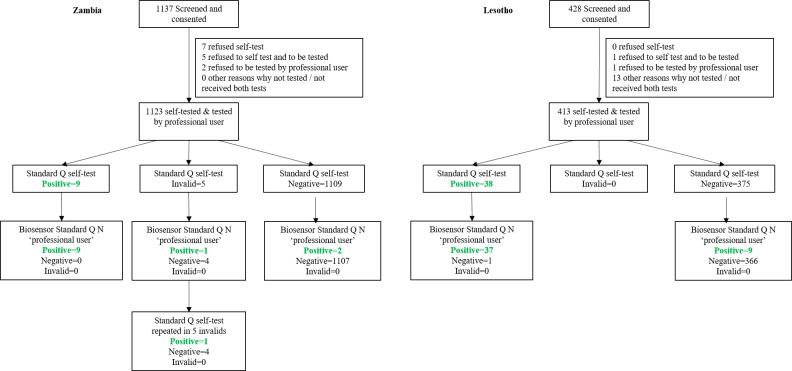
Cognitive interviews in Lesotho and Zambia showed overall good understanding of IFU. In Zambia, acceptability of self-testing was high, though some participants had difficulties in conducting certain steps in the IFU correctly. Agreement between Ag-RDT self-test and Ag-RDT by professional users in Lesotho (428 participants) and Zambia (1136 participants) was high, 97.3% (403/414, 95% CI: 95.3-98.7) and 99.8% (1116/1118, 95% CI: 99.4-100) respectively.
CONCLUSION
Findings from this study support the use of Ag-RDT self-testing within COVID-19 control strategies in sub-Saharan Africa, contributing to increase the testing capacity and access in hard-to reach settings.
简介
抗原快速检测(Ag-RDT)的自我检测是 COVID-19 控制策略的重要组成部分,得到了广泛支持。然而,撒哈拉以南非洲地区自我检测的规模仍然不足,关于自我检测的可接受性以及专业用户进行的 Ag-RDT 自我检测和 Ag-RDT 检测之间的一致性,证据有限。博特纳研究中心儿童健康-欧洲和发展中国家临床试验伙伴关系)在莱索托和赞比亚之间建立了合作关系,旨在解决 Ag-RDT 自我检测方面的这些差距,并为该地区增加其使用做出贡献。
方法
采用定性和定量数据分析进行了一项横断面研究。首先,进行了 14 次深入的认知访谈(赞比亚 5 次,莱索托 9 次),以评估参与者对自我检测使用说明(IFU)的理解。在第二步中,使用 SD Biosensor STANDARD Q COVID-19 Ag-RDT 评估 Ag-RDT 自我检测和专业用户进行的 Ag-RDT 检测之间的测试一致性。在赞比亚,还评估了自我检测的可用性和可接受性。
结果
莱索托和赞比亚的认知访谈显示,IFU 的总体理解良好。在赞比亚,自我检测的可接受性很高,尽管一些参与者在正确执行 IFU 的某些步骤方面存在困难。莱索托(428 名参与者)和赞比亚(1136 名参与者)Ag-RDT 自我检测与专业用户进行的 Ag-RDT 检测之间的一致性很高,分别为 97.3%(403/414,95%CI:95.3-98.7)和 99.8%(1116/1118,95%CI:99.4-100)。
结论
这项研究的结果支持在撒哈拉以南非洲的 COVID-19 控制策略中使用 Ag-RDT 自我检测,有助于提高难以到达地区的检测能力和可及性。
 Zotero 插件