
马达加斯加湿地含羞草属和田菁属豆科植物茎结瘤的发生和多样性。
Occurrence and diversity of stem nodulation in Aeschynomene and Sesbania legumes from wetlands of Madagascar.
机构信息
Laboratoire de Microbiologie de l'Environnement-Centre National de Recherches sur l'Environnement, BP 1739, Fiadanana, Antananarivo, Madagascar.
Department of Ethnobotany and Botany, National Center for Applied Pharmaceutical Research, Antananarivo 101, Madagascar.
出版信息
Sci Rep. 2024 Feb 29;14(1):5024. doi: 10.1038/s41598-024-55247-7.
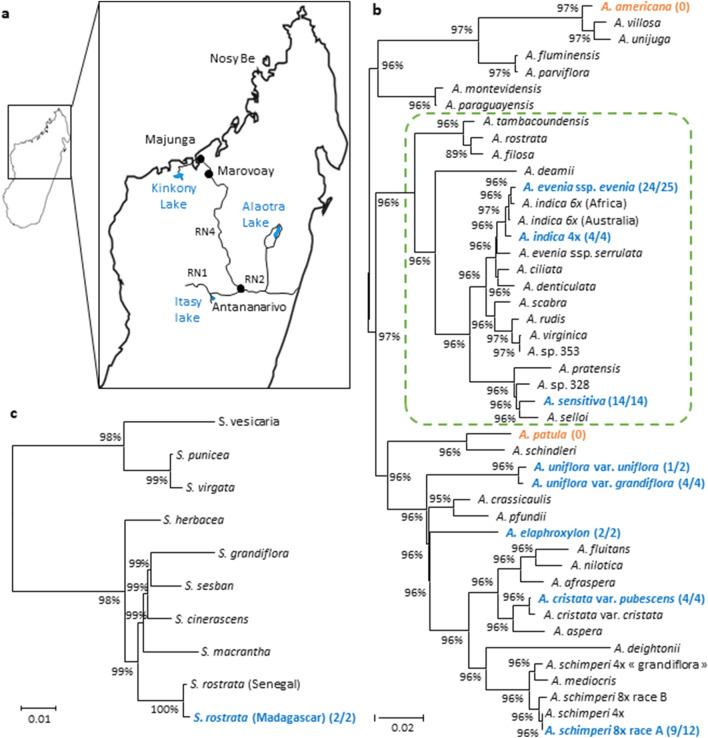
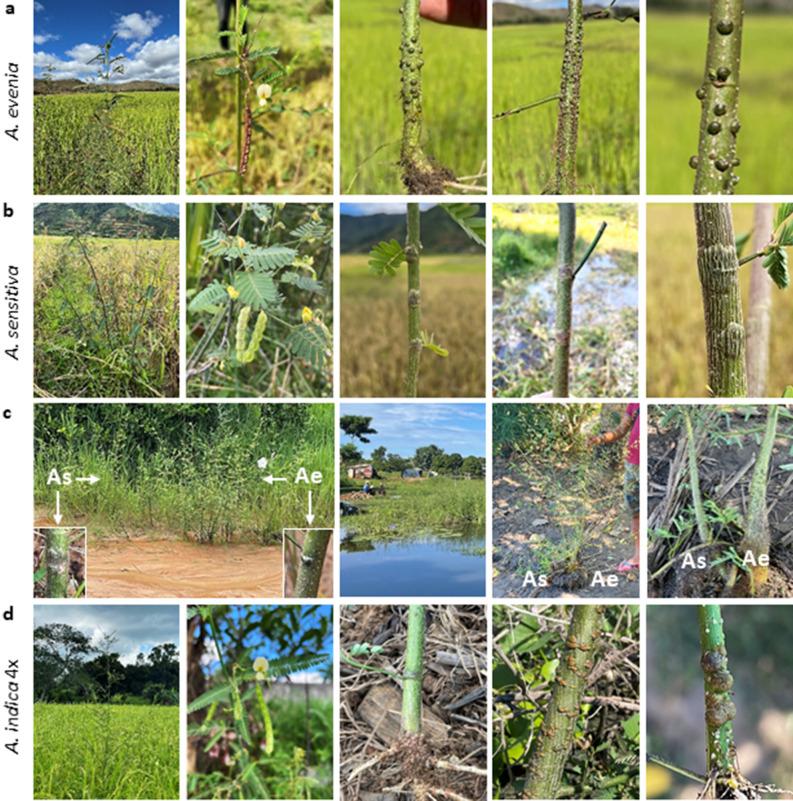
Legumes have the ability to establish a nitrogen-fixing symbiosis with soil rhizobia that they house in specific organs, the nodules. In most rhizobium-legume interactions, nodulation occurs on the root. However, certain tropical legumes growing in wetlands possess a unique trait: the capacity to form rhizobia-harbouring nodules on the stem. Despite the originality of the stem nodulation process, its occurrence and diversity in waterlogging-tolerant legumes remains underexplored, impeding a comprehensive analysis of its genetics and biology. Here, we aimed at filling this gap by surveying stem nodulation in legume species-rich wetlands of Madagascar. Stem nodulation was readily observed in eight hydrophytic species of the legume genera, Aeschynomene and Sesbania, for which significant variations in stem nodule density and morphology was documented. Among these species, A. evenia, which is used as genetic model to study the rhizobial symbiosis, was found to be frequently stem-nodulated. Two other Aeschynomene species, A. cristata and A. uniflora, were evidenced to display a profuse stem-nodulation as occurs in S. rostrata. These findings extend our knowledge on legumes species that are endowed with stem nodulation and further indicate that A. evenia, A. cristata, A. uniflora and S. rostrata are of special interest for the study of stem nodulation. As such, these legume species represent opportunities to investigate different modalities of the nitrogen-fixing symbiosis and this knowledge could provide cues for the engineering of nitrogen-fixation in non-legume crops.
豆类植物具有与土壤根瘤菌建立共生固氮的能力,这些根瘤菌存在于特定的器官——根瘤中。在大多数根瘤菌-豆科植物相互作用中,根瘤发生在根部。然而,某些生长在湿地中的热带豆科植物具有独特的特性:能够在茎上形成含有根瘤菌的根瘤。尽管茎结瘤过程具有创新性,但在耐水淹豆科植物中,其发生和多样性仍未得到充分探索,这阻碍了对其遗传学和生物学的全面分析。在这里,我们旨在通过调查马达加斯加富含豆科植物的湿地中的茎结瘤现象来填补这一空白。在 Aeschynomene 和 Sesbania 属的八种水生豆科植物中,很容易观察到茎结瘤现象,这些植物的茎结瘤密度和形态存在显著差异。在这些物种中,Aeschynomene evenia 被用作研究根瘤共生关系的遗传模型,被发现经常发生茎结瘤。另外两种 Aeschynomene 物种,Aeschynomene cristata 和 Aeschynomene uniflora,也被证明具有类似于 S. rostrata 那样丰富的茎结瘤现象。这些发现扩展了我们对具有茎结瘤特性的豆科植物的认识,并进一步表明 Aeschynomene evenia、Aeschynomene cristata、Aeschynomene uniflora 和 Sesbania rostrata 特别适合研究茎结瘤。因此,这些豆科植物为研究固氮共生的不同模式提供了机会,这一知识可能为非豆科作物固氮的工程提供线索。

 Zotero 插件