
高分辨率气候变化观测和预估在评估与热相关极端事件中的应用。
High resolution climate change observations and projections for the evaluation of heat-related extremes.
机构信息
Climate Hazards Center, University of California, Santa Barbara, CA, 93106, USA.
Sierra Nevada Research Institute, University of California, Merced, CA, 95343, USA.
出版信息
Sci Data. 2024 Mar 1;11(1):261. doi: 10.1038/s41597-024-03074-w.
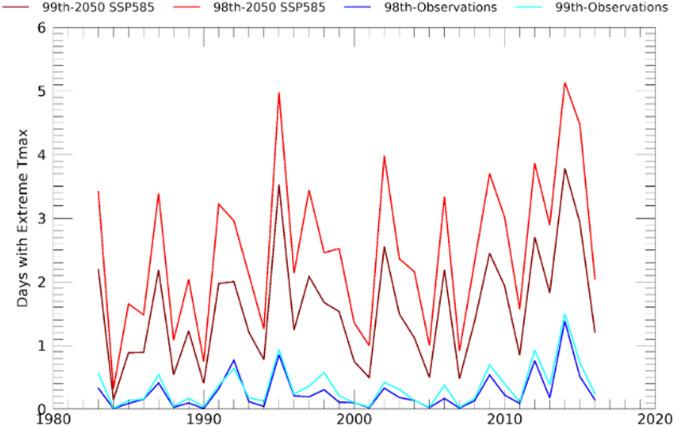
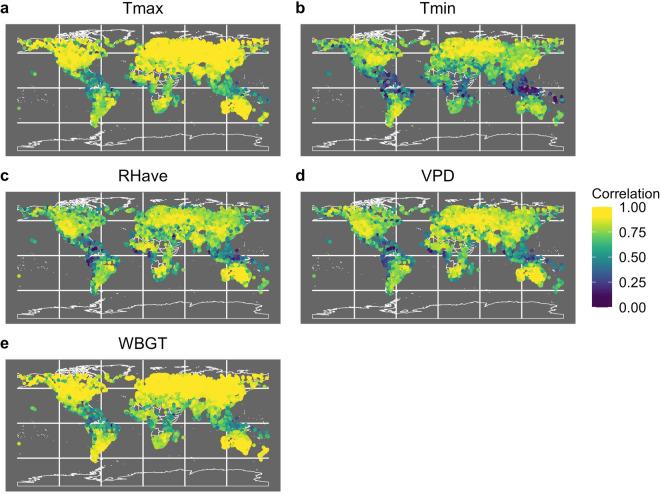
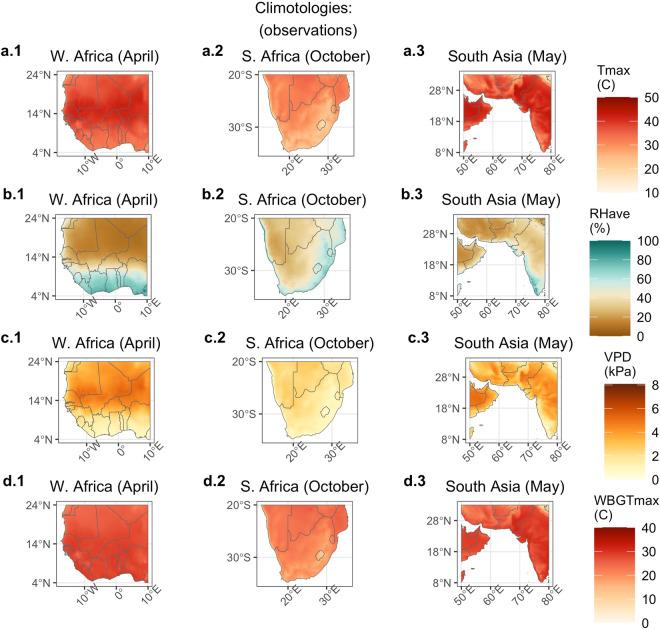
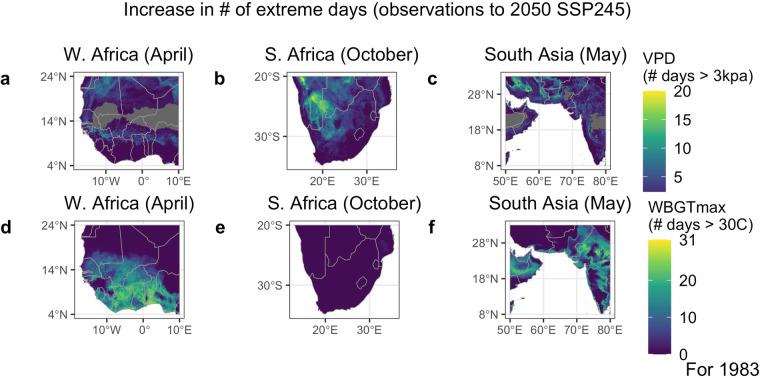
The Climate Hazards Center Coupled Model Intercomparison Project Phase 6 climate projection dataset (CHC-CMIP6) was developed to support the analysis of climate-related hazards, including extreme humid heat and drought conditions, over the recent past and in the near-future. Global daily high resolution (0.05°) grids of the Climate Hazards InfraRed Temperature with Stations temperature product, the Climate Hazards InfraRed Precipitation with Stations precipitation product, and ERA5-derived relative humidity form the basis of the 1983-2016 historical record, from which daily Vapor Pressure Deficits (VPD) and maximum Wet Bulb Globe Temperatures (WBGT) were derived. Large CMIP6 ensembles from the Shared Socioeconomic Pathway 2-4.5 and SSP 5-8.5 scenarios were then used to develop high resolution daily 2030 and 2050 'delta' fields. These deltas were used to perturb the historical observations, thereby generating 0.05° 2030 and 2050 projections of daily precipitation, temperature, relative humidity, and derived VPD and WBGT. Finally, monthly counts of frequency of extremes for each variable were derived for each time period.
气候危害中心耦合模型比较计划第六阶段气候投影数据集(CHC-CMIP6)的开发是为了支持对与气候相关的危害进行分析,包括最近过去和不久的将来的极端湿热和干旱条件。气候危害红外与台站温度产品的全球每日高分辨率(0.05°)网格、气候危害红外与台站降水产品的全球每日高分辨率(0.05°)网格以及 ERA5 衍生的相对湿度构成了 1983-2016 年历史记录的基础,从中可以得出每日水汽压亏缺(VPD)和最高湿球温度(WBGT)。然后,使用来自共享社会经济路径 2-4.5 和 SSP 5-8.5 情景的大型 CMIP6 集合来开发高分辨率每日 2030 年和 2050 年“增量”字段。这些增量用于扰乱历史观测值,从而生成每日降水、温度、相对湿度以及衍生的 VPD 和 WBGT 的 0.05° 2030 年和 2050 年投影。最后,为每个时间段的每个变量计算了极端频率的月度计数。




 Zotero 插件