
一种电荷依赖的长程力驱动溶液中物质的定制组装。
A charge-dependent long-ranged force drives tailored assembly of matter in solution.
作者信息
Wang Sida, Walker-Gibbons Rowan, Watkins Bethany, Flynn Melissa, Krishnan Madhavi
机构信息
Physical and Theoretical Chemistry Laboratory, Department of Chemistry, University of Oxford, Oxford, UK.
The Kavli Institute for Nanoscience Discovery, Oxford, UK.
出版信息
Nat Nanotechnol. 2024 Apr;19(4):485-493. doi: 10.1038/s41565-024-01621-5. Epub 2024 Mar 1.
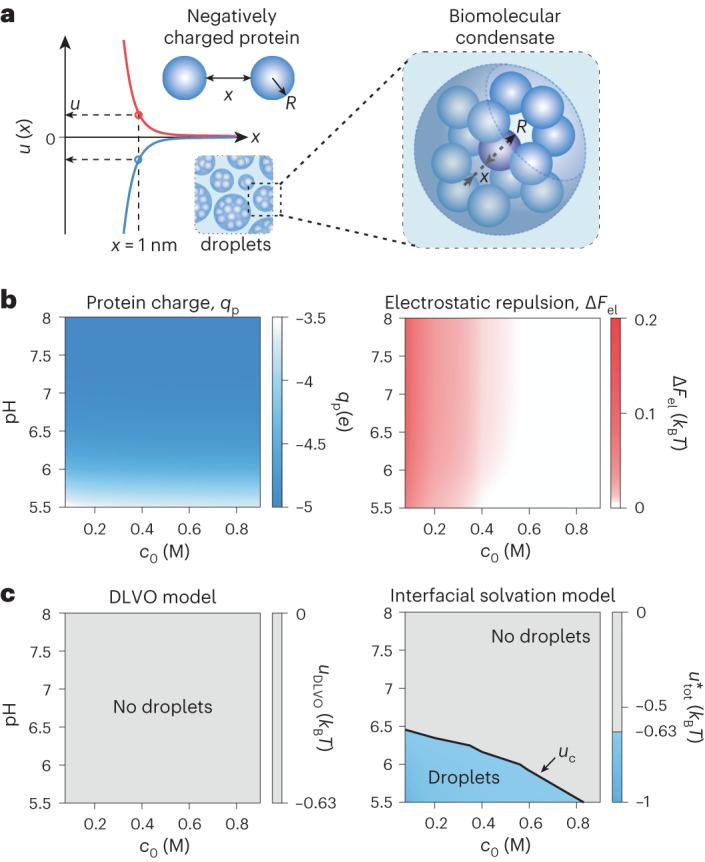
The interaction between charged objects in solution is generally expected to recapitulate two central principles of electromagnetics: (1) like-charged objects repel, and (2) they do so regardless of the sign of their electrical charge. Here we demonstrate experimentally that the solvent plays a hitherto unforeseen but crucial role in interparticle interactions, and importantly, that interactions in the fluid phase can break charge-reversal symmetry. We show that in aqueous solution, negatively charged particles can attract at long range while positively charged particles repel. In solvents that exhibit an inversion of the net molecular dipole at an interface, such as alcohols, we find that the converse can be true: positively charged particles may attract whereas negatives repel. The observations hold across a wide variety of surface chemistries: from inorganic silica and polymeric particles to polyelectrolyte- and polypeptide-coated surfaces in aqueous solution. A theory of interparticle interactions that invokes solvent structuring at an interface captures the observations. Our study establishes a nanoscopic interfacial mechanism by which solvent molecules may give rise to a strong and long-ranged force in solution, with immediate ramifications for a range of particulate and molecular processes across length scales such as self-assembly, gelation and crystallization, biomolecular condensation, coacervation, and phase segregation.
溶液中带电物体之间的相互作用通常被认为遵循电磁学的两个核心原理
(1)同种电荷的物体相互排斥,(2)这种排斥作用与电荷的正负无关。在此,我们通过实验证明,溶剂在粒子间相互作用中起着迄今未被预见但至关重要的作用,重要的是,液相中的相互作用可以打破电荷反转对称性。我们表明,在水溶液中,带负电的粒子在远距离时会相互吸引,而带正电的粒子则相互排斥。在诸如醇类等在界面处净分子偶极发生反转的溶剂中,我们发现情况可能相反:带正电的粒子可能相互吸引,而带负电的粒子则相互排斥。这些观察结果适用于多种表面化学:从无机二氧化硅和聚合物颗粒到水溶液中聚电解质和多肽包覆的表面。一种涉及界面处溶剂结构的粒子间相互作用理论解释了这些观察结果。我们的研究建立了一种纳米级界面机制,通过该机制溶剂分子可能在溶液中产生强大且远距离的力,这对一系列跨长度尺度的颗粒和分子过程具有直接影响,例如自组装、凝胶化和结晶、生物分子凝聚、凝聚和相分离。


 Zotero 插件