
基于全国性人群数据库的糖尿病管理对新冠疫情大流行第一年 COVID-19 感染与 HbA1c 水平关联的修饰作用。
Modification effect of receipt of diabetes care on the association between COVID-19 infection and HbA1c level during the first year of the coronavirus pandemic using a nationwide population-based database.
机构信息
Department of Prevention of Diabetes and Lifestyle-Related Diseases, Graduate School of Medicine, The University of Tokyo, Tokyo, Japan.
Department of Eat-loss Medicine, Graduate School of Medicine, The University of Tokyo, Tokyo, Japan.
出版信息
J Diabetes Investig. 2024 Jul;15(7):953-963. doi: 10.1111/jdi.14171. Epub 2024 Mar 2.
AIMS/INTRODUCTION: We assessed the modification effect of adherence to diabetes care on the association between HbA1c levels and the risk of coronavirus disease 2019 (COVID-19) among individuals with diabetes using a population-based database.
MATERIAL AND METHODS
We retrospectively identified individuals with diabetes during routine health checkups performed in 2019 in Japan using a population-based claims database (JMDC, Tokyo, Japan). We assessed the risk of COVID-19 infection in 2020 in relation to HbA1c levels during routine checkups, stratified by the presence/absence of follow-up for diabetes care in 2019. Several sensitivity analyses were performed.
RESULTS
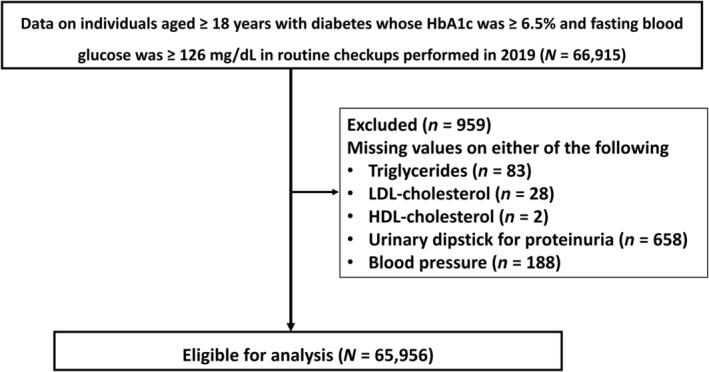
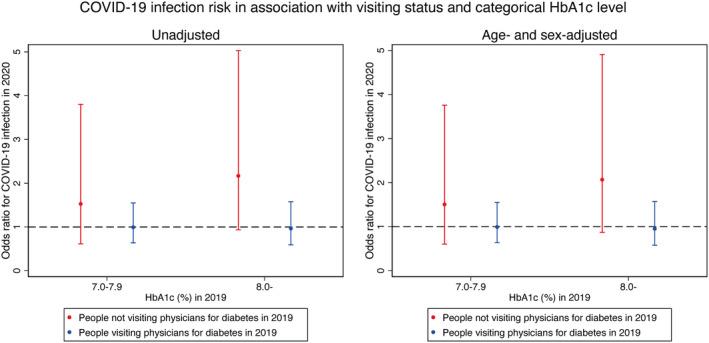
We identified 65,956 individuals with an HbA1c ≥6.5% and fasting glucose ≥126 mg/dL in routine checkups, including 52,637 and 13,319 with and without at least one physician consultation for diabetes care in 2019, respectively. Although high HbA1c levels were associated with an increased risk of COVID-19 infection in a dose-dependent manner among individuals without diabetes care in 2019 (odds ratios, 1.53 and 2.17 in individuals with HbA1c of 7.0-7.9% and ≥8.0%, respectively) with a reference to HbA1c of 6.5-6.9%, individuals with diabetes care had no such trend in 2019 (odds ratios, 0.99 and 0.97 among individuals with HbA1c of 7.0-7.9% and ≥8.0%, respectively). Sensitivity analyses yielded consistent results when the variable definitions were changed and after multivariable adjustment with multiple imputation.
CONCLUSIONS
This population-based study suggests that adherence to diabetes care may modify the association between HbA1c levels and the risk of COVID-19 infection.
目的/引言:我们使用基于人群的数据库评估了糖尿病患者对糖尿病护理的依从性对糖化血红蛋白(HbA1c)水平与 2019 年冠状病毒病 2019(COVID-19)风险之间关联的修饰作用。
材料和方法
我们使用基于人群的索赔数据库(日本东京 JMDC)从 2019 年的常规健康检查中回顾性地确定了糖尿病患者。我们评估了 2020 年 COVID-19 感染的风险与常规检查中 HbA1c 水平的关系,按 2019 年糖尿病护理随访的有无进行分层。进行了几项敏感性分析。
结果
我们在常规检查中确定了 65956 名 HbA1c≥6.5%和空腹血糖≥126mg/dL 的个体,其中包括 2019 年分别有 52637 名和 13319 名至少有一次糖尿病护理医生就诊。尽管在 2019 年未接受糖尿病护理的个体中,HbA1c 水平与 COVID-19 感染风险呈剂量依赖性增加(HbA1c 为 7.0-7.9%和≥8.0%的个体的比值比分别为 1.53 和 2.17),但与 HbA1c 为 6.5-6.9%的个体相比,在 2019 年接受糖尿病护理的个体则无此趋势(HbA1c 为 7.0-7.9%和≥8.0%的个体的比值比分别为 0.99 和 0.97)。当改变变量定义并在多重插补后进行多变量调整时,敏感性分析得出了一致的结果。
结论
这项基于人群的研究表明,糖尿病护理的依从性可能会改变 HbA1c 水平与 COVID-19 感染风险之间的关联。

 Zotero 插件