
胆汁酸谱分析作为儿童炎症性肠病分期的有效生物标志物。
Bile acid profiling as an effective biomarker for staging in pediatric inflammatory bowel disease.
作者信息
Chen Wei, Wang Daosheng, Deng Xing, Zhang Hong, Dong Danfeng, Su Tongxuan, Lu Qiuya, Jiang Cen, Ni Qi, Cui Yingchao, Zhao Qianli, Wang Xuefeng, Xiao Yuan, Peng Yibing
机构信息
Department of Laboratory Medicine, Ruijin Hospital, Shanghai Jiao Tong University School of Medicine, Shanghai, China.
Department of Gastroenterology, Xiamen Children's Hospital, Children's Hospital of Fudan University at Xiamen, Fujian, China.
出版信息
Gut Microbes. 2024 Jan-Dec;16(1):2323231. doi: 10.1080/19490976.2024.2323231. Epub 2024 Mar 4.
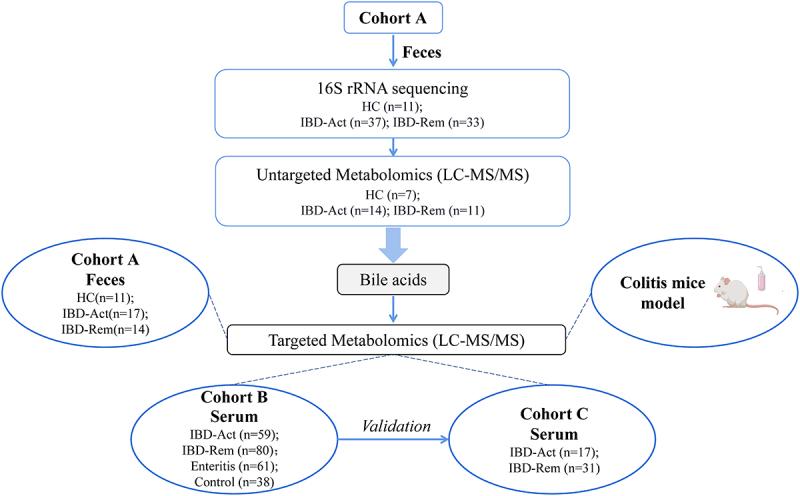
Rapid and accurate clinical staging of pediatric patients with inflammatory bowel disease (IBD) is crucial to determine the appropriate therapeutic approach. This study aimed to identify effective, convenient biomarkers for staging IBD in pediatric patients. We recruited cohorts of pediatric patients with varying severities of IBD to compare the features of the intestinal microbiota and metabolites between the active and remitting disease stages. Metabolites with potential for staging were targeted for further assessment in both patients and colitis model mice. The performance of these markers was determined using machine learning and was validated in a separate patient cohort. Pediatric patients with IBD exhibited distinct gut microbiota structures at different stages of disease activity. The enterotypes of patients with remitting and active disease were and , respectively. The bile secretion pathway showed the most significant differences between the two stages. Fecal and serum bile acid (BA) levels were strongly related to disease activity in both children and mice. The ratio of primary BAs to secondary BAs in serum was developed as a novel comprehensive index, showing excellent diagnostic performance in stratifying IBD activity (0.84 area under the receiver operating characteristic curve in the primary cohort; 77% accuracy in the validation cohort). In conclusion, we report profound insights into the interactions between the gut microbiota and metabolites in pediatric IBD. Serum BAs have potential as biomarkers for classifying disease activity, and may facilitate the personalization of treatment for IBD.
对炎症性肠病(IBD)患儿进行快速准确的临床分期对于确定合适的治疗方法至关重要。本研究旨在识别用于IBD患儿分期的有效、便捷生物标志物。我们招募了不同严重程度的IBD患儿队列,以比较疾病活动期和缓解期肠道微生物群和代谢物的特征。对具有分期潜力的代谢物在患者和结肠炎模型小鼠中进行进一步评估。使用机器学习确定这些标志物的性能,并在另一个患者队列中进行验证。IBD患儿在疾病活动的不同阶段表现出不同的肠道微生物群结构。缓解期和活动期患者的肠型分别为 和 。胆汁分泌途径在两个阶段之间表现出最显著的差异。粪便和血清胆汁酸(BA)水平在儿童和小鼠中均与疾病活动密切相关。血清中初级胆汁酸与次级胆汁酸的比值被开发为一种新的综合指标,在分层IBD活动方面表现出优异的诊断性能(在主要队列中受试者操作特征曲线下面积为0.84;在验证队列中准确率为77%)。总之,我们报告了对IBD患儿肠道微生物群与代谢物之间相互作用的深刻见解。血清胆汁酸有潜力作为疾病活动分类生物标志物,并可能有助于IBD治疗的个性化。



 Zotero 插件