
加拿大安大略省社区居住成年人的虚弱与死亡率和医疗保健利用的年龄和性别特异性关联。
Age- and sex-specific associations of frailty with mortality and healthcare utilization in community-dwelling adults from ontario, Canada.
机构信息
Health Sciences North Research Institute, Sudbury, ON, Canada.
NOSM University, Sudbury/Thunder Bay, ON, Canada.
出版信息
BMC Geriatr. 2024 Mar 4;24(1):223. doi: 10.1186/s12877-024-04842-4.
BACKGROUND
Understanding how health trajectories are related to the likelihood of adverse outcomes and healthcare utilization is key to planning effective strategies for improving health span and the delivery of care to older adults. Frailty measures are useful tools for risk stratification in community-based and primary care settings, although their effectiveness in adults younger than 60 is not well described.
METHODS
We performed a 10-year retrospective analysis of secondary data from the Ontario Health Study, which included 161,149 adults aged ≥ 18. Outcomes including all-cause mortality and hospital admissions were obtained through linkage to ICES administrative databases with a median follow-up of 7.1-years. Frailty was characterized using a 30-item frailty index.
RESULTS
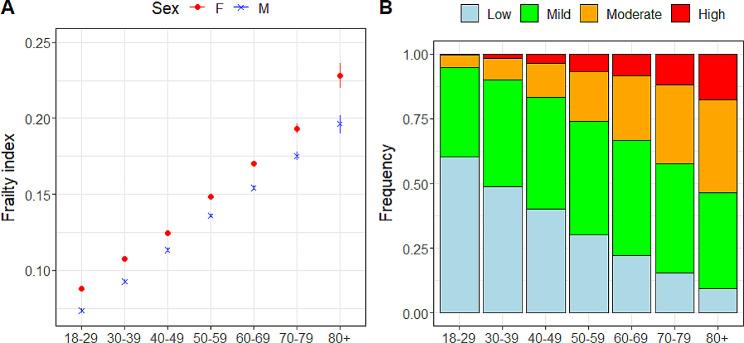
Frailty increased linearly with age and was higher for women at all ages. A 0.1-increase in frailty was significantly associated with mortality (HR = 1.47), the total number of outpatient (IRR = 1.35) and inpatient (IRR = 1.60) admissions over time, and length of stay (IRR = 1.12). However, with exception to length of stay, these estimates differed depending on age and sex. The hazard of death associated with frailty was greater at younger ages, particularly in women. Associations with admissions also decreased with age, similarly between sexes for outpatient visits and more so in men for inpatient.
CONCLUSIONS
These findings suggest that frailty is an important health construct for both younger and older adults. Hence targeted interventions to reduce the impact of frailty before the age of 60 would likely have important economic and social implications in both the short- and long-term.
背景
了解健康轨迹与不良结局和医疗保健利用的可能性之间的关系,是制定有效策略以延长健康寿命和为老年人提供护理的关键。在社区和初级保健环境中,虚弱测量是风险分层的有用工具,尽管它们在 60 岁以下成年人中的有效性尚未得到很好的描述。
方法
我们对安大略省健康研究的二次数据进行了为期 10 年的回顾性分析,该研究包括 161149 名年龄≥18 岁的成年人。通过与 ICES 行政数据库的链接获得了包括全因死亡率和住院治疗在内的所有结局,中位随访时间为 7.1 年。使用 30 项虚弱指数来描述虚弱情况。
结果
虚弱程度随年龄呈线性增加,且在所有年龄段女性的虚弱程度更高。虚弱程度每增加 0.1,死亡率的风险比(HR)增加 1.47,随着时间的推移,门诊(IRR)和住院(IRR)就诊次数和住院时间的增长率分别为 1.35 和 1.60。然而,除了住院时间外,这些估计值因年龄和性别而异。与虚弱相关的死亡风险在较年轻的年龄更高,尤其是女性。与就诊相关的风险随着年龄的增长而降低,在门诊就诊中男女相似,而在住院就诊中男性更为明显。
结论
这些发现表明,虚弱对于年轻和老年成年人都是一个重要的健康概念。因此,在 60 岁之前针对虚弱采取干预措施,可能会在短期和长期内对经济和社会产生重要影响。


 Zotero 插件