
玉米种子和玉米芽对噬菌体的感染性反应。
Infectivity responses of to bacteriophages on maize seeds and maize sprouts.
作者信息
Xiang Nan, Wong Catherine W Y, Guo Xinbo, Wang Siyun
机构信息
School of Food Science and Engineering, Guangdong Province Key Laboratory for Green Processing of Natural Products and Product Safety, Engineering Research Center of Starch and Vegetable Protein Processing Ministry of Education, South China University of Technology, Guangzhou, 510640, China.
Food, Nutrition and Health, University of British Columbia, 120-2205 East Mall, Vancouver, BC, V6R 1Z4, Canada.
出版信息
Curr Res Food Sci. 2024 Feb 25;8:100708. doi: 10.1016/j.crfs.2024.100708. eCollection 2024.
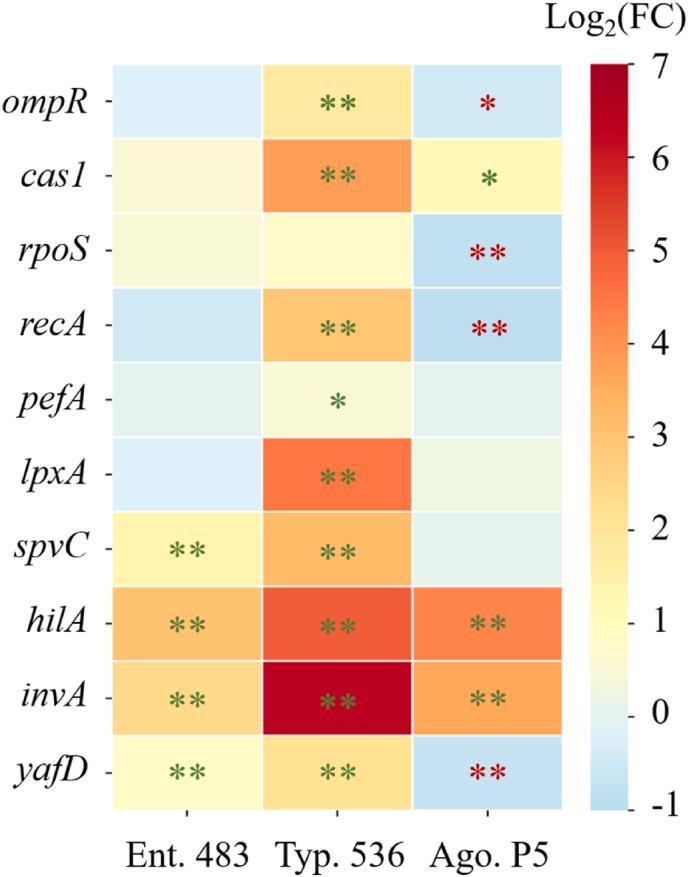
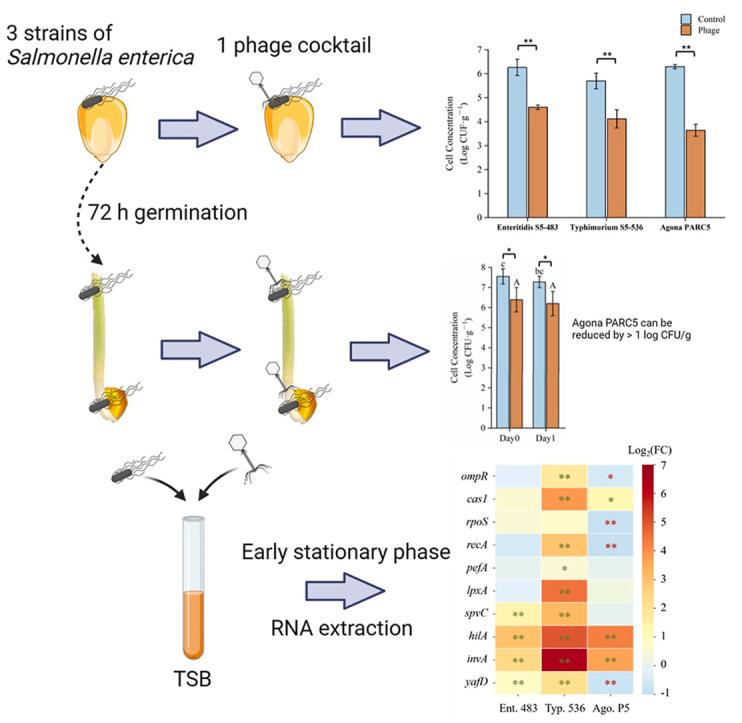
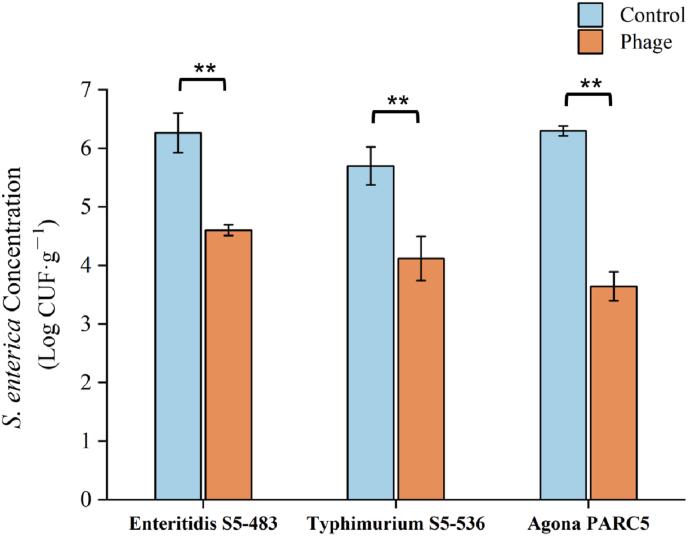
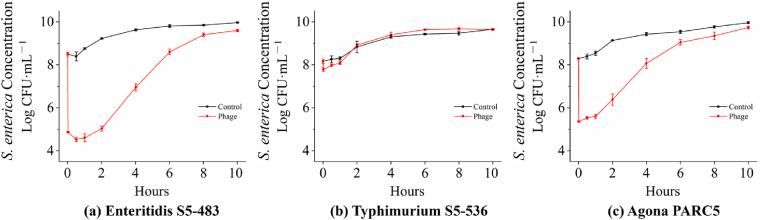
() is a major foodborne pathogen leading to a large number of outbreaks and bringing food safety concerns to sprouts. The control of on maize sprouts is important because raw maize sprouts have been gaining attention as a novel superfood. Compared to conventional chemical methods, the applications of bacteriophages are regarded as natural and organic. This study investigated the effects of a 2 h phage cocktail (SF1 and SI1, MOI 1000) soaking on reducing the populations of three strains: Enteritidis S5-483, Typhimurium S5-536, and Agona PARC5 on maize seeds and during the storage of maize sprouts. The results showed that the phage cocktail treatment effectively reduced populations of strains by 1-3 log CFU/g on maize seeds and decreased population of Agona PACR5 by 1.16 log CFU/g on maize sprouts from 7.55 log CFU/g at day 0 of the storage period. On the other hand, the upregulations of flagella gene by 1.5-folds and membrane gene by 23-folds in Typhimurium S5-536 indicated a differential response to the phage cocktail treatment. Conversely, stress response genes , , and , as well as the DNA repair gene , were downregulated in Agona PARC5. This work shows the use of bacteriophages could contribute as a part of hurdle effect to reduce populations and is beneficial to develop strategies for controlling foodborne pathogens in the production and storage of maize sprouts.
(某菌)是一种主要的食源性病原体,导致大量疫情爆发,并引发了对豆芽食品安全的担忧。控制(某菌)在玉米芽上的生长很重要,因为生玉米芽作为一种新型超级食品正受到关注。与传统化学方法相比,噬菌体的应用被认为是天然和有机的。本研究调查了2小时噬菌体鸡尾酒(SF1和SI1,感染复数1000)浸泡对减少玉米种子上以及玉米芽储存期间三种(某菌)菌株数量的影响:肠炎沙门氏菌S5 - 483、鼠伤寒沙门氏菌S5 - 536和阿哥纳沙门氏菌PARC5。结果表明,噬菌体鸡尾酒处理有效地使玉米种子上的(某菌)菌株数量减少了1 - 3 log CFU/g,并使玉米芽上的阿哥纳沙门氏菌PACR5数量从储存期第0天的7.55 log CFU/g减少了1.16 log CFU/g。另一方面,鼠伤寒沙门氏菌S5 - 536中鞭毛基因上调了1.5倍,膜基因上调了23倍,这表明对噬菌体鸡尾酒处理有不同的反应。相反,阿哥纳沙门氏菌PARC5中的应激反应基因、和,以及DNA修复基因被下调。这项工作表明,使用噬菌体可以作为栅栏效应的一部分,有助于减少(某菌)数量,有利于制定在玉米芽生产和储存过程中控制食源性病原体的策略。

 Zotero 插件